Get Full Government Meeting Transcripts, Videos, & Alerts Forever!
Get email alerts on the Homelessness topic
No spam. Unsubscribe anytime.
Council hears calls to fund Homelessness Strategy Office; TRE scenarios outline options
Summary
Speakers and staff urged more ongoing funding for outreach, rapid rehousing and permanent supportive housing; city staff outlined a multiscenario tax-rate election framework where larger scenarios (≈5¢) fund the full HSO plan.
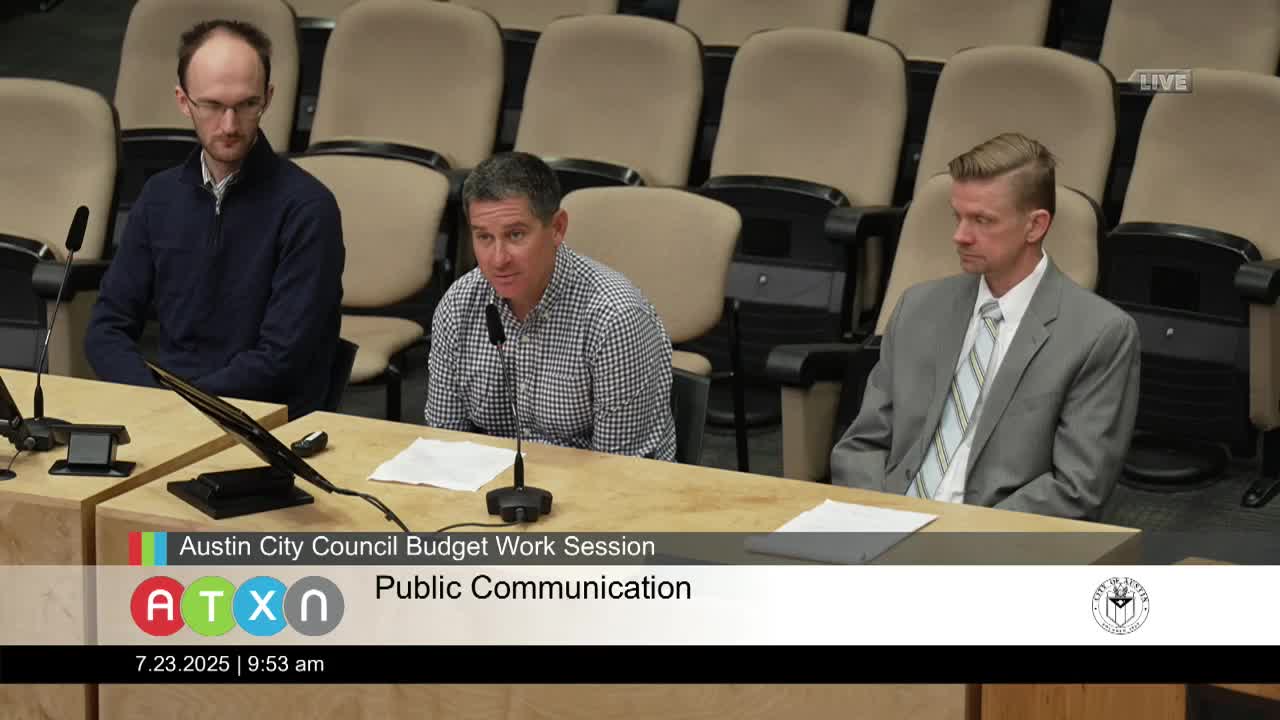
Austin City Council members heard more than two hours of public testimony and staff briefings on July 23 about funding needs for the city’s response to unsheltered homelessness and how a possible tax rate election could pay for that work.
Director David Gray and other speakers said the Office of Homeless Strategies and Operations (HSO) needs additional ongoing resources to staff outreach, preserve shelter capacity and expand rapid rehousing and permanent supportive housing. Gray told the council the proposed fiscal 2026 budget includes $51.5 million for HSO — including about $36.4 million in social-service contracts — and adds 12 positions for outreach and encampment management, plus ongoing funding for the Eighth Street shelter and one‑time support for the Marshall Yard.
The council heard from housing advocates and providers who said the proposed baseline budget is not sufficient to implement HSO’s full staff plan and the action framework the council endorsed earlier this year. Matthew Malika, executive director of the Ending Community Homelessness Coalition, called the plan “strategic and actionable” and said the full implementation will require additional funding beyond the city manager’s base budget.
Council staff presented an eight‑scenario package of tax‑rate election (TRE) options that range from a single penny to higher multi‑penny increases. City staff said the smallest scenario (1¢) is largely targeted to immediate one‑time needs and balancing FY26, while larger scenarios add sustained annual revenue. Gray said many of HSO’s priorities — including shelter expansions, ongoing rapid rehousing and prevention — become viable in the midrange scenarios; he told the council the staff response’s recommended mix of investments is most closely matched by the 5¢ scenario.
Advocates at the meeting highlighted specific shortfalls. Aloki Shaw of United Workers/Integral Care and other providers said a recent temporary expansion of the 24/7 mobile crisis outreach team (EMCOT) was funded with one‑time dollars and needs permanent funding. Several speakers emphasized that ramps, emergency housing vouchers and time‑limited ARPA supports are ending, which will increase demand for locally funded tenant‑based vouchers and other subsidies.
Gray and HSO staff said the city is pursuing philanthropic and partner funding alongside council consideration of TRE options. Gray said the office has identified prevention, rapid rehousing and permanent supportive housing as priorities; he told the council that scenario E (the 5¢ scenario in staff materials) lists $12 million for rapid rehousing from the city side, and HSO is urging other local funders to contribute as well.
The council asked staff for more detail on scenario timing and multiyear projections and for public‑facing transparency on contract performance in HSO programs. Staff said they will produce a contract transparency page and provide updates to committees and council memos. No formal votes were taken at the work session.
Local context: several provider speakers — including Caritas of Austin, ECHO and a coalition representing homeless service providers — urged council to pursue a TRE to fund the full response plan. City staff told council that a one‑time $14.1 million transfer from the budget stabilization reserve is used in FY26 to avoid cutting many social‑service contracts now; the FY27 forecast includes further reductions totaling $16.8 million unless other revenues are secured.
What’s next: City staff will present additional enterprise and CIP budget detail at the July 29 session; council will set a maximum tax rate under state Truth‑in‑Taxation rules on July 31 and decide whether to place a TRE on the ballot after further committee and council deliberations.