Get Full Government Meeting Transcripts, Videos, & Alerts Forever!
Get email alerts on the Veterans Justice topic
No spam. Unsubscribe anytime.
Local Veterans Treatment Court staff describe program that diverts veterans from prison into treatment
Summary
Program director Yvonne Whitaker described eligibility, team composition and 18-month treatment phases for the El Paso Veterans Treatment Court, and invited mentors and community volunteers to participate.
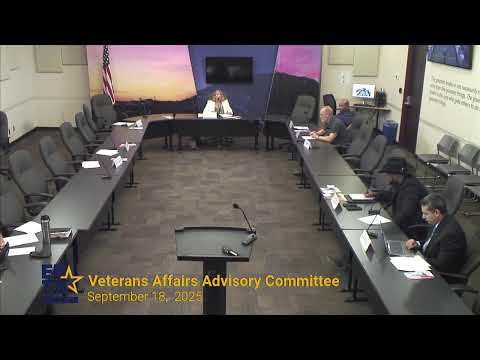
El Paso’s Veterans Treatment Court program offers an 18-month, court-supervised treatment pathway intended to divert veterans and active service members from the traditional criminal-justice process, the program director told the Veterans Affairs Advisory Committee Sept. 18.
“Once the participant meets these milestones for that particular phase, they will be able to move forward to the next phase,” Yvonne Whitaker, the court’s program director, said. Whitaker described a five-phase program of progressively longer intervals of supervision and treatment that culminates in aftercare.
Whitaker said the program is modeled on an approach developed by Judge Robert Russell in Buffalo, N.Y., and that the El Paso court began operating in 2012. She told the committee the team meets weekly and includes judges from local district courts, an assistant district attorney, a public defender, the program director, a specialty court liaison, in-house counseling, probation and compliance officers, a sheriff’s officer and police officer, and a lead mentor coordinator — identified in the meeting as Donna Juarez.
Eligibility considerations the district attorney’s office reviews include discharge status (anything other than dishonorable is generally acceptable), the nature of the pending felony or misdemeanor, mental-health history, violent criminal history, and prior participation in the program. Whitaker said the district attorney is the gatekeeper who decides whether a candidate may enter the program.
Participants receive assessments from the Veterans Benefits Administration and the Veterans Health Administration to determine benefits, housing, substance-use and mental-health services, and vocational supports. Whitaker described sanctions for infractions (typically additional community-service hours) and rewards for compliance. If the district attorney qualifies a veteran and the participant completes the program successfully, the participant’s case can be dismissed and expunged at no cost, Whitaker said, with paperwork handled by the public defender’s office.
Whitaker invited volunteers to serve as mentors, or “battle buddies,” who coach participants and provide nonreportable support to the court. She said mentors must submit a short bio, complete Justice for Vets training, and sign memoranda of understanding. Whitaker said mentors perform no reporting to the court except in cases where they believe a participant intends to harm themselves or others.
Whitaker also announced a graduation scheduled for Sept. 24 in Court 346 at the courthouse; she described a recent graduation ceremony and awards the program gives graduates who remain sanction-free.
No formal policy changes or votes were taken during the advisory committee meeting; Whitaker’s presentation was informational and included a request for additional mentors and volunteer support for participants.