Get Full Government Meeting Transcripts, Videos, & Alerts Forever!
Get email alerts on the Municipal Governance topic
No spam. Unsubscribe anytime.
Jacksonville City Council approves dozens of measures; heated public comment on budget, zoning and social services
Summary
At its Aug. 26 meeting the Jacksonville City Council approved a long list of routine and contested items, postponed one quasi-judicial case, and heard extended public comment focused on the mayor’s budget, homelessness services and two contested zoning proposals on the West Side and Cortez Road.
The Jacksonville City Council on Tuesday approved a string of bills, took up amendments tied to economic development funding and heard more than an hour of public comment focused on the mayor’s proposed budget, services for people experiencing homelessness and two controversial land-use proposals.
Council members approved and amended multiple routine measures and appointments and voted to postpone one quasi-judicial item to Sept. 9. Public speakers pressed the council to preserve funding for senior nutrition and homelessness services, opposed proposed budget amendments targeting diversity and immigrant programs, and urged the council to deny two rezonings that residents said would worsen flooding, remove mature tree buffers and, in one case, allow animal slaughtering operations in a residential area.
The meeting opened with ceremonial resolutions recognizing University of North Florida women’s athletics and change-of-command ceremonies at local military installations. The council then moved through a heavy consent agenda and a lengthy quasi‑judicial and legislative calendar that produced dozens of roll-call votes.
Why it matters: Council action this month occurs amid debate over millage rates, proposed cuts or “red line” amendments to the mayor’s budget and increased public pressure over homelessness, senior services and neighborhood protections. Several contested land-use items drew large turnouts and multiple speakers who said rezoning would harm public health, property values and stormwater systems.
What the council did: The body voted in favor of numerous bills and resolutions and approved committee-recommended amendments in several cases. Notable procedural outcomes included: - Postponement: Quasi‑judicial item 2025-0419 was postponed to Sept. 9, 2025 after a motion by Council Member Pittman (motion carried 17–0). - Multiple approvals: The council recorded approvals for a sequence of bills read during the quasi‑judicial block and consent agenda, including but not limited to 2025-0450, 2025-0451, 2025-0452, 2025-0453, 2025-0454, 2025-0455 (amended); 2025-0497; 2025-0518 (as amended); 2025-0519; 2025-0520; 2025-0521; 2025-0523; 2025-0528; 2025-0534; 2025-0538 (as amended); 2025-0560 (Emerald Trail resolution); and 2025-0606 (a funding allocation tied to better Jacksonville plan projects) among others. Vote tallies where recorded on the transcript are reported below in “Votes at a glance.”
Budget debate and public comment: Dozens of speakers used the meeting’s public‑comment period to urge the council to fully fund the mayor’s budget and to restore or protect programs that serve seniors, people experiencing homelessness, and immigrant communities. Speakers included service providers and neighborhood advocates who warned that small line‑item cuts would translate into missed meals, fewer wellness checks and reduced senior services.
Lanell Philman, who said she works with people at risk of homelessness, told the council: “There are seniors who are in their seventies, eighties, or nineties who are experiencing homelessness for the first time ... many of these seniors lived in the same property for 10 or 15 or more years and were able to live independently on their limited Social Security benefits. Unfortunately ... when investors bought up their rental inventory, many suffered a rent increase of 40, 50, 60% or more.”
Speakers also pushed back against budget amendments proposed in the finance committee that would bar or limit funding for diversity, equity and inclusion (DEI) programs and immigrant‑focused efforts. Opponents characterized such amendments as ideological and urged the council to “keep the dollar” for services rather than redirect funds for a small millage rollback that many speakers said would yield negligible savings for most residents.
Land‑use controversies: Two zoning matters drew concentrated neighborhood opposition. Residents near 6210–6211 Pernicia/Perinicia (Pernicia) Street argued that a proposed change to RLD‑60 density would replace existing tree cover and open land with smaller lots, worsen existing drainage problems and increase traffic on narrow residential streets. Neighbors submitted photos and signatures and said unpermitted tree clearing and debris left on the site created flooding and rodent problems.
Property owner Jacob Parker, who told the council he has revised plans since an earlier PUD request was denied, asked for conventional RLD‑60 zoning and said his proposal would add 12 site‑built homes, utilities and a retention pond. The owner said the project would tie into public utilities, build sidewalks and reduce on‑site runoff compared with current conditions.
Separately, residents of Cortez Road strongly opposed a companion rezoning request that they said would allow animal processing or slaughterhouse activity adjacent to homes, wetlands and local wells. Multiple residents said the site backs up to wetlands used by wildlife, that many homes in the area rely on well water and that a slaughtering operation would pose risks to water quality, air and neighborhood character.
Council process notes: Several items were amended on the floor or carried with committee amendments. Council members recused themselves on a small number of quasi‑judicial matters where conflicts were disclosed. The council majority voted to take up an addendum and approved emergency and second‑reading items as listed below.
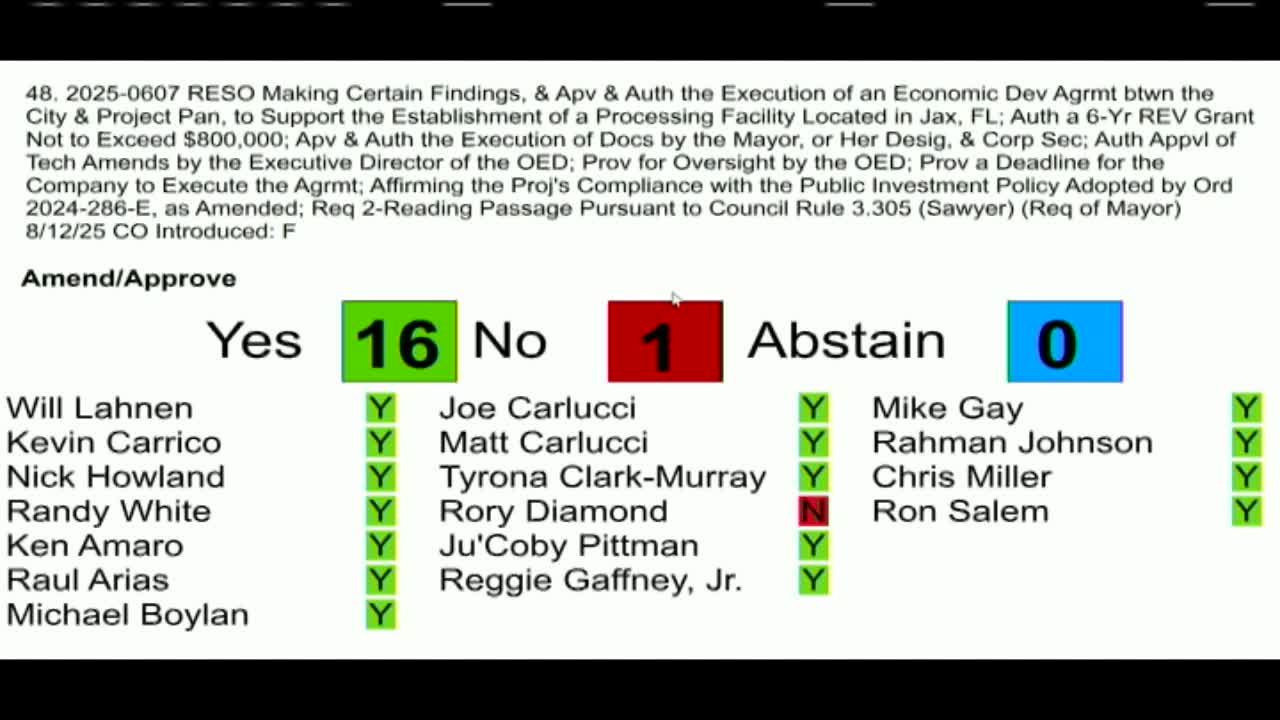
Votes at a glance (selected items shown with outcomes as recorded in the meeting transcript): - 2025‑0419 — Postponed to 09/09/2025 (motion by Council Member Pittman; vote recorded as 17 yays, 0 nays) - 2025‑0450 — Approved (recorded on the floor) - 2025‑0451 — Approved (recorded on the floor) - 2025‑0452 — Approved (17–0 recorded) - 2025‑0453 — Approved (17–0 recorded) - 2025‑0454 — Approved (17–0 recorded) - 2025‑0455 — Approved as amended (amendment adopted by voice vote; final recorded 17–0) - 2025‑0497 — Approved (17–0 recorded) - 2025‑0518 — Approved as amended (amendment carried; final recorded 17–0) - 2025‑0519 — Approved (17–0 recorded) - 2025‑0520 — Approved (17–0 recorded) - 2025‑0521 — Approved (17–0 recorded) - 2025‑0523 — Approved after reconsideration and amendment (motion to reconsider carried; final recorded 18–0) - 2025‑0528 — Approved (final recorded 18–0) - 2025‑0534 — Approved (final recorded 16–1 on one third‑reading item shown in transcript) - 2025‑0538 — Approved as amended (floor amendment by Council Member Clark Murray; final recorded 17 yays, 1 nay) - 2025‑0560 (Emerald Trail resolution) — Approved (recorded 15 yeas, 2 nays in the transcript after a brief exchange about fiscal constraints) - 2025‑0606 (Better Jacksonville plan allocation) — Approved as emergency; recorded 14 yays, 0 nays, 3 abstentions (multiple members disclosed potential organizational conflicts)
A fuller roll call: The transcript contains roll‑call outcomes for many other numbered items read and approved during the quasi‑judicial block and consent agenda. Those vote tallies and the final text for each ordinance or resolution are on file with legislative services and are reflected by the bill numbers recorded above as they appeared in the council meeting.
What’s next: Dozens of contested land‑use items were continued to committee public hearings (many continued to Sept. 9) and the council chair noted additional neighborhood meetings are scheduled (for example, a Sept. 18 community meeting on one of the Cortez Road matters). Council members and staff said they will take additional public input prior to further committee action.
Ending note: The meeting included multiple ceremonial recognitions and appointments but the evening’s substantive public comments strongly emphasized seniors, housing affordability and neighborhood protections. Several speakers asked the council to prioritize full funding for Meals on Wheels, affordable‑housing initiatives and local health programs rather than small property‑tax reductions that, they said, would not meaningfully benefit low‑income residents.