Get Full Government Meeting Transcripts, Videos, & Alerts Forever!
Get email alerts on the Transportation Infrastructure topic
No spam. Unsubscribe anytime.
Transportation department outlines FY26 budget, Vision Zero, Complete Streets and bike, transit projects
Summary
San Antonio’s Transportation Department presented a proposed FY26 budget and updates on Vision Zero safety work, the Complete Streets policy implementation, the bike network plan, and transit-oriented development aligned with Via’s green and silver lines; staff also described $5.5 million in Safe Streets for All grant programming.
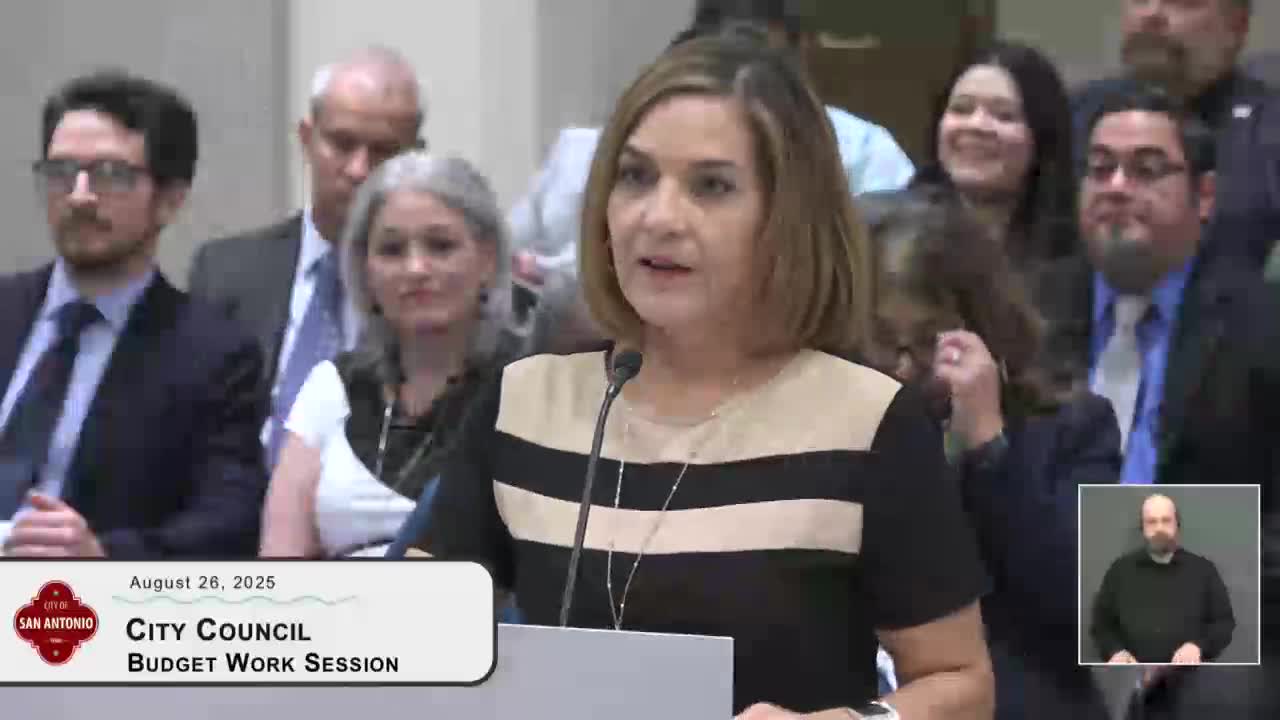
Catherine (Kat) Hernandez, director of the city’s Transportation Department, told City Council members on Tuesday that her team’s proposed fiscal 2026 budget is $9,600,000 and that the department’s 14 full-time positions will continue work on corridor planning, policy adoption and project implementation.
Hernandez summarized progress on four policies the council adopted in 2024 and 2025 — the updated Vision Zero action plan, the Complete Streets policy, the transit-oriented development (TOD) policy framework and the city’s newly adopted bike network plan — and described ongoing project work and grant-funded initiatives.
Key items in the presentation
- Vision Zero and high-injury corridors: The Vision Zero update (adopted September 2024) identifies the city’s high-injury and high-risk corridors. Hernandez said the department is evaluating safety countermeasures on eight of the 20 highest-impact corridors and plans to evaluate three additional corridors in the next fiscal year. The department applied for federal Safe Streets and Roads for All funding to expand corridor evaluation.
- Safe Streets for All grant: San Antonio was awarded a $5,500,000 Safe Streets for All grant in 2023. Hernandez said that grant will fund eight midblock crosswalks on Zarzamora (a high-injury corridor) and a safety outreach and education campaign across 10 corridors; the grant also includes funding for a marketing/outreach piece (about $1.2 million of the award was described as the marketing/outreach component) and quick-build pilot projects.
- Complete Streets and design guidance: After council adopted the Complete Streets policy in September 2024, the department is drafting an implementation plan that includes updates to the city design guide and an open house for public input in September. Smart Growth America ranked San Antonio’s Complete Streets policy first nationally and the policy earned a CityHealth gold medal, Hernandez noted.
- Transit-oriented development and Via’s projects: The transportation director said the TOD policy framework aligns zoning, infrastructure and community priorities along advanced rapid transit corridors. Hernandez said Via’s Green Line is 100% designed and moving into construction (utility work beginning this month) with station-area sidewalk and intersection work anticipated in 2026; the Silver Line is at 40% design with construction expected to begin in 2027. The department is also conducting walk-zone analyses for initial Green Line stations and traffic calming studies near Hildebrand.
- Bike network plan implementation: The bike network plan adopted in January 2025 identifies a tiered, citywide approach to bicycle infrastructure. The department described plans to create a spine of Tier 1 bike facilities, evaluate citywide ordinances (including limiting parking on designated bike facilities), and deploy quick-build pilots. Staff said they will evaluate ordinance changes with public input and expect a 9–12 month process for an ordinance change, while noting the change will be applied contextually rather than citywide immediately.
Project portfolio and timeline requests
Hernandez presented a citywide map showing 53 ongoing departmental projects: 17 in pre-design, 22 in design, 9 under construction and 5 slated for completion this fiscal year. Council members requested completion timelines, crash-reduction statistics for Vision Zero projects, and corridor-specific implementation schedules; Hernandez and staff agreed to provide those materials.
Council concerns and follow-up direction
Council members and the mayor asked the transportation department to provide data showing how infrastructure safety investments — CPTED, Complete Streets, corridor improvements — affect police responses and crash rates before and after interventions. Multiple members requested lists of the 20 high-impact corridors and details about the 53 projects by district. Hernandez said staff would coordinate further, offering to accelerate some targeted “no parking in bike lanes” enforcement via signage and targeted outreach where immediate safety benefits are clear.
Ending
The transportation department described a mix of grant-funded and locally supported activities to move projects into design and construction. Staff committed to follow-up on timelines and data on safety outcomes, grant match requirements and corridor-level project lists for council offices.