Get Full Government Meeting Transcripts, Videos, & Alerts Forever!
Get email alerts on the Flood Risk Building Bridge 2 topic
No spam. Unsubscribe anytime.
Marin County officials present FEMA CLOMR application for Building Bridge 2; town hears concerns about downstream impacts and mitigation
Summary
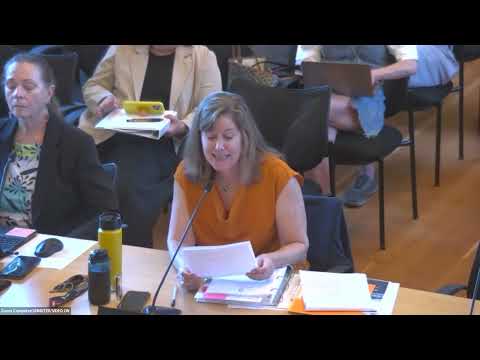
Marin County Flood Control staff told the Ross Town Council on Aug. 14 that the county has submitted a conditional letter of map revision (CLOMR) to FEMA for the San Anselmo flood‑risk reduction project that would remove Building Bridge 2, while acknowledging the county’s analysis shows modeled rises on dozens of downstream parcels and proposing targeted mitigations.
Marin County Flood Control staff told the Ross Town Council on Aug. 14 that the county has submitted a conditional letter of map revision (CLOMR) to FEMA for the San Anselmo flood‑risk reduction project that would remove Building Bridge 2 (BB2) in downtown San Anselmo.
The county said the BB2 removal is designed to reduce downtown overbank flooding and reduce the extent of the 100‑year FEMA floodplain in parts of the Ross Valley, but modeling shows a modeled rise in the base flood elevation on 58 parcels in the CLOMR study area. County staff said 20 parcels in the town of Ross would see modeled increases and that 11 structures in Ross are proposed for wet‑floodproofing or other mitigation.
“This is a project with a lot of history. It’s a very complex, technically challenging project, and the district has for quite some time not done a great job of communicating with residents,” said Chris Blanc, interim public works director for Marin County. “We can and will do better with our communications.”
Why it matters: the county says the overall project would reduce flood damage across Ross Valley — it estimates a reduction in 10‑year flood damage and fewer properties affected in certain scenarios — but removal of the BB2 obstruction can raise water levels locally in the channel during rare large floods. The CLOMR process lets FEMA review the county’s hydraulic analysis and proposed mitigations before construction permits are issued.
What county staff said: Judd Goodman, the county’s project director for BB2, summarized the CLOMR submittal and explained its three‑step evaluation: identify parcels with modeled rises; compare rises to surveyed structure elevations; and, where necessary, propose mitigation. He said the county identified 58 parcels with modeled rises across the CLOMR reach and that 12 structures overall were recommended for mitigation (10 in Ross), mostly by wet‑floodproofing measures such as elevating mechanical equipment, adding flood vents, or anchoring elements to resist flotation.
Goodman said the modeled rise immediately downstream of BB2 is largest in San Anselmo and diminishes at the Winship Avenue/Sir Francis Drake crossing; downstream rises near Ross were modeled at about 1–2 inches in the county’s 1‑D FEMA model. The county also acknowledged that overland flow and street‑side flooding — which the project aims to reduce — are the primary causes of many property floods in the valley.
County officials emphasized uncertainty and next steps: FEMA’s formal review can take up to six months; the CLOMR is not a construction permit; and FEMA may request additional analysis or different mitigations. The county plans individual meetings with property owners proposed for mitigation and expects the county’s CLOMR review to be completed by late 2025. The county said grant funding for Flood Zone 9 projects remains available but warned that one grant source may not be extended beyond December 2025.
Concerns from residents and council: dozens of residents spoke during public comment, pressing for clearer maps, answers about who pays for mitigation, the timeline for mitigation, and why some properties are marked for mitigation but not others. Property owners downstream of BB2 in Ross said they had little advance notice and questioned the modeling, including differences between the 1‑D hydraulic model used for FEMA and previous 2‑D modeling used for the EIR.
Council members asked the county to provide detailed, zoomed‑in maps for Ross showing which houses would see base‑flood‑elevation changes, to explain differences between 1‑D and 2‑D model results, and to describe funding for mitigation. Rich Simonich, Ross public works director, said notices had been sent to affected property owners and that county staff would meet individually with those owners.
What’s next: the county will meet with the Flood Zone 9 advisory board and San Anselmo officials, continue property‑level outreach, and await FEMA’s CLOMR comments. If FEMA concurs, the county will proceed with design and the town of San Anselmo would need to issue required building permits to remove BB2; the county said it does not seek action from Ross at this meeting.
Ending: County staff urged patience and more transparent, one‑to‑one outreach. “We are going to try to do our best to earn that back, so that we can make the right decisions about what to do with this project in the future,” Blanc said.