Get Full Government Meeting Transcripts, Videos, & Alerts Forever!
Get email alerts on the County Budget topic
No spam. Unsubscribe anytime.
Harris County faces budget fight as residents warn cuts to youth, health services
Summary
Harris County Commissioners Court discussed a draft FY2026 budget on Aug. 26 as dozens of residents urged officials not to cut youth programs, clinics and parks to pay for pay raises for law enforcement. Commissioners and staff said a final budget will be set in September; the court approved limited overtime and some mandatory judicial pay steps.
HARRIS COUNTY, Texas — Commissioners and county staff on Tuesday wrestled with a draft Fiscal Year 2026 budget that officials said must close a multi‑hundred‑million‑dollar shortfall, while dozens of residents urged the court not to trim services for youth, seniors, parks and public health to pay for proposed law‑enforcement raises.
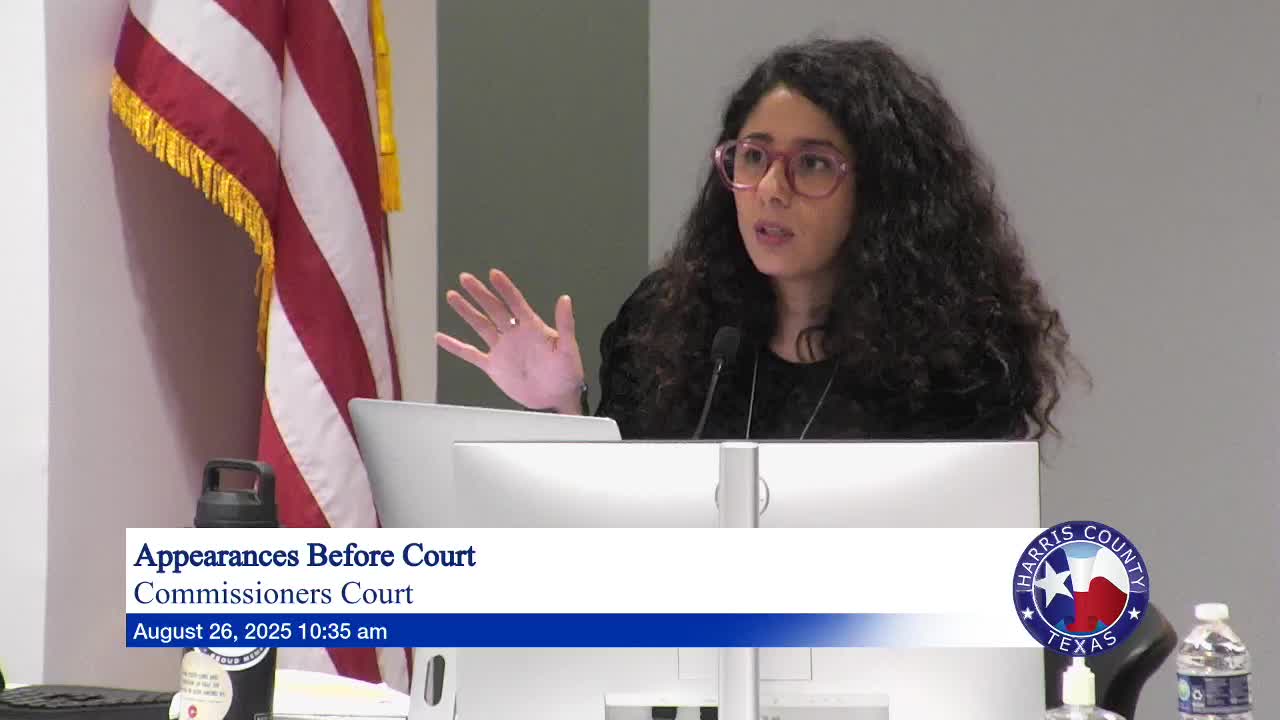
Dozens of residents and nonprofit leaders told the court at a nearly five‑hour public comment session that cuts to prevention and social‑services programs — including youth mentoring, mental‑health services and community centers — would harm public safety and the county’s most vulnerable people. Commissioners repeatedly said a final budget would not be adopted until September after further analysis and public hearings.
Why it matters: County staff told the court they inherited a budget gap after earlier decisions and declining one‑time federal revenue. The court’s deliberations over how to cover the shortfall — whether through cuts, use of one‑time funds, or by seeking voter approval for new revenue — will determine the scope of services that remain intact next year.
The draft submitted by county administration balances the books by combining revenue updates, departmental savings, vacancy management and other offsets; County Administrator Daniel Ramos told the court the draft should be considered preliminary and recommended waiting until the formal budget amendment process in September to take final action.
Public comments and priorities
Representatives of Collective Action for Youth and several community groups urged the court to protect funding for programs that serve young people and families. “I’m not against giving all public servants raises, but what I am against is taking money away from other departments in order to do so,” said Michael Galloway, who identified himself as manager of the Credible Messenger program. He and other speakers described mentoring and violence‑prevention programs as cost‑effective alternatives to longer‑term criminal‑justice expenses.
Other speakers — seniors who use the county’s community center buses, leaders of parks groups, nonprofit workforce‑training providers and small‑business advocates — urged commissioners to preserve precinct budgets, parks and libraries. Several speakers who said they or family members rely on county health clinics described the programs as life‑saving and urged protections for public‑health spending.
“As we deliberate the budget, focus on what unites us: a shared commitment to the people of Harris County,” said Adriana Tames, CEO of the Tejano Center, describing locally funded education and childcare efforts that county grants have supported.
Actions taken at the meeting
The court did not adopt a final budget. The administration asked commissioners to delay adoption until formal amendment hearings in September; Ramos said the proposed budget will be finalized for adoption on Sept. 18 after an amendment day on Sept. 9.
The court did vote to authorize a limited, targeted expense now: it approved overtime pay (rather than compensatory time) for district‑clerk and pretrial‑services staff so those offices can meet urgent new duties created by Senate Bill 9, which changes procedures for certain felony bail hearings. The motion to authorize overtime, made in response to the district clerk’s request, passed unanimously.
Separately, the court approved mandatory judicial pay adjustments required by state law for certain categories of judges. Commissioners voted to implement those minimum increases (as required by statute) effective Sept. 1.
What commissioners said
Judge Lina Hidalgo, who presided over the meeting, repeatedly urged the court to balance fiscal discipline with preserving core services. “This budget is a draft,” she told residents. “Everything in here can be amended — my recommendation is to wait until Sept. 9 to take final action.”
Commissioner Rodney Ellis said the shortfall reflects both structural pressures and policy choices taken earlier in the year, and he urged colleagues to put specific, auditable proposals on the table so the public can see how a multi‑hundred‑million gap would be closed. “We can’t just talk about efficiencies,” he said. “We need a clear account of how the numbers add up.”
Commissioner Adrian Garcia, a frequent defender of precinct spending, said he supported retaining parks, community centers and public‑health services while also looking for creative revenue and savings. Commissioner Lesley Briones stressed maintaining core services such as libraries, parks and flood resilience and asked staff and advocates to identify “least painful” savings options.
What’s next
County administration and department heads will continue to refine the draft budget. The court scheduled an amendment meeting on Sept. 9 and a final adoption vote on Sept. 18. Commissioners and staff said they will hold departmental hearings during September, and staff will return with more detailed line‑by‑line options for reductions, reallocations and proposals to preserve services.
Ending
For now, the most immediate change approved at the Aug. 26 session is operational: county clerks and pretrial staff were authorized to work overtime as they implement procedural changes linked to state law. The larger choices about which programs remain at current funding levels and which would be trimmed will be taken in the coming weeks after additional hearings and staff reports.