Get Full Government Meeting Transcripts, Videos, & Alerts Forever!
Get email alerts on the Education Policy topic
No spam. Unsubscribe anytime.
Superintendent warns special session could bring deep cuts; board hears concerns about proposed AI law
Summary
Superintendent Wendy Berhanzl told the Harrison School District No. 2 board on Aug. 21 that a state special session called to close a large budget gap could result in cuts and that proposed AI legislation raises liability concerns for districts.
Superintendent Wendy Berhanzl told the Harrison School District No. 2 Board of Education on Aug. 21 that a state special legislative session was called to address what she described as "an $808,100,000,000 gap in the state budget," and she urged the board to watch two state bills related to artificial intelligence.
Berhanzl said the special session would consider proposals that shift decisions about cuts to the governor and the Joint Budget Committee and that the shifts would be a substantial change to checks and balances. "We are fiercely pushing back on that," she said, adding that lawmakers were talking about tapping reserves, trimming programs and changing some tax deductions but that details were not yet available.
On proposed AI legislation, Berhanzl said Harrison School District 2 and other districts are concerned that one version of the bill—referenced in the meeting as the Rodriguez bill—would create significant liability for districts and could require hiring additional legal counsel to manage risks. She described a scenario in which a district purchases a software product that a vendor represents as "AI compliant," but the product later proves not to meet whatever compliance standard the law requires; under that version, the district could face lawsuits despite not controlling the vendor's code. "That is really a no," she said of the Rodriguez measure, and she said district organizers were pushing for amendments.
Berhanzl described a second AI-related bill, associated in the discussion with Representative Lindquist, as having vaguer language that is preferable to the Rodriguez bill but still raises concerns about how courts or lawyers might interpret it. She said some districts have shifted positions after reviewing bill language: "If you saw the news yesterday, DPS said, we support the Rodriguez bill, which is the first one I mentioned. And we don't know why CASE and CASB are not making a motion or other school districts. Today, EPS was fully informed of what's in the bill, and they've retracted that statement and say, no. Amend is the way to go." (All quoted remarks are from Wendy Berhanzl during the board meeting.)
Berhanzl said state leaders indicated they would try to protect Medicaid while making cuts elsewhere, and she emphasized uncertainty about what the final package would include. The board did not take a formal position during the meeting; trustees asked no substantive follow-up questions after the update.
The superintendent's remarks came during the "legislative updates" agenda item. No formal motions or votes were recorded on the state budget or AI bills at this meeting; the comments served as information for the board.
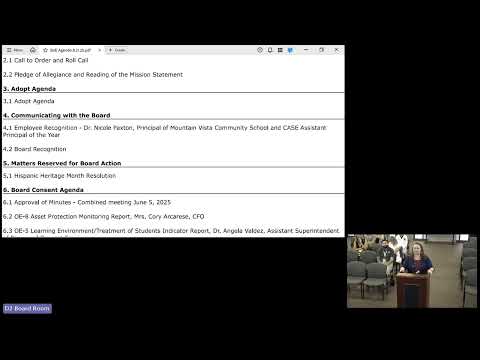
Ending: Board members moved on to other agenda items after the update, including recognitions and routine consent items.