Get Full Government Meeting Transcripts, Videos, & Alerts Forever!
Get email alerts on the Drainage Infrastructure topic
No spam. Unsubscribe anytime.
Hidalgo County drainage officials say nearly $1 billion in district work remains; court approves interlocal with UTRGV and multiple project payments
Summary
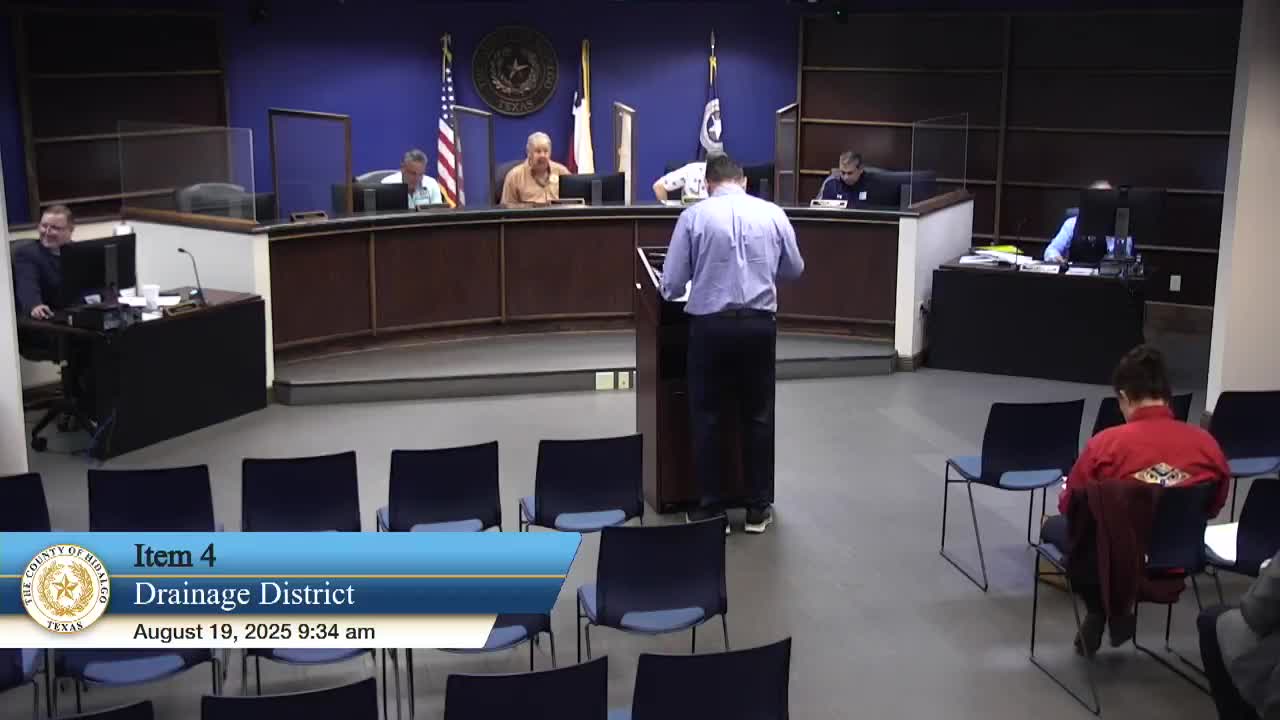
Drainage District No. 1 leaders told the court they have invested about $200 million since 2018 but still face roughly a $1 billion gap for district-only drainage projects. Commissioners approved an interlocal with the University of Texas Rio Grande Valley and several professional services and contractor payments tied to drainage work.
During a joint meeting of the Hidalgo County Drainage District No. 1 board and the Hidalgo County Commissioner's Court, district staff reported large remaining needs for drainage infrastructure and the court approved multiple contracts and payments related to ongoing projects.
Drainage District staff said the district has “invested at least $200,000,000 since 2018” and has leveraged additional state and federal partnerships, but that district-owned facilities still face “about almost a billion dollars” in additional needs. The district’s presentation, described by the ACD‑1 general manager during the meeting, noted roughly $28,000,000 in partnership funds and other leveraged amounts the district has used to extend local dollars toward projects.
The presentation to the court described recent outreach in Austin, where district representatives and Commissioner David Fuentes testified for state attention and possible funding. “We were invited to participate in this testimony ... to highlight the need of the area, but also the plan that we put in place,” Commissioner Fuentes said during the meeting.
The court approved an interlocal agreement with the University of Texas Rio Grande Valley to allow shared use of a green area adjacent to the new stadium for pedestrian access and limited tailgating; the agreement was presented as pending final legal review. County staff said the interlocal includes access and pedestrian-use provisions and would be finalized after legal review.
Commissioners also approved several project-related items tied to drainage work and district operations, including: - Approval to enter a subscription service with ClearGov Inc. for financial reporting services at $10,800 per year; the subscription will automatically renew for one-year terms, subject to final legal review. - Acceptance of professional engineering services/work authorization associated with the Base Lateral Ditch 2023 monitoring project (workstation acceptance noted at $90,006.21 as submitted under contract CHCDD1250540819). - Payment approvals tied to construction and contractor invoices for district projects, including an application payment from Core Equipment LLC ($157,925.06) and multiple construction payment approvals related to Nolanda Loop/Nolana extension projects coordinated through Precinct 2 (items presented and approved in court; amounts and contractor names were provided in agenda materials and were approved subject to each project’s contract terms).
Court action on these items was taken by motion and voice vote; on each listed item the court’s record states “All in favor say aye. Motion carries.” Specific named vote tallies were not recorded in the meeting transcript.
Why it matters: Hidalgo County’s drainage system serves as a key component of flood mitigation and stormwater management across multiple precincts. Officials told the court the district’s local investments and partnerships have produced progress but that the majority of needed capital remains unfunded; county and district leaders said ongoing state-level engagement is intended to identify additional funding.
District staff said they will continue to pursue state and federal funding opportunities and to package project-level requests for potential grants and appropriations. Staff also asked the court to note continuing project-level obligations and to approve routine contract and payment items so work can proceed pending legal review and contractor requirements.