Get Full Government Meeting Transcripts, Videos, & Alerts Forever!
Get email alerts on the Employee Benefits topic
No spam. Unsubscribe anytime.
Temple benefits trust selects low-cost vendor for city health plan after debate over disruption and rebates
Summary
The City of Temple Employee Benefits Trust voted to move forward with Butler Benefits/High Plains Health Plan as the low-cost vendor for the city's medical plan after discussing premiums, retiree contributions, network disruption, and pharmacy rebates.
The City of Temple Employee Benefits Trust voted to select Butler Benefits (administered by High Plains Health Plan) as the low-cost vendor for the city’s employee health plan after a motion passed at the trust’s Aug. 15 reconvened meeting.
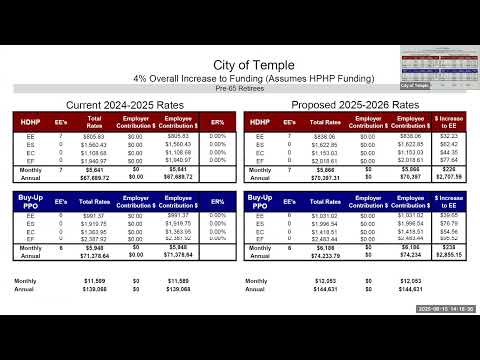
Tara Raymore, the trust’s benefits consultant, told trustees the presentation assumed the city would pay 60% of any premium increase and employees 40%, and that “the maximum increase an employee would see is approximately $78” under the recommended vendor option. Raymore said the lowest-cost vendor proposal would show a much smaller employee increase, about $25.93 in the buy-up PPO example presented.
The trust’s decision followed extended discussion about differences among bidders, how premiums were calculated and funded, and possible service disruption for employees if the trust chose the lowest-cost proposal. “The lowest cost vendor, I just have some concern about disruption, with employees being able to see their providers,” Raymore said, describing a higher disruption rate and differences in pharmacy programs compared with the city’s incumbent plan.
Raymore and other staff described key assumptions used to model costs: funding a “fully mature year” (12 months, including an IBNR allowance), a 60/40 city-employee split for estimates, and a retiree contribution of $200 per month for retirees with 25 or more years of service. Raymore said the plan documents currently show 13 retirees covered in the city medical plans and that number “might be 14 today.”
Trustees pressed staff on missing network data for a second-tier (First Health) network associated with the lowest-cost proposal. Raymore said that tier’s network data had to be requested from First Health and “it could take several days” to receive it; she warned the trust that the missing tier data made some disruption estimates incomplete.
Trustees also discussed pharmacy rebates and credits. Raymore said the recommended vendor (UnitedHealthcare, the higher-cost proposal) included a guaranteed $1.15 per-employee-per-month credit applied monthly, while the lower-cost bidder’s pharmacy rebate estimate was presented as an annual estimate (about $679,000) that would be paid later and could vary. Raymore summarized the difference in total proposed cost between the recommended and lowest-cost proposals as roughly $635,000 per fiscal year across all funds; she and staff further explained that the employer-side difference was about $423,000 and the employee-side difference about $212,000 under the 60/40 split used for the illustrations.
After discussion and a brief recess while staff attempted to obtain missing tier data from the vendor and consultant, Benefits Trust member Kirkendall moved to contract with Butler (the low-cost provider). The motion was seconded by Benefits Trust member Pilkington. The clerk announced the vote as four yes, zero no, and one abstention; the motion carried.
The trust’s action applies only to agenda item A at the reconvened meeting. Staff and the benefits consultant (McGriff) were asked to follow up on outstanding network data for tier 2 and to complete implementation steps and paperwork tied to the vendor selection and any negotiated credits or performance-share terms.
The trust did not adopt changes to retiree eligibility or contribution policy during the meeting: Raymore reiterated existing practice that qualifying retirees receive $200 per month toward insurance if they have 25 or more years of service. Trustees also emphasized the need for clear employee communications about network tiers, pharmacy differences, and any co-pay or deductible changes before any coverage transition.