Get Full Government Meeting Transcripts, Videos, & Alerts Forever!
Get email alerts on the Stormwater Bylaw topic
No spam. Unsubscribe anytime.
Lakeville planners propose fee, timeline changes in stormwater bylaw rewrite
Summary
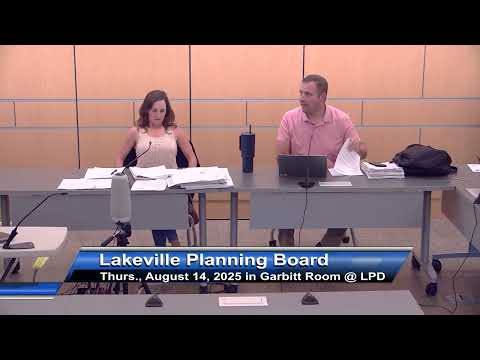
The Lakeville Planning Board reviewed proposed edits to the town’s stormwater management bylaw on Aug. 14, including who administers the rule, when applicants will pay a stormwater fee and a change to the public‑hearing timeline.
The Lakeville Planning Board reviewed proposed edits to the town’s stormwater management bylaw on Aug. 14, including who administers the rule, when applicants will pay a stormwater fee and a change to the public‑hearing timeline.
Interim town planner Makayla (listed in the meeting as the interim town planner) told the board she had moved most authority for the bylaw to the planning board, with Conservation Commission review used only when a separate conservation permit — and not planning board review — is required. She also presented two fee options and a proposed timeline change from 21 days to match the site‑plan review calendar.
The proposal would: (1) make the planning board the primary administrative authority for the stormwater bylaw except where only conservation review is needed, (2) let the board decide whether to charge a separate stormwater application fee in addition to other application fees or only when stormwater is the standalone application, and (3) align the stormwater public‑hearing schedule with site‑plan or subdivision timelines rather than require a separate hearing within 21 days of receipt.
Makayla said peer reviewers recommended avoiding duplicate fees for most projects because “most one‑acre projects will require site plan review. They kinda recommended that for right now, we don't charge a separate stormwater fee when the project is already paying for another one.” Board members agreed with that approach, citing both cost‑recovery concerns and legal limits on charging more than an agency’s reasonable cost for review. The board then discussed numeric fee suggestions that staff had gathered from comparable communities and settled on two practical guidelines: use the separate fee only for standalone stormwater reviews, and keep residential/subdivision fee tiers that include a $100 per‑lot unit with a $500 cap for residential subdivision calculations (the board agreed verbally to a $100 per lot up to a $500 maximum for residential subdivisions). Members also signaled support for a $100 per‑acre structure with a modest minimum for standalone commercial/industrial stormwater permits, while noting the exact dollar figures could be adjusted in the bylaw language before final adoption.
On process, members asked staff to change the 21‑day requirement to 30 days so the stormwater hearing schedule would track the site‑plan/subdivision calendar and avoid separate, overlapping public‑notice cycles. Board members also instructed staff to include a required stormwater checklist in the site‑plan application so applicants file stormwater material with their site‑plan packet when both reviews apply. The board asked the planner to send a revised clean draft to town counsel that calls out the 30‑day timeline and to return with a recommended enforcement path (town planner vs. DPW/building commissioner) after counsel’s review.
The board did not vote to adopt the bylaw at the meeting; members asked staff to prepare a revised draft with the indicated fee approach, the 30‑day hearing language, and an updated application checklist for the next meeting and for a town council / town counsel review before a public hearing on the bylaw.