Get Full Government Meeting Transcripts, Videos, & Alerts Forever!
Get email alerts on the Affordable Housing topic
No spam. Unsubscribe anytime.
Maui committee delays vote on Kahului state-supported affordable housing as safety, streets and tree plans are resolved
Summary
Maui County—ouncil—ommittee recessed its discussion of HHFDC—xemptions for a proposed mixed-use site in Kahului and directed the developer and county departments to resolve driveway placement, traffic and 22complete streets22 issues, landscaping/tree disposition and funding questions before a resumed meeting Aug. 20.
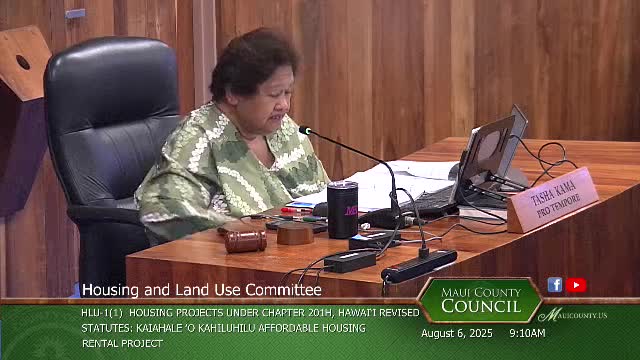
The Maui County Council—ommittee on Housing and Land Use recessed its hearing on a state-backed affordable housing project in Kahului and asked the developer and multiple county departments to work out outstanding safety, traffic and landscaping issues before the committee reconvenes.
The committee spent much of the session reviewing exemptions the Hawaii Housing Finance and Development Corporation (HHFDC) requested from county standards for streets, sidewalks and related fees (referenced in the packet as Exhibit A / Granicus item 17). County public works staff said they had safety concerns about a permanent secondary fire-access driveway that would be near the Kahului Transit Center. Committee members and county staff urged a traffic evaluation of the driveway and surrounding circulation before granting broad exemptions.
Why it matters: committee members said the matters affect resident safety and project readiness. The committee is operating under a roughly 45-day local deadline to approve or deny the HHFDC request, and the project team said that council approval is needed to advance in state financing cycles. Committee members also flagged state law (referred to repeatedly as Act 294) that limits the county27s ability to add costs or conditions to state-initiated affordable housing, complicating the committee27s options.
Key details
- Scope of review: The hearing covered three main exemption requests (identified in Granicus materials as C1, C2 and C3) tied to driveway/inspection fees and landscaping/tree requirements within the public right-of-way. Public Works asked that exemptions be narrowed or that the developer provide clearer limits for what is being waived.
- Driveway and transit-center proximity: Public Works and several council members said the proposed permanent secondary fire-access driveway had not been evaluated in sufficient detail for how it would interact with bus-hub circulation. The committee asked the project team to provide a traffic memo or updated evaluation addressing the intersection of the fire access, the Kahului Transit Center and the planned civic/office portion of the larger site.
- Project phasing and responsibilities: HHFDC representatives and their architect noted the site is being developed in phases: the residential (affordable housing) component is moving forward sooner than the state-owned DAGS (Department of Accounting and General Services) civic/office portion. Committee members and HHFDC agreed the timing creates coordination challenges because on-site improvements serve the entire site, even if construction is parcelled.
- Trees and landscaping: The project27s submitted landscape sheet (L1.1) shows trees on private property rather than in the county right-of-way. Committee members asked for clarity about which street-tree requirements the developer would meet on-site versus in the public right-of-way and how existing mature coconut and banyan trees on the parcel would be handled (possible relocation, reuse or removal). The committee directed the parties to coordinate with the county27s resources office about disposition of trees that would be removed.
- Funding and fee waivers: Committee members reviewed packet figures that estimate exemptions and waived fees in the millions (committee discussion referenced totals around $3.73 million). County staff said the Affordable Housing Fund can be used in some cases to offset certain fees, such as water system development charges, but that transfers would require follow-up (competitive application or existing FY allocation language). Committee counsel and staff reiterated they cannot unilaterally add new conditions that would transfer project cost onto the developer in ways precluded by Act 294.
- Schedule and timing: The project team told the committee that council approval is a required step for the consolidated application the project will submit to secure low-income housing tax credit (LIHTC) funding in the state application round. The developer indicated plans to pursue funding requests in early 2026 and to proceed through permitting in subsequent years; the committee emphasized those timing pressures while also demanding clearer technical documentation now.
Committee direction and next steps
The committee did not take a final vote on the exemption requests. Instead it recessed the hearing and directed staff, HHFDC/developer representatives and relevant county departments (Public Works, Housing, Water, Planning, Fire and Transportation) to meet and produce a clarified package for the committee27s next session. The chair set an August 20 meeting date and asked parties to provide updated materials in advance so members could review them prior to posting. Public Works specifically offered to work with the project team on narrowed exemption language and timing for delivery of required off-site improvements.
Ending
The Housing and Land Use Committee recessed to reconvene Aug. 20, 2025, at 9 a.m. Members said they expect updated, consolidated materials from staff and the applicant beforehand to permit an informed vote at the next meeting.