Get Full Government Meeting Transcripts, Videos, & Alerts Forever!
Get email alerts on the Federal Funding And Local Health topic
No spam. Unsubscribe anytime.
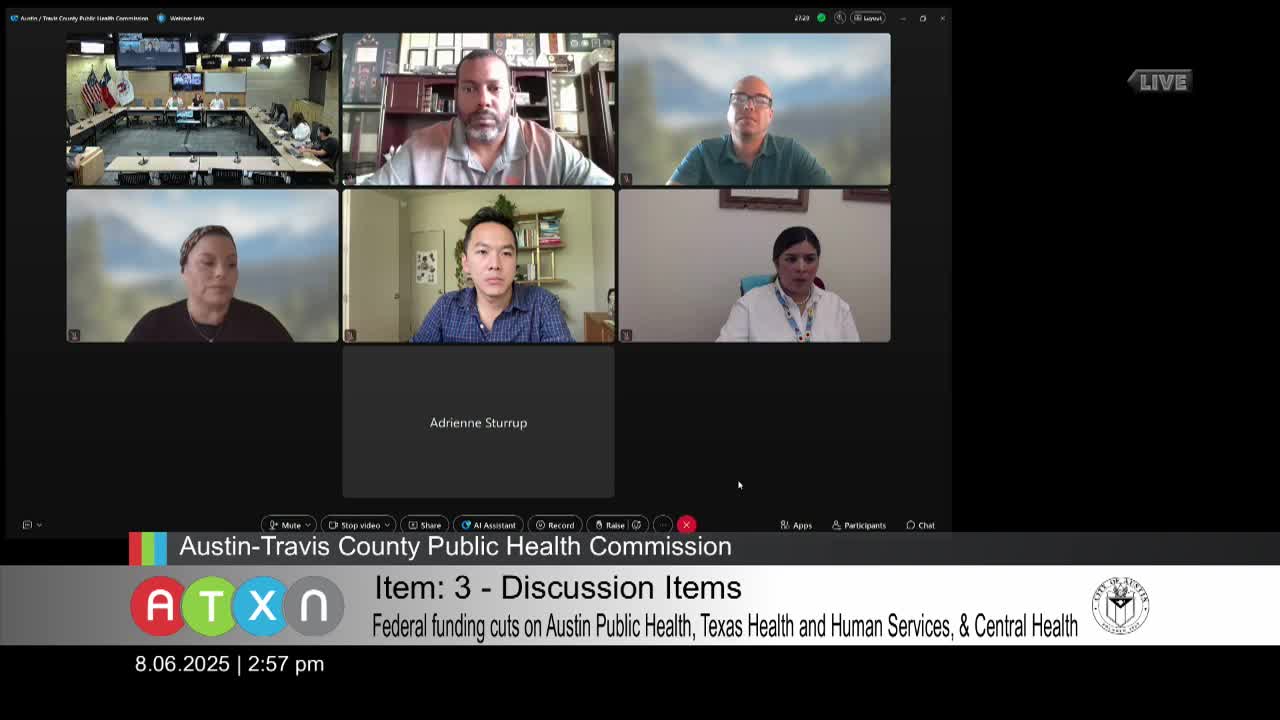
Austin Public Health director warns federal grant cuts are causing staff instability and service gaps; requests $9.2M in local support
Summary
Director Stirrup told the Public Health Commission that abrupt starts and stops in federal grant funding have put core programs and staff at risk, and that the department has identified about $9.2 million in general-fund needs to stabilize services and maintain outbreak and emergency response capacity.
Director Stirrup, leading Austin Public Health, told the commission that the department has experienced "stops and starts" in federal grant funding since May and is operating under persistent instability.
Stirrup said the uncertainty affects services the department considers core and statutorily mandated under the Texas Health and Safety Code: adult immunizations for safety-net populations, technical support for vaccine-for-children providers, disease-intervention and follow-up for communicable diseases (including HIV, STIs and tuberculosis), the refugee clinic, and the public-health emergency response program, including BioWatch and air monitoring.
Stirrup said the department has worked to preserve jobs where possible but that abrupt funding changes have forced last-minute separations and reassignments. "We've lost x dollars because things are still in flux," Stirrup said, adding that stops and starts have required staff reassignments and created gaps in institutional knowledge. She told commissioners the department has identified "upwards of $9,200,000 in general fund" or other local revenue, including through a possible tax-rate election, to shore up core services and reduce instability.
Stirrup and staff told commissioners that 47 APH staff had been impacted by grant disruptions to date. She said most impacted employees were placed into other city positions or elsewhere within the department, while four took voluntary separations; nonetheless, the department lost "capacity and institutional knowledge" important for field-based services and emergency response.
Commissioners asked whether the department has captured the community-level impacts and whether contingency or emergency-response plans exist for a local shortfall. Stirrup said APH created a story map to "humanize the impacts" and plans to update it as grant-level information becomes clearer; she also said written emergency plans exist, but restoring surge capacity will take time and recruitment if funds are not secured.
Stirrup said the department's funding model is staff-heavy for grant-funded positions: about half of APH staff are supported by grants although grants make up approximately 30% of the department's budget, which she said places staffing at disproportionate risk when grants are cut. She told commissioners that in the early spring the city manager identified roughly 300 positions at risk citywide; of those, 287 were APH employees.
On possible local responses, Stirrup and commissioners discussed the tax-rate election (TRE) as a funding vehicle. Stirrup said a TRE is "our best bet" to shore up public-health infrastructure given competing citywide budget needs and a projected city deficit. She said APH would work to "right-size" operations to match available funding if local revenue is not secured, and that community partners could absorb some services but would not replace the department's mandated roles.
Why it matters: APH leadership described immediate staffing and capacity risks for outbreak control, immunizations, harm-reduction support and emergency response if federal grant funding remains uncertain. The department requested local funding options to stabilize programs while federal appropriations remain in flux.