Get Full Government Meeting Transcripts, Videos, & Alerts Forever!
Get email alerts on the State Legislation Public Health topic
No spam. Unsubscribe anytime.
Austin Public Health summarizes Texas Legislature changes that limit local authority on immunizations, food permitting and DEI programs
Summary
At a July meeting, Austin Public Health staff reviewed dozens of bills from the 89th Texas Legislature that staff say shift authority to the state and could weaken local immunization enforcement, reduce local food permitting, and curtail diversity, equity and inclusion programs.
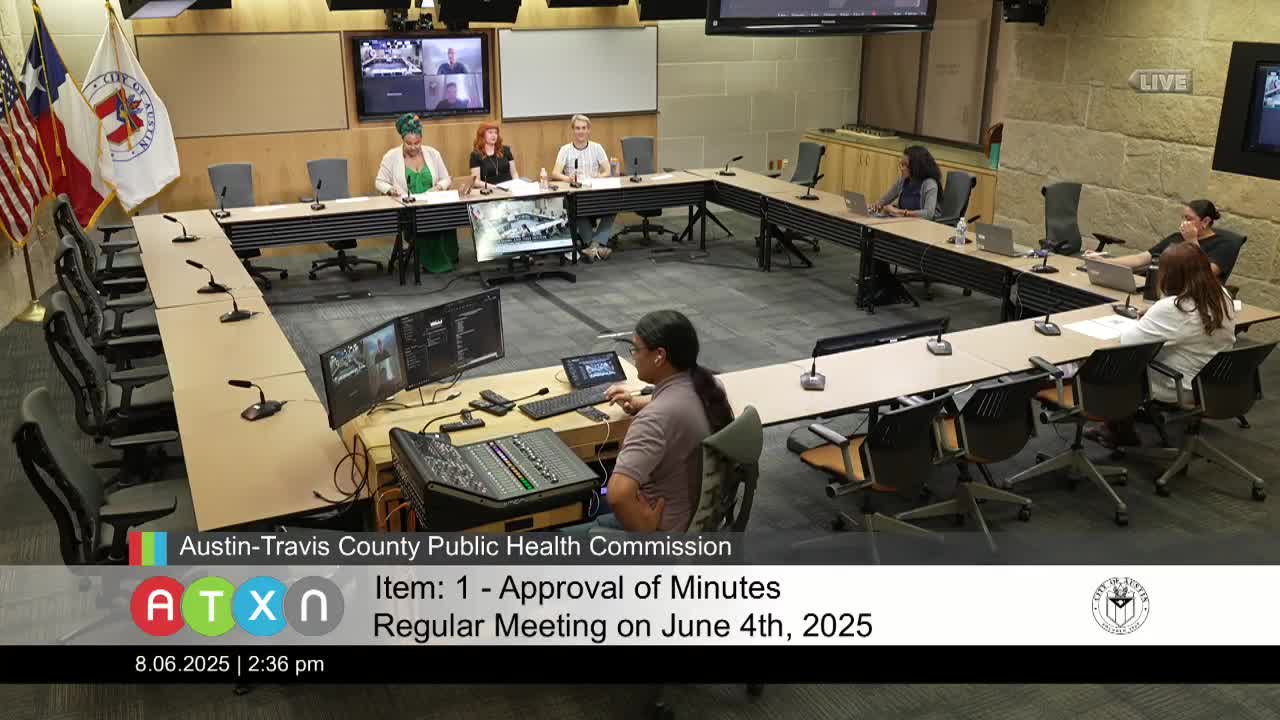
Juanita Jackson, staff liaison with Austin Public Health, briefed the Public Health Commission on bills from the 89th Texas Legislature and their likely effects on local public-health programs.
Jackson said the department tracked 149 bills assigned to Austin Public Health and noted that roughly two dozen had passed as of June 22. She said the session produced measures affecting immunization records, school admissions, mobile food permitting, drug-testing equipment, diversity-equity-inclusion (DEI) programs, and emergency-preparedness authorities.
Jackson told commissioners that immunization-related bills the department tracked include SB 94, which she described as prohibiting schools and childcare facilities from denying admission for individuals who submitted exemption documentation; HB 1586, which she said revises the immunization exemption process and removes security restrictions on affidavit forms; and two identical bills, cited as SB 46 and HB 772, that change the Texas Immunization Registry from an opt-in to an opt-out system. Jackson said those changes, in combination, "decrease immunization compliance," "increase risk of outbreak," and create administrative burdens for local entities responsible for monitoring pending affidavit requests.
On food regulation, Jackson highlighted bills she identified as SB 10108 and HB 2844 (as cited in her briefing), and HB 2156. She said these bills limit local permitting, restrict certification and fee requirements beyond state rules, and transfer regulatory authority for some mobile food vendors to the Texas Department of State Health Services. Jackson warned that the changes could "create gaps in local enforcement capacity, delaying localized responses to foodborne illnesses and outbreaks," and noted a potential loss of local permitting-fee revenue.
Regarding drug-policy and harm-reduction bills, Jackson cited a bill she labeled HB 401496 (as spoken in the briefing) that, she said, would remove barriers to distributing fentanyl testing equipment and exempt such equipment from prosecution under paraphernalia laws. She and staff identified other identical bills she cited as SB 362, SB 540 and HB 253 that amend statute language to decriminalize possession or distribution of drug-testing equipment.
Jackson described several DEI-related measures that passed or advanced, including bills she cited as HB 72770, HB 167 (named "Ending Institutional Racism Act" in her briefing), HB 436, HB 1521 and HB 3227. She said measures that passed would limit or prohibit use of public funds for DEI programs, ban DEI offices in many government entities, and restrict the use of race- or gender-related criteria in hiring or contracting. Jackson said these bills "pose a substantial threat to local public-health agencies' ability to address structural inequalities through evidence-based DEI programs," and could undermine outreach and data quality for marginalized populations.
Jackson also reviewed bills related to public-health emergency preparedness. She listed measures tracked by the department — including items she labeled SB 131, SB 132, SB 30131, HB 820, HB 2541, SB 1218, HB 1776, SB 940, HP 3360362 and SB 2101 — and said they varied in goals from disease-surveillance modernization to clarifying the roles of the Texas Department of State Health Services and local authorities during emergencies.
Jackson concluded by inviting questions and offering to share the full slide deck and contact information for follow-up.
Why it matters: Austin Public Health staff told commissioners they interpret the session's package of bills as shifting authority or enforcement capacity to the state in several areas and creating operational and data burdens for local health departments. The department said changes to immunization reporting, local permitting authority, and constraints on targeted outreach could affect routine prevention and outbreak response.