Get Full Government Meeting Transcripts, Videos, & Alerts Forever!
Get email alerts on the Vacation Home Rental Ordinance Amendments topic
No spam. Unsubscribe anytime.
Douglas County advisory board backs package of Lake Tahoe vacation‑rental code changes, forwards recommendations to commissioners
Summary
The Douglas County Vacation Home Rental Advisory Board voted 3–1 to forward recommended changes to Chapter 20.622 of the county code — the Lake Tahoe vacation home rental ordinance — to county staff for transmission to the Board of County Commissioners.
The Douglas County Vacation Home Rental Advisory Board voted 3–1 to forward recommended changes to Chapter 20.622 of the county code — the Lake Tahoe vacation home rental ordinance — to county staff for transmission to the Board of County Commissioners.
The package discussed at length on the advisory board’s agenda includes a new, consolidated “code of conduct” to be provided to renters; changes to insurance minimums and requirements for how policies are documented; requirements for local contact posting and timely response to complaints; clarifications on fines and permit revocation; and a proposal to reorganize enforcement language. Board members also debated rules on parking placards, whether owners must hire licensed local property managers, and minimum-age or on‑site requirements for renters; no formal change requiring the renter to be physically on-site was adopted.
Why it matters: The recommendations affect how vacation home rentals (VHRs) are regulated and enforced in the Lake Tahoe area of Douglas County, with implications for neighborhood traffic and safety, liability and insurance coverage, enforcement workloads for county staff and sheriff’s deputies, and options available to property owners and managers.
Board discussion and staff rationale Ernie Strelo, a county staff member participating in the meeting, summarized proposed insurance changes and the staff rationale for limiting certain policy types. "When you have a claim against me, there's a different process if I have a direct claim on my property insurance. Versus I have a general all comers umbrella policy," Strelo said, explaining why staff had previously recommended excluding umbrella‑only evidence when it complicated administrative review. Strelo told the board staff had reviewed industry guidance and that insurance carriers had urged higher liability limits because of increased fire and accident risk.
Board members debated tiers of minimum liability coverage. One slide referenced raising limits for some properties from $500,000 to $1 million; board members said lower‑risk, smaller units might not need the highest tier. Property managers raised concerns that raising minimums would be difficult for managers who aggregate dozens of listings. In discussion, a property manager named Heidi Gunter was cited for describing how a manager responsible for many homes would face challenges if every owner had to raise coverage.
Code of conduct, posting and response requirements The advisory board agreed to create a single, consolidated code of conduct that operators must provide to renters. The code will include items already required elsewhere in the code — quiet hours, occupancy limits listed on the permit, trash and parking instructions — and a set of minimum items to be included for renters. Board members asked staff to mark obligations "if applicable" when an item (for example, a fire pit) does not apply to a specific property.
The board discussed where the required information must be posted at a VHR. Strelo said the intent is that information be posted "in a conspicuous place near the entrance of the VHR" so a responding deputy can readily find it. Board members asked that the code clarify whether local contacts must respond to the complainant or to the county; one board member suggested a short response standard (one hour was mentioned in discussion) so complaints are acknowledged quickly. The board reached consensus to require a posted local contact and prompt response, with staff to tighten wording.
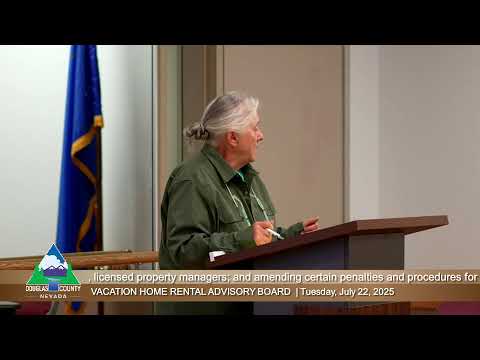
Neighborhood impacts raised in public comment Resident Caroline Turner described local impacts of VHR density in her neighborhood, telling the board: "This is a single entry area to, 29 homes, with 5 DHRs, adding up to an additional up to 16 vehicles and up to 38 people." Turner said narrow streets, lack of sidewalks and church traffic compound safety and access concerns, and she described instances of strangers approaching homes and guests failing to follow trash and noise rules. The board noted these neighborhood concerns as context for the density, parking and code‑of‑conduct provisions.
Age, renter presence and renter identification Board members revisited existing age and renter‑identification language. AJ Ajayak read an existing code passage that the minimum age to rent is recorded in the code and that owners must obtain a renter’s identification; Ajayak noted the code requires owners to keep copies of renter driver's licenses for two years. Some members proposed editing language to specify that the named renter must be an occupant during the rental period; others opposed making onsite presence a blanket requirement. The advisory board did not adopt a new, uniform requirement that the person who signs the rental must be physically present for the entire stay; the matter was discussed but left unresolved for further staff refinement.
Property managers and compliance Board members debated whether owners who decline to hire local licensed property managers should face nonrenewal of permits after repeated nonresponse to complaints. Strelo told the board staff data do not clearly show property managers always perform better than individual owners; he said staff had seen both responsive landlords and responsive managers. The board made no universal finding that managers are categorically superior, and language was adjusted to give staff discretion in enforcement and renewal decisions.
Parking, placards and enforcement reorganization Members discussed removing a requirement for parking placards in certain single‑family settings and asked staff for more research on unintended consequences before wholesale removal in multifamily contexts. The board agreed to reorganize enforcement code language (authority of the director, noticing violations, suspension and penalty procedure) and clarified that the permit revocation language will permit fines and enforcement actions tied to revocation when appropriate.
Votes and formal actions - The agenda was approved 4–0 (motion and second recorded; mover not specified in transcript; second recorded as Lauren Romaine). - Minutes for the June 25, 2025 meeting were approved 4–0 (mover and seconder not specified in the transcript). - After discussion and public comment, the board moved to accept the consolidated set of recommendations reflected in the board slides (referenced by page numbers during the meeting). That motion carried 3–1; the board directed staff to incorporate the consensus edits and forward the package to county staff and ultimately to the Board of County Commissioners for their consideration.
What remains unresolved or for staff follow‑up Board members left several items for staff refinement or later consideration: a final determination on whether and how to require on‑site presence of the renter, precise insurance tiers and which properties should fall into each tier, further review of parking placard removal in multifamily settings, and the precise response time standard and posting language for local contacts. Staff was asked to correct an omission noted in the packet (bear‑box instructions had been inadvertently removed from a draft list) and to incorporate clarifying language that items be echoed on the permit only "if applicable." Strelo said staff would incorporate the board's consensus language and return materials for the commissioners.
Ending Board members scheduled no final vote at this meeting to adopt an ordinance; instead, they forwarded the recommended revisions and asked staff to prepare the code changes and supporting materials for the Board of County Commissioners’ review. The board closed with an opportunity for final public comment and adjourned following a motion and a second.