Get Full Government Meeting Transcripts, Videos, & Alerts Forever!
Get email alerts on the School Facilities topic
No spam. Unsubscribe anytime.
Indianapolis education alliance spotlights school facilities, funding gaps and a transportation pilot
Summary
The Indianapolis Local Education Alliance met at Adelante Schools to examine school facilities, a proposed transportation-and-facilities pilot and the funding constraints that shape who pays for buildings and buses.
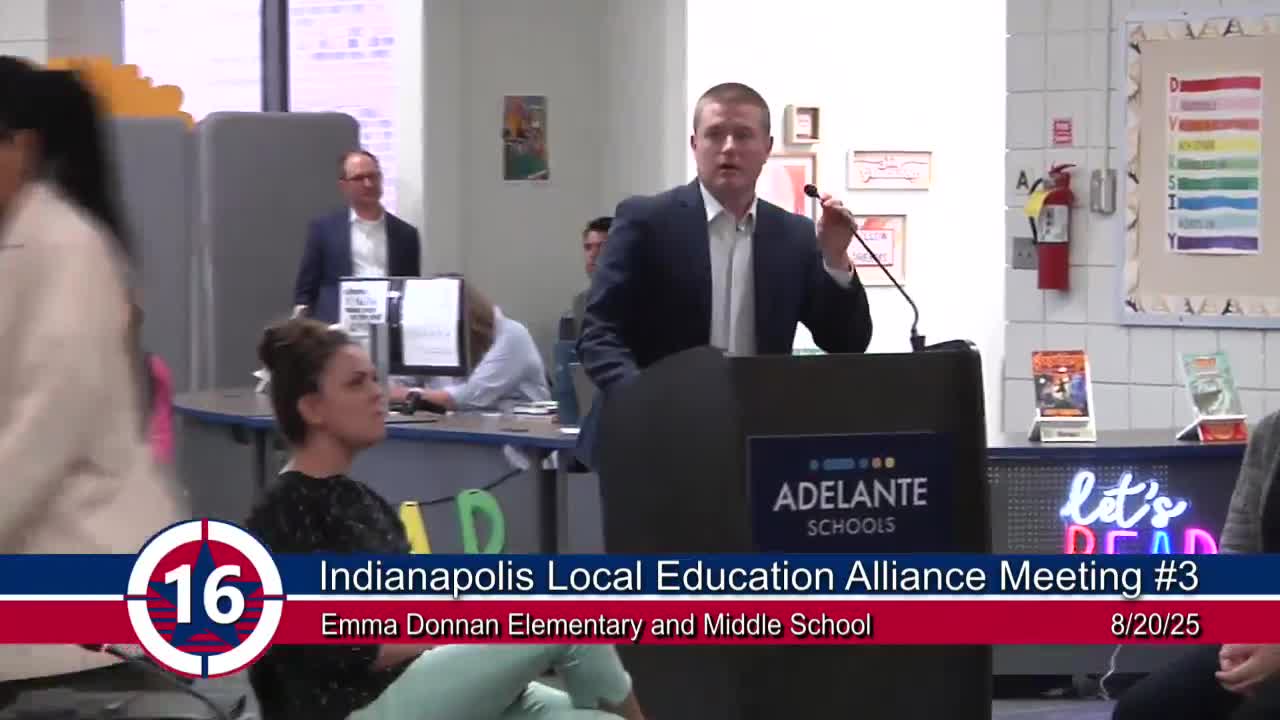
The Indianapolis Local Education Alliance on Aug. — during a public meeting at Adelante Schools — focused on school facilities, a proposed transportation-and-facilities pilot that would span dozens of schools, and the limits of existing facility funding that Alliance members and public speakers said will shape decisions for years.
Presenters included Eddie Rangel of Adelante Schools; Dr. Kiana Warren of Purdue Polytechnic High School (PPHS); Andy Seibert of TogetherEd, the nonprofit that submitted the pilot application; and Andrew Stroop, deputy superintendent for Indianapolis Public Schools (IPS). Superintendent Alicia Johnson and other IPS operations staff answered member questions. The meeting drew an extended question-and-answer period and a large public-comment turnout; 38 people had signed up to speak.
Why it matters: Committee members said facilities and transportation decisions will affect how public resources are shared across district-run schools, innovation-network schools and independent charters inside the IPS boundary. Alliance members pressed for common data and definitions so policy recommendations can account for enrollment trends, debt service and how property-tax funding is allocated.
Presentations and pilot details Andy Seibert, chief executive officer of TogetherEd, said the nonprofit consolidated a transportation and facilities pilot application on behalf of 54 schools representing “close to 22,000 students.” He told the Alliance the pilot aims to test multimodal transportation options and shared facility uses such as athletics, robotics and after-school programming.
Seibert: “The Indianapolis-based pilot application that we submitted on behalf of 54 schools that represent close to 22,000 students, we consolidated transportation and facility pilot.”
Dr. Kiana Warren described PPHS campuses and the trade-offs her schools face when they lease or co-locate instead of owning. She said the White River / Mallory campus offers maker space, labs and transit access but limits long-term investments because the network does not own the building. At Broad Ripple, shared athletic facilities are an advantage, she said, but co-location creates scheduling constraints and layout inefficiencies.
Warren: “We have a large lot with the possibility for future expansion. We have a kitchen that allows for scratch cooking ... but we do not own the building so it limits some of the long-term investments we can make.”
Eddie Rangel, chief operations leader at Adelante Schools, opened the meeting in the host school and described recent gains at Adelante: improved attendance, a large decrease in chronically absent students and test-score gains he attributed to consistent community programs and local partnerships.
Jordan Habib, Adelante27s chief operating officer during public comment, told the Alliance: “Indianapolis Public Schools is incredibly good at facilities,” and said Adelante pays IPS for services such as custodial and IT because it is cost-effective.
IPS overview and funding context Deputy Superintendent Andrew Stroop and IPS staff presented an overview of the district27s portfolio and of how facility funding works. Stroop said there are roughly 98 public school buildings within the IPS boundary and 65 of them are owned by IPS. He also described the citywide mix of district, innovation and charter schools that serve boundary residents.
Stroop: “We27ve got about 98 total public school buildings in the boundary. Sixty-five of them are IPS-owned facilities.”
IPS finance and operations staff outlined revenue and spending lines on property-tax funded accounts that support facilities and transportation. The district27s finance team said the operations fund receives roughly $100 million annually that covers repairs, custodial services and transportation; about $50 million of that is for transportation and roughly $25 million for administrative support. IPS also described a 2023 capital referendum (voters approved approximately $410 million) that funded large capital projects, and said outstanding district debt is on the order of several hundred million dollars with about $100 million paid in annual debt service.
Public and member questions: utilization, co-location and the "$1 law" Alliance members pressed presenters on how to measure building capacity and utilization. Stroop and Superintendent Alicia Johnson said capacity metrics can vary by program and urged the Alliance to set shared definitions before using utilization to recommend facility actions.
Johnson: “If you ask that question, you might get four or five different answers. We have to be clear on what it is we desire to be true, and that will drive how we come up with our solutions.”
Several Alliance members and public speakers raised the state27s so-called "$1 law" (the state law that limits how district-owned property can be sold or transferred to charter operators) and asked whether the Alliance should recommend repeal or modification. Superintendent Johnson said IPS opposes the dollar-law requirement and that the Alliance must consider whether uniform standards and the distribution of limited resources are the priority.
Public comments and calls for transparency During the public-comment period, speakers representing parents, teachers, community nonprofits and academic researchers urged the Alliance to publish facility and enrollment data, to pause new charter openings, to repeal the "$1 law" and to ensure school finance changes do not shrink services for district-run students.
A recurring theme from commenters was demand for transparency. Several parents and service providers asked that the Alliance publish its facility-survey results and enrollment data so families can make informed choices. Other commenters warned that selling or transferring district buildings at below-market prices can leave the public sector with long-term liabilities while private operators profit.
No formal actions recorded The Alliance meeting produced discussion and questions but no formal votes or motions on pilot approval, property sales or legislation. Presenters and Alliance members repeatedly said further analysis is required before the group can make binding recommendations.
What comes next Alliance members asked for a shared data framework and clearer definitions of building capacity and utilization before drafting policy recommendations. Presenters and public speakers urged the Alliance to weigh the trade-offs among program autonomy, shared use, fiscal efficiency and community accountability as the Alliance develops guidance on facilities and the transportation pilot.
Ending: The Alliance did not adopt any motions at the meeting; members and staff agreed to continue data collection and follow-up conversations about the transportation-and-facilities pilot, facility metrics and how state property-tax and facility laws will affect future options.