Get Full Government Meeting Transcripts, Videos, & Alerts Forever!
Get email alerts on the Eagle Crest Cup Repeal topic
No spam. Unsubscribe anytime.
Quorum court rejects repeal of conditional-use permit rule for Eagle Crest recovery home
Summary
At its August 2025 meeting the Washington County Quorum Court voted down a proposed ordinance that would have repealed the county's requirement that certain recovery homes obtain a conditional-use permit, after extended debate about federal civil-rights law, local zoning authority and potential legal costs.
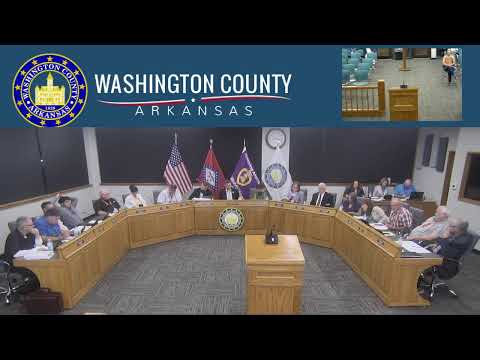
At its August 2025 meeting, the Washington County Quorum Court voted against an ordinance that would have repealed the county's conditional-use permit (CUP) requirement as applied to the Eagle Crest recovery facility.
The vote on the motion to pass (moved by Justice Lyons, seconded by Justice Rio Stafford) failed, with 4 voting yes, 7 voting no and 1 abstention. The court had before it legal guidance and public comment arguing both that federal disability law preempts local zoning and that neighborhood safety and planning oversight remain pressing concerns.
The issue drew the meeting's longest debate. Justice Lyons argued the county risked a large civil-rights judgment if it maintained a CUP requirement, citing a November 2016 joint U.S. Department of Housing and Urban Development/Department of Justice statement and a temporary injunction by U.S. District Judge Brooks that, Lyons said, "concludes that there is a substantial probability that the plaintiff . . . will succeed at trial." Justice Lyons said treating recovery homes differently from other shared-occupancy arrangements could violate the Fair Housing Act and the Americans with Disabilities Act and expose taxpayers to legal fees.
Opponents told the court they sympathized with federal-law concerns but said local planning oversight and neighbors' safety needed to be protected. Justice Koger described the outcome as "setting a dangerous precedent" that could undermine land-use integrity if local conditions and oversight were removed. Several neighbors and attorneys representing neighbors urged the court not to adopt language that explicitly names a private party or that appears to be a carve-out for a single operator.
County legal counsel, identified in the meeting as Counselor Lester, told the court there is a pending federal case and that an agreed injunction allows Eagle Crest to continue operating while the litigation proceeds. Counselor Lester said the case is set for trial in U.S. District Court in February 2026 and that the county previously had a repeal that was overturned in state court because the planning board had not held a required public hearing.
Public commenters included neighbors who said they feared traffic, noise and safety impacts, and supporters of Eagle Crest who said recovery residences provide needed services and should receive the same protections as other housing for people with disabilities. Speakers included Mary McKinney and Charles McKinney (neighbors), attorney Steve Zaga (representing the McKinneys), and Seth Haines (representing Eagle Crest).
After roll-call voting, the motion to repeal failed. The court did not pass any alternative conditions or direct staff to prepare a substitute ordinance during the meeting.
What happened next: item 8.1 failed and the pending federal litigation remains active; several justices called for caution and for the county to avoid further litigation costs.
Ending: Several justices said they hoped to find a way to address neighbors' complaints through enforcement of state building, septic and fire codes (which local officials said are enforced by state agencies) or through negotiated conditions short of reopening litigation, but no formal follow-up motion was adopted at the meeting.