Get Full Government Meeting Transcripts, Videos, & Alerts Forever!
Get email alerts on the Public Nuisance Ordinance topic
No spam. Unsubscribe anytime.
Caroline County commissioners review draft public‑nuisance ordinance; staff to refine appeals process
Summary
County officials and staff discussed a proposed ordinance defining public nuisances and formalizing abatement procedures, focusing on definitions, due process, agricultural exemptions, appeals and budget implications. Staff will meet to refine language before introduction.
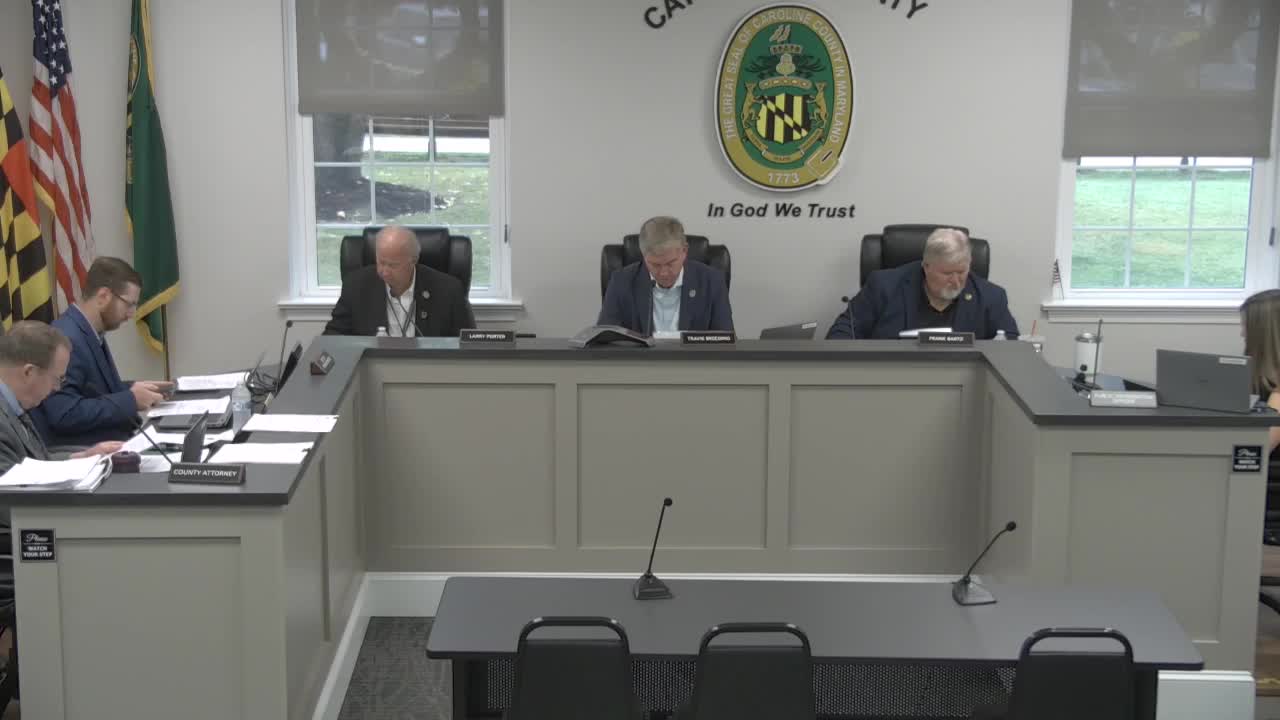
Caroline County commissioners discussed a draft ordinance on public nuisances during an Aug. 19 workshop, receiving legal and health‑department input and directing staff to tighten definitions and the appeals process before formal introduction.
The draft would add a definition and abatement procedure to chapter 175 and set out how the county and the health officer would identify, notify and — if necessary — abate public nuisances. County Attorney Stuart Barrell said the measure aims to give local structure to powers that already exist under state law: “A public nuisance is something that affects an entire area, the public at large or perhaps a section.”
Commissioners and staff told the board the proposal is intended to provide clearer, faster local responses to problems such as burning, long‑term trash accumulation, occupied recreational vehicles and abandoned structures while preserving due process for property owners.
Key points discussed
- Scope and definitions: Commissioners raised concern about the line between private and public nuisance. Barrell said the state’s Health‑General language and case law distinguish public nuisances from private disputes, and that there is no fixed numeric threshold: “A public nuisance is one that goes beyond that. It doesn't have to affect 2, 3, 4. There's no, there's no set number.”
- Agricultural exemptions: The draft would exclude conditions resulting from farm operations that follow generally accepted agricultural practices unless they pose an immediate safety or health hazard. Commissioners noted agriculture has been a recurring concern in past attempts to address nuisances.
- Enforcement and evidence limits: Planning and codes staff currently view many complaints from public rights‑of‑way because staff lack authority to trespass. Director of Planning and Codes Crystal Dads said the county’s current enforcement often relies on photos and neighbor reports and that a local ordinance could let codes staff issue civil citations more quickly: “If you were to adopt burning regulations and use, you know, our processes we have in place through civil citation... they get cited. They don't do it again.”
- Coordination with health department and legal counsel: Health Officer Robin Cahor described recent complaint activity for environmental health issues and stressed the need for legal support when abatement escalates: “There were, like, 15, I think, over a 6 month period, that were investigated. A few of them notices were issued. Once the notice of violation is issued, it usually rectifies the situation... It's after that where it's the issue.” Cahor said she can pursue emergency action under state authority but needs local legal resources for timely abatement.
- Appeals and hearing forum: Commissioner Larry Porter voiced worry that appeals could overrun the regular commissioners’ calendar if many landowners contest abatement orders, noting the board should avoid creating too many new bodies. Porter said he did not want the county to end up regularly scheduling multiple hearing dockets: “My biggest concern in this entire thing.” Staff discussed alternatives including special meetings, the Board of Zoning Appeals or a new advisory panel.
- Budget and lien/clean costs: Staff flagged that abatement by the county requires budgeted funds or a lien/collection mechanism. Commissioners noted that while liens are an option, up‑front county outlays may be needed for emergency abatement.
- Priority issues raised: commissioners and staff identified three priorities to address in drafting: open burning enforcement, temporary habitation in recreational vehicles when it creates unsanitary conditions, and abandoned or derelict structures that pose hazards or depress neighborhood property values.
Next steps
Staff agreed to meet — including planning and codes, the health department and administration — to refine language on triggers, appeals and legal representation and to circulate a revised draft before any formal introduction. A public commenter who follows county preservation issues offered to tour properties and work with staff on identifying sites that could fall under the proposed ordinance.
The workshop discussion did not include a vote; commissioners directed staff to continue drafting and return for a future introduction.