Get Full Government Meeting Transcripts, Videos, & Alerts Forever!
Get email alerts on the Instruction topic
No spam. Unsubscribe anytime.
Las Cruces Public Schools reports mixed gains on new strategic goals; district keeps focus on student growth and teacher supports
Summary
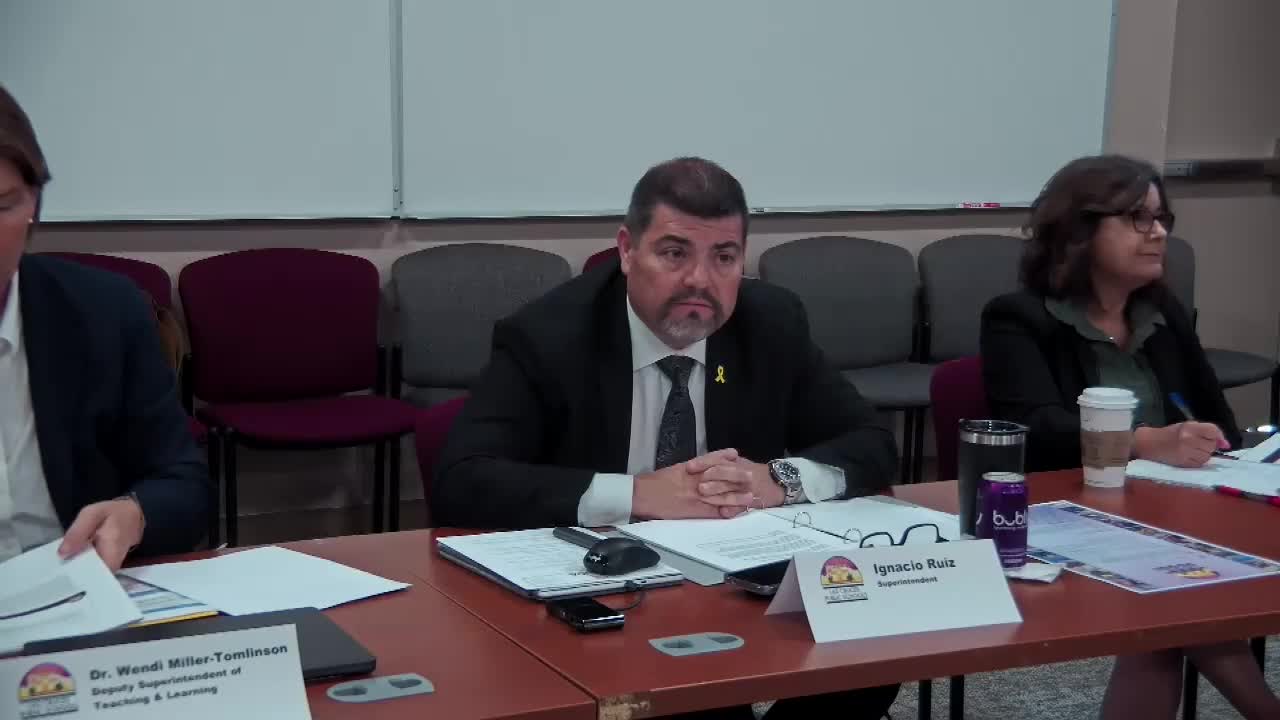
LAS CRUCES, N.M. — Las Cruces Public Schools Superintendent Ruiz and district leaders told the school board on Aug. 12 that the district has made measurable but incomplete progress in year one of a six-goal strategic plan focused on academic growth, student and staff well-being, safety and engagement.
LAS CRUCES, N.M. — Las Cruces Public Schools Superintendent Ruiz and district leaders told the school board on Aug. 12 that the district has made measurable but incomplete progress in year one of a six-goal strategic plan focused on academic growth, student and staff well-being, safety and engagement.
District officials front‑loaded the presentation with assessment results for literacy and mathematics, reporting that districtwide growth (as measured by the i-Ready short-cycle diagnostic) varied by grade band: elementary students showed the largest gains (59% showing "typical" growth from baseline to end-of-year in literacy), middle-school growth was more moderate and high school outcomes lagged in diagnostics compared with prior SAT-based summative results. Deputy Superintendent Wendy Miller Tomlinson said the board set a year-one target of 100% of students meeting their growth targets; leaders characterized that goal as intentionally ambitious and said the district is using the diagnostics to guide instruction rather than as standalone, high-stakes measures.
Why it matters: The metrics the district used measure "typical growth" (one year's expected progress) rather than any growth at all, officials said. That distinction explains why a student who improved but did not meet the typical growth target is counted differently in headline percentages. Board members pressed for disaggregated and cohort analyses (including how many students met stretch growth targets or partially bridged toward proficiency). Staff said those breakdowns exist and will be provided on request.
Key details from the presentation: - Literacy: Elementary diagnostic proficiency moved from about 20% to over 52% on interim measures; districtwide end-of-year literacy growth to typical targets was reported at 59% for elementary. Middle school and high school showed smaller gains on the diagnostics. District officials noted proficiency and diagnostic instruments differ and will not match one-to-one (for example, high school summative SAT results historically differ from i-Ready diagnostics). - Mathematics: Elementary diagnostics showed typical-growth gains to about 51% by end of year; middle-school and high-school diagnostic gains were smaller. Summative proficiency in mathematics remained lower than literacy in the most recent public summative data the district cited. - Instructional supports: The district described a year-long professional learning (PL) model built on teacher-facilitated cohorts (88 teacher facilitators each working with a cohort of 25–30 peers), priority standards, and proficiency scales. Teachers reported positive feedback on July 22 PL sessions; the district said facilitators were paid and had attended a three-day institute to prepare. - Curriculum and graduation pathways: Presenters described expanded work on capstone projects and alternative pathways, including use of capstones for credit recovery, original research, and community culmination of a program of study.
What the board asked for: Members requested more cohort and longitudinal cohort analyses, counts of students who met stretch growth or partial targets, and clearer links between diagnostic growth and summative proficiency. Staff said it can provide cohort-by-cohort comparisons and additional disaggregations (including Martinez-Yazzie student groups).
Ending: District leaders said the presentation represents first-year data and that the district will continue to refine how it reports growth (baseline definitions, cohort tracking, stretch goals) while expanding teacher supports so assessment data translate into classroom practice. The board did not change the instruction goals at the meeting but asked for additional detail in future reports.
Speakers: Superintendent Ruiz (Superintendent, Las Cruces Public Schools), Dr. Wendy Miller Tomlinson (Deputy Superintendent of Teaching and Learning), Stephanie Wyka (Everest Analytics, consultant), Teacher facilitators (unnamed), several board members including President Courtney, Vice President Nolan, Secretary Wofford, Member Frank, Member Tenorio.
Topics: instruction, assessments, professional learning, capstones