Get Full Government Meeting Transcripts, Videos, & Alerts Forever!
Get email alerts on the School Consolidation Feeder Patterns topic
No spam. Unsubscribe anytime.
Austin ISD trustees preview consolidation plan, ask staff to sharpen feeder‑pattern, enrollment and program guidance
Summary
Austin ISD trustees reviewed staff analysis of school utilization, feeder‑pattern splits and program placement at a lengthy Aug. 7 work session and directed staff to return with draft boundary and consolidation options tied explicitly to district goals and equity protections; no closures or boundary changes were approved at the meeting.
Austin Independent School District trustees spent a work session on Aug. 7 reviewing a district analysis of underused capacity, feeder‑pattern “splits,” and the timeline for a consolidation and boundary‑realignment process intended to shore up school resources and reduce the district’s structural budget shortfall.
Superintendent Segura told trustees the district is aiming to reduce costs and improve how resources are distributed across campuses so “every child gets what they need,” and said the work is intended to produce both operating savings and better alignment between programming and the district scorecard. "We are not able to do that. That's just the honest truth," Segura said of the district’s current ability to provide consistent services at every campus.
The board heard staff describe updated facility‑use calculations and a multi‑step schedule of deliverables. Staff said current systemwide utilization is about 75% for elementary schools, 69% for middle schools, 83% for high schools and 76% overall, and presented an 85–90% utilization range as the district’s target for a “stable” system. Staff said the measures reflect a refined methodology that accounts for special‑education seeding and building constraints. Trustees and staff discussed both program placement and whether some specialized programs should remain zone‑based or be reclassified as opt‑in choice programs.
Why it matters
Trustees and staff repeatedly framed the exercise as linked to student outcomes: trustees asked staff to tie consolidation proposals back to the district scorecard (early literacy, middle‑school algebra completion, college‑career‑military readiness and bilingual/dual‑language outcomes). Board members and consultants urged that the superintendent’s recommendations show how proposed consolidations and boundary changes will affect those measures and the students most often underserved.
What staff presented
- Timeline and deliverables: Staff said a rubric and scored list of every campus will be posted before the Aug. 14 board meeting; a draft consolidation and boundary package is planned for Oct. 9; October–November community engagement on transition plans; and a board vote on a recommended consolidation package currently targeted for Nov. 20. Staff also reminded trustees of a separate near‑term administrative timeline tied to an Aug. 18 bond sale and said the Aug. 14 information session will include a vote that helps permit the district to proceed with the bond timeline.
- Fiscal framing: Staff said the targeted savings from realignment would be “about $30,000,000” (staff phrased this as a target to help close a budget shortfall), and noted an earlier cited state “hold harmless” provision tied to Senate Bill 4 that staff said could save the district about $15,000,000 over time if the bond sale proceeds on the stated schedule. Segura and staff characterized some of that $15 million as a reimbursement realized over time, not immediate cash.
- Capacity and enrollment: Staff said the district currently has about 72,500 students in 116 campuses and noted historical changes in enrollment. Staff also reported that the district’s average in‑district transfer rate is approximately 25%, with some campuses seeing transfer rates far higher (staff said some campuses have transfer‑out rates as high as 70%).
- Feeder‑pattern analysis and examples: Staff walked trustees through maps and flowcharts showing many “splits” in feeder patterns (elementary→middle→high) and cited Martin Middle School and the Eastside feeder patterns as examples where students from a single middle school route to multiple high schools. Staff recommended trustees give the demographer target parameters — for example, maximum number of splits — so they can produce feasible boundary options.
Trustee questions and board direction
Trustees pressed for several types of guidance and clarified tradeoffs: whether the board wants strict numeric targets (for example, limiting how many different high schools a single middle school may feed into), whether small area splits below a defined minimum (staff mentioned roughly a 30% minimum as a useful “critical mass”) should be avoided, and how to treat island zones and anomalous boundaries. Trustees expressed broad support for improving feeder alignment and for asking staff to produce options tied to specific, achievable targets (trustees discussed aiming for a maximum of three feeder‑destinations for a middle school as an example target rather than an absolute rule).
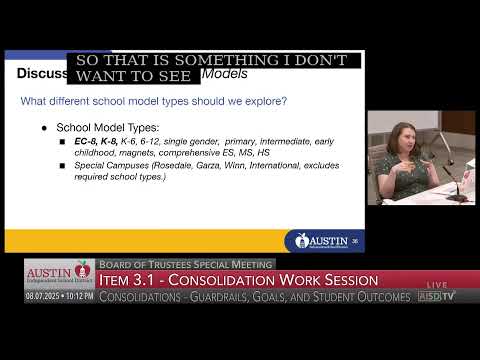
Trustees also asked for programmatic analysis: staff was asked to show where specialized programming (for example, dual‑language, early college high schools, CTE hubs, Montessori and other admission‑based programs) is located, how much each program costs and how easily it could be moved or replicated elsewhere. Trustees requested that staff explain whether programs continue to serve their original intent and whether moving a program would better serve district goals and equity priorities.
Equity and academic baseline
Trustees and staff repeatedly returned to a core question: what should every neighborhood school be able to guarantee for students? Multiple trustees said the board should adopt a clear baseline for campus staffing and services (for example, proven supports for early literacy and numeracy, counselor allocations, and tiered intervention staffing) so that communities understand what will remain at zone schools even as other specialized programs are restructured.
Special education and multilingual services were discussed as examples where some trustees asked the district to prioritize inclusive placement options and to ensure that dual‑language pathways and the Seal of Biliteracy remain continuous as students move through grades.
No final consolidation votes; next steps
No campus was named for closure and no boundary changes were voted on during the Aug. 7 session. Trustees provided staff with multiple requests for follow‑up information and analytical constraints the demographer and planning team should use when producing draft boundary options. Staff said they will return with scored campus lists and draft consolidation packages on the schedule above and with analyses that explicitly tie options to the district scorecard and to equity considerations.
Votes at a glance
- Motion to adjourn the special meeting (mover: Secretary Gonzales). Outcome: approved by the board; meeting adjourned at 10:15 p.m.
Ending
Trustees directed staff to bring more detailed analyses, including demographer runs tied to specific feeder‑pattern targets, clearer articulation of a baseline set of services for neighborhood schools, and program‑level cost and re‑start feasibility for specialized offerings. Staff and trustees agreed to continue community engagement on transition plans if boundary or consolidation recommendations proceed to the fall package.