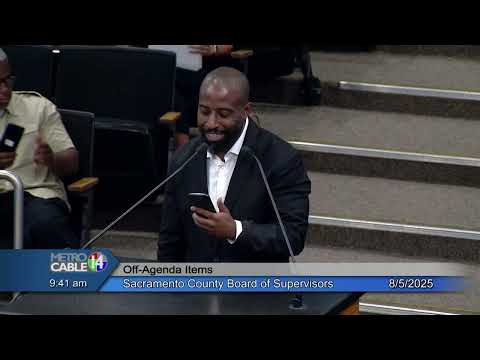
Public commentator says jail release practices fall short of sheriff's commitment
Summary
A public commenter presented a 24-hour count alleging that Sacramento County jail release practices do not match commitments from the sheriff's office about releases during business hours and access to post-release resources.
Barbara Ran, a volunteer with Decarcerate Sacramento, told the Sacramento County Board of Supervisors on Aug. 5 that a 24-hour count she and volunteers conducted found fewer than the sheriff's office–reported number of releases occurring during daytime business hours.
Ran said Decarcerate Sacramento observed 57.7 percent of jail releases between 6 a.m. and 5 p.m. during a midnight-to-midnight count; the sheriff's office has told community members that a higher share of releases occur during business hours. Ran also said only 27.5 percent of released people were allowed to make a free phone call as part of their release process and alleged phones taken from people were often not returned.
Ran said a large sign at the jail entrance indicates there is “no set time for releases,” and that the main jail schedules some inmate releases 24/7. She urged the sheriff to meet an earlier stated commitment that releases happen during business hours and to ensure released people receive promised resource guides, bus passes, phone charging and phone calls, and assistance from programs such as the Exodus Project.
The remarks came during the meeting’s off‑agenda public comment period. No county action or staff response to Ran’s specific claims was recorded in the transcript during the meeting.
Ran identified two county staffers, Eric Jones and Laura Foster, as having written that “100% of people released should be between hours, business hours of 6AM to 5PM.” Ran reported that the records she received were not public and that the only way to independently verify the sheriff’s numbers was the 24‑hour count she described.
The board did not take formal action on Ran’s statements during the meeting. The Brown Act and the board’s public comment procedures were noted at the meeting start; those rules limit the board’s ability to discuss off‑agenda items at length, and Ran’s remarks were recorded as public comment rather than a staff report or an item requiring board action.
Ran’s comments and the dataset she referenced may be useful to the board or staff if they request or receive a formal audit or staff report from the sheriff’s office addressing release scheduling and distribution of post‑release resources.
AI generated
The text on this page is AI generated. Summaries, highlights, analysis, and video transcripts are all produced from the original source material.
AI can make mistakes, so if you spot one, and we will fix it for everyone.
Note: the source content is unaltered by us. Any content source we link to, be it a video, an audio recording, or a document, is presented exactly as its publisher released it. That publisher is usually a government body, sometimes an individual official or another organisation.