Get Full Government Meeting Transcripts, Videos, & Alerts Forever!
Get email alerts on the Food Safety Eggs topic
No spam. Unsubscribe anytime.
DATCP opens scope-statement review of ATCP 88 egg rules; stakeholders press for clarity on 150- and 3,000-bird thresholds and traceability
Summary
Wisconsin Department of Agriculture, Trade and Consumer Protection staff opened a scope-statement meeting on revisions to ATCP 88 (eggs), discussing licensing and registration exemptions at 150 birds, federal ties at 3,000 birds, nest-run producer registration, facility standards, labeling, and recall/traceability gaps raised by health officials.
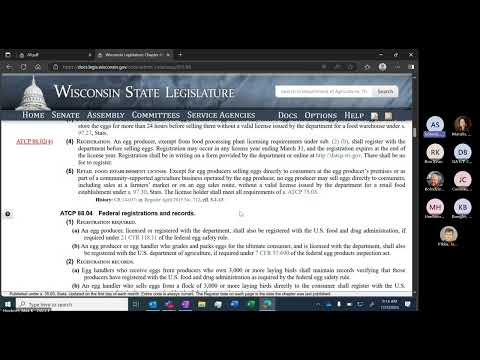
Max Huebner, program and policy analyst with the dairy program at the Department of Agriculture, Trade and Consumer Protection, opened a virtual meeting on the department’s planned scope statement for revising ATCP 88, the state egg-handling chapter. "My name is Max Huebner. I'm the program and policy analyst with the dairy program," he said, and he explained the meeting would collect problems with the current rule rather than propose final regulatory language.
The scope-statement meeting focused on whether to open multiple portions of ATCP 88 for revision and on specific points that stakeholders flagged as unclear or out of date. The most discussed items were (1) the 150-laying-bird threshold that affects state licensing and retail exemptions, (2) the federal 3,000-layer threshold that affects FDA oversight and testing, and (3) traceability and recall requirements raised by public-health staff.
Why it matters: changes to ATCP 88 would affect small producers who sell at farmers markets and direct to consumers, grading and processing facilities, and public-health outbreak investigations. Several public-health speakers urged the department to maintain or strengthen traceability and recall provisions so investigators can identify sources quickly during salmonella or other eggborne outbreaks.
Licensing and the 150-layer exemption
Staff outlined that ATCP 88.022 currently exempts producers with 150 or fewer laying birds from a food processing license, while those selling at retail sites may still require a retail food establishment license or a transient license for farmers markets. Stakeholders asked whether the 150-bird threshold remains practical and how it interacts with other code sections referenced in ATCP 88, including ATCP 75.03 and ATCP 97.3.
A DATCP staff member, Alex, said the department can open the licensing and registration sections broadly in the scope statement to clarify or revise exemptions and cross-references. Participants noted the exemption means many small producers operate without the same testing or licensing obligations as larger producers.
Federal oversight and the 3,000-layer threshold
Participants raised the separate federal threshold for registration and testing. Alex and others explained that facilities with 3,000 or more laying birds are generally subject to FDA oversight under the egg rule, while the state does not hold a contract with FDA to conduct those inspections. Karen Bigler, an enteric epidemiologist with the Department of Health Services, asked: "Are there any requirements, in this language about traceability?" and said traceability gaps complicated a recent egg outbreak investigation. DATCP staff noted FDA has been expanding risk-based attention to some farms under 3,000 layers and that federal rules may change over time.
Stakeholders, including public-health staff, expressed concern that testing thresholds based on flock size leave many smaller producers outside routine surveillance. One participant said food safety "doesn't start at 150," a point echoed by others who called for better monitoring, clearer labeling, or consumer-facing information for eggs from producers that are not part of a testing program.
Nest-run producers and registration
The meeting addressed ATCP 88.204, the registration requirement for nest-run producers who ship unprocessed eggs to grading stations. Staff described the current registration as annual and largely enforced on an honor system; attendees proposed exploring ways to improve the registry, such as working from grading-station records, to get a more complete list of nest-run producers.
Facility, equipment and handling standards
DATCP staff reviewed several sections the department expects to open or examine, including construction and maintenance of egg-handling facilities (ATCP 88.06), equipment and utensil standards (88.12), cleaning and sanitizing (88.14), egg-handling rooms (88.08), temperature standards (88.18), and egg cleaning and storage operations (88.20). Participants raised specific suggestions: clarify drain-board or non–hand‑operated faucet requirements for producers with particular practices, better describe ambient‑temperature requirements for eggs, and confirm whether temperature logs or other recordkeeping for holding temperatures should be required. Staff said the code currently includes time limits for refrigeration but not a general temperature log requirement.
Grading, packing, labeling, special products
The department noted its grading standards reference USDA tables for chicken eggs and that the rule mainly addresses chicken eggs; producers and staff asked for explicit handling for non‑chicken eggs (quail, turkey, goose) that are often marketed as "ungraded." The packet also includes labeling and packing rules (sell-by/use-by statements, safe-handling language, exemptions for sales directly to consumers or handlers) and a short, state‑unique section on balut (incubated fertile eggs). Alex noted Wisconsin appears to be among the few states with a specific rule for balut and suggested its placement or necessity could be reconsidered in a revision. Another brief topic was the eggshell oil provision, which some attendees said appears dated and might be consolidated with general "safe and suitable compounds" language or removed.
Traceability, recall plans and recordkeeping
Public-health staff emphasized recall-plan and traceability language. Jen Como from the Department of Health Services urged the department to preserve or strengthen provisions that support outbreak investigations: "When going back and doing a investigation on an outbreak, maybe looking at this section to ensure safety and how to, follow the eggs that are sold back to certain individuals. That should be reviewed if this section is going to be either updated or removed." DATCP said ATCP 88 includes a recall‑plan requirement (88.42) that lists points of contact and procedures for tracking egg lots; staff indicated that traceability and recordkeeping (receipts for dealers buying from producers) will be reviewed and that any changes should not hinder outbreak investigations.
Next steps and process
Huebner said the department will draft a scope statement for secretary’s office approval; once approved the department will hold rule‑revision meetings (in person and virtual) to consider specific language changes. He told participants they could submit additional comments by email and that opening a section in the scope statement does not require the department to change that language, only to review it. Staff noted some references (e.g., ATCP 70, DNR NR rules, and federal CFR citations) will need updating to match current cross‑references.
What the meeting did not decide
The session was a scoping and information‑gathering meeting; no final rule revisions, motions, or votes were taken. Staff repeatedly noted the scope statement must list problems with the rule rather than draft replacement language; detailed drafting will follow after scope approval.
Closing
Huebner said the scope‑statement approval process will take a number of months and announced the department will schedule further stakeholder sessions if the scope statement is approved. He asked participants to watch for posted meeting notices and said materials and recordings would be made available on the DATCP website once posted.