Get Full Government Meeting Transcripts, Videos, & Alerts Forever!
Get email alerts on the State Legislation Housing topic
No spam. Unsubscribe anytime.
Work session: town staff outlines recent state housing legislation and explains Ag‑to‑Urban groundwater program
Summary
Staff briefed the commission on a set of recently signed and failed state housing bills and on Senate Bill 1611 (the Ag‑to‑Urban program), which creates a program to convert irrigation rights into groundwater savings credits that can be used for housing development.
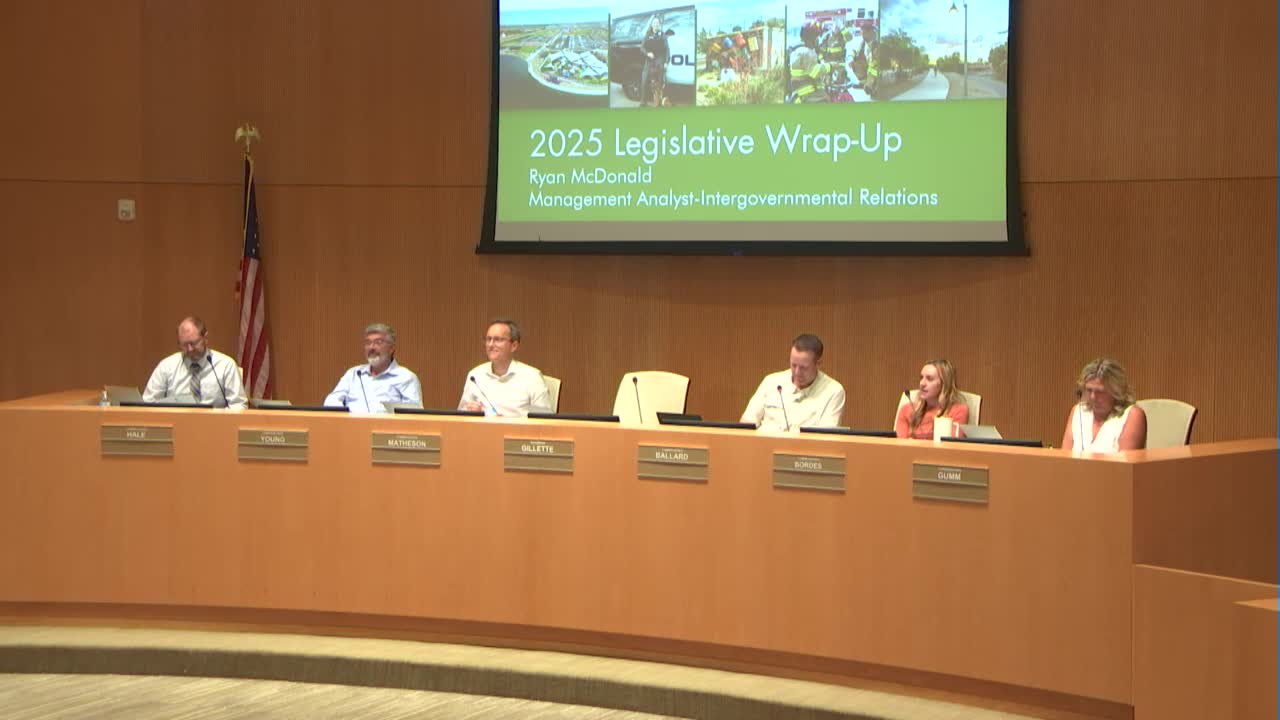
At a Queen Creek Planning and Zoning Commission work session (date not specified), staff briefed commissioners on state housing legislation from the recent legislative session, the town’s formal tracking of bills, and next steps for local implementation.
Ryan (presenting) summarized several bills the town tracked. He described bills that failed and those that passed. Among the passed measures staff highlighted were Senate Bill 2447, which requires municipalities to adopt ordinances allowing administrative review (without a public hearing) of certain site plans and plat amendments; Senate Bill 1353, which requires the town to maintain a list of third‑party reviewers for single‑family building permit reviews if staff does not act within specified timeframes; and “SB 15 29,” which will require municipalities to establish preapproved housing design plans for single‑family homes and ADUs by specified implementation dates.
Ryan described Senate Bill 1611 (ag‑to‑urban) as a key measure for Queen Creek. “Senate Bill 16 11 allows a program for owners of irrigation rights to voluntary relinquish these rights in exchange for groundwater savings credits,” he said. Under the program, properties that participate would receive 1.5 credits per acre converted; the credits can be used to support housing. Ryan said program implementation by the Arizona Department of Water Resources will take time (staff estimated 24–36 months), and that credits are initially available for five years with extensions if the town becomes a designated water provider. Staff displayed a map of parcels the program could unlock and said the program is designed to reduce overall water use compared with continued agricultural irrigation.
Ryan also reviewed ADU‑related and municipal zoning bills: House Bill 2928 (ADU clarifications and deadlines), and House Bill 2721, which requires cities to allow duplexes, triplexes, fourplexes and townhomes on lots zoned single‑family within one mile of a central business district and on 20% of new developments larger than 10 contiguous acres, among other requirements. He said SB 1529 (preapproved plan procurement) and other bills create specific procurement and implementation tasks the town will need to complete and that staff will return with text amendments and implementation steps for commission and council consideration.
Ryan outlined next steps including procuring the preapproved house designs required by SB 15 29, preparing text amendments to comply with the new laws, and running the Ag‑to‑Urban application process once ADWR completes program rules. He said timelines vary: some compliance items are due in 2026 and others extend into 2027 or later. Commissioners asked clarifying questions about how the preapproved plans apply to different zoning districts and about assumptions in the ag‑to‑urban water‑savings calculations; staff responded that preapproved plans are intended to be available across single‑family zoning if the plan fits the lot and that ADWR will determine conversion specifics.