Get Full Government Meeting Transcripts, Videos, & Alerts Forever!
Get email alerts on the Budget Utility Rates topic
No spam. Unsubscribe anytime.
Council hears FY26 budget options: 6% COLA favored; utility-rate increases proposed to fund $365M CIP
Summary
Finance staff presented two personnel-cost scenarios (6% COLA vs. 5.5% merit + 3% COLA) and a utility-rate model tied to a $365 million five-year CIP. Council members indicated early support for a 6% across-the-board COLA and requested further review of step/merit schedules for public safety.
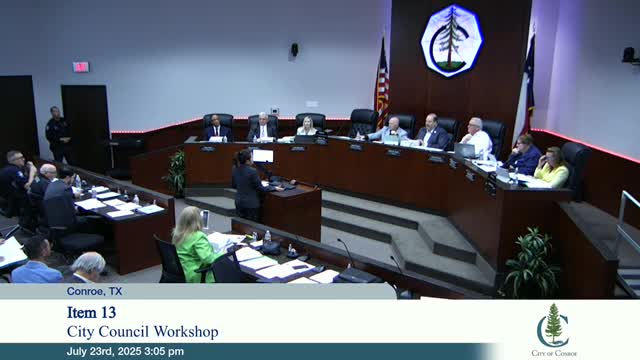
City finance staff presented updated FY26 budget scenarios and a multi-year utility-rate model to the Conroe City Council on July 23, including two personnel compensation options and a proposed multi-year schedule of water and sewer rate increases to finance a five-year capital-improvement program.
Personnel options: Director of Finance (Ms. Gibbs) presented two personnel scenarios. Option 1: a 6% cost-of-living adjustment (COLA) across the board, estimated to cost about $3.8 million. Option 2: a hybrid plan with up to 5.5% merit increases for non-civil-service employees plus a 3% COLA (civil service employees would receive step increases), estimated at roughly $4.0 million in additional personnel costs. Several council members signaled preliminary support for option 1 (6% COLA) as a broad-based approach to retain and recruit employees, while reserving additional step/merit work for a later review.
Utility rates and CIP funding: NewGen Strategies and Solutions presented a utility-rate model tied to a $365 million water-and-sewer capital improvement program (CIP). The study estimated the net revenue requirement from rates at roughly $53.5 million for FY26, with projected annual debt-service requirements of about $27.5 million in FY26 rising to approximately $57.3 million by 2030 under the current CIP funding assumptions. The consultant proposed a modest rate increase in FY26 (about 3'2/3.5% for residential and a larger percentage for commercial customers), with incremental increases through 2030 to fund the CIP and preserve reserve targets.
Impact on typical bills: Under the model and accounting for an estimated reduction in an SJRA pass-through fee, a typical 5,000-gallon residential bill would rise from about $89.11 to roughly $91.31 (net of the projected pass-through decrease). Commercial customers with higher usage would see larger dollar impacts under the consultant's scenario.
Council discussion and direction: Council members stressed a desire to be equitable across employee groups and to protect recruitment and retention. Several members endorsed the 6% COLA as an immediate measure and asked staff to revisit merit/step schedules, particularly for fire and police, for later action. Staff recommended setting a public hearing on the FY26 operating budget for August 28 at 9:30 a.m.; the council accepted the hearing date as the next step.
Ending: Staff will return with recommended budget ordinances and the council-directed refinements; no final budget vote occurred July 23.