Get Full Government Meeting Transcripts, Videos, & Alerts Forever!
Get email alerts on the Child Welfare topic
No spam. Unsubscribe anytime.
Subcommittee reviews audit finding 150 child deaths were not evaluated by MDHHS Office of Family Advocate
Summary
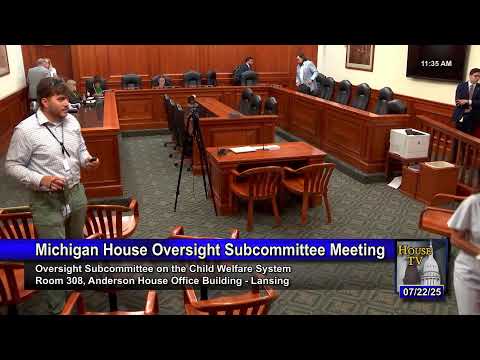
The Michigan House Oversight Subcommittee on Child Welfare heard testimony about an Office of Auditor General performance audit, issued April 10, 2025, that found the Michigan Department of Health and Human Services' Office of Family Advocate (OFA) excluded 150 child death notifications from its Safe Systems review evaluation process and paused public reporting of the Child Fatality Registry.
The Michigan House Oversight Subcommittee on Child Welfare heard testimony about an Office of Auditor General performance audit, issued April 10, 2025, that found the Michigan Department of Health and Human Services''s Office of Family Advocate (OFA) excluded 150 child death notifications from its Safe Systems review evaluation process and did not complete Safe Systems reviews for a substantial number of deaths that met the review criteria.
The audit, which covered Jan. 1, 2023, through June 30, 2024, concluded OFA's efforts "were sufficient with exceptions," said Ivy Jaroche, audit manager for performance audits of MDHHS at the Office of Auditor General. The report identified a material finding that OFA needed to improve its Safe Systems review process and a second material finding about validation and error correction for MDHHS's publicly reported Child Fatality Registry information.
Why it matters: Safe Systems reviews (SSR) are retrospective, system-focused examinations of child deaths designed to identify systemic barriers and recommend policy or practice changes. The audit said OFA did not consistently evaluate all child death notifications that met SSR criteria, collected inaccurate data for some reviews, and did not always distribute its 2022 Safe Systems Review annual report to all internal MDHHS offices with responsibilities related to the report''a lapse the auditors characterized as a material condition.
What the audit found
- OFA excluded 150 child deaths from its SSR evaluation process during the audit period and did not complete SSRs for a significant portion of deaths that auditors said met SSR criteria. Auditors reported that OFA selected 35 child death notifications for SSRs rather than reviewing all 143 death notifications that auditors identified as meeting SSR criteria for that period. The audit referenced inaccuracies in OFA''s data used for its annual SSR report: 6 of 21 selected SSRs contained inaccurate information on items such as gender, cause of death, and scoring for quality-improvement needs.
- OFA approved its 2022 Safe Systems Review annual report for distribution in May 2024; the audit found OFA provided the final report or high-level recommendations to some MDHHS child-welfare areas in July and November 2024 but had not distributed the report to the Children's Services Agency Out-of-Home Services Bureau management or Business Service Center directors despite recommendations affecting those areas.
- OFA identified discrepancies in the MISACWIS/mySACWIS queries used to populate the public Child Fatality Registry''including duplicated records and erroneous dates''and temporarily paused public registry reporting while validating the data. As of December 2024, auditors said historical registry information that contained identified discrepancies had not been updated.
MDHHS response and corrective measures
Demetrius Starling, deputy director and Children's Services administrator at MDHHS, told the subcommittee that OFA is an internal component of the Children's Services Administration and is part of the agency's Continuous Quality Improvement framework. He emphasized that Safe Systems reviews are not CPS investigations and described SSRs as "retrospective reviews" that start at least 90 days after a death and aim to identify systemic improvement opportunities.
Starling said the 150 cases auditors identified were notified to OFA via vital records (the Electronic Death Registration System) and were not first reported to MDHHS's centralized intake unit; he said OFA verified that none of those deaths were the result of suspected child abuse or neglect. "I wanted to be clear that this does not mean that any allegations of child abuse or neglect were not investigated by CPS," Starling said, adding that CPS investigations had occurred where appropriate.
MDHHS told the committee it has taken steps to correct the problems auditors identified. Starling said OFA modified mySACWIS query language, enhanced data validation, resumed weekly/monthly validation and reporting, updated the public website for statutory compliance, and enacted procedures to ensure annual reporting is completed and distributed internally. He told lawmakers that OFA had resumed public Child Fatality Registry reporting in January 2025 after improvements to validation and error correction, and that MDHHS had submitted a final corrective action plan to the State Budget Office; acceptance by the State Budget Office remained pending at the time of the hearing.
Quotes from the hearing
"For this objective, we concluded OFA's efforts were sufficient with exceptions," Ivy Jaroche said, summarizing the Office of Auditor General's overall conclusions. Starling described SSRs and the department's approach: "The Safe Systems review is not an investigation into a child death or any type of child abuse or neglect ... It is a retrospective, systemic review."
Questions from lawmakers
Committee members pressed auditors and MDHHS on the numbers and the public availability of information. Representatives asked whether the 150 deaths had been investigated; MDHHS said CPS had investigated the deaths where appropriate and that the SSR is a separate, qualitative tool designed to identify systemwide improvements rather than to replace CPS or coroner investigations. Lawmakers also pressed for improved public messaging and clearer delineation of responsibilities among CPS, OFA, and the independent Office of Child Advocate.
Formal action taken
At the start of the hearing Representative Regis moved to approve the minutes of the 24th meeting/hearing; the motion was approved without objection.
What comes next
Auditors said they typically follow up on material findings within 12 to 18 months, subject to office resources and agency timelines in corrective action plans. MDHHS told the committee it has implemented multiple corrective steps, including updated queries, increased validation cadence, changes to SSR protocol and sampling methodology, and improved information sharing within the department. Lawmakers requested additional data on the cases cited in the audit and asked the department to clarify public-facing materials so the public and local offices better understand the differences between SSRs, CPS investigations and the Office of Child Advocate's role.
The committee adjourned after closing remarks about the subcommittee's oversight duties.