Get Full Government Meeting Transcripts, Videos, & Alerts Forever!
Get email alerts on the Municipal Finance topic
No spam. Unsubscribe anytime.
Enid commission approves loan pledge for Ames waterline, adopts flood-code change and clears transit grant applications; several other votes pass
Summary
The Enid City Commission approved a series of resolutions and appointments, including a pledge of sales-tax-backed revenues to secure up to $10.745 million in financing for the Ames waterline project, a change to the municipal flood code, appointments to a local enforcement board, and multiple transit grant applications.
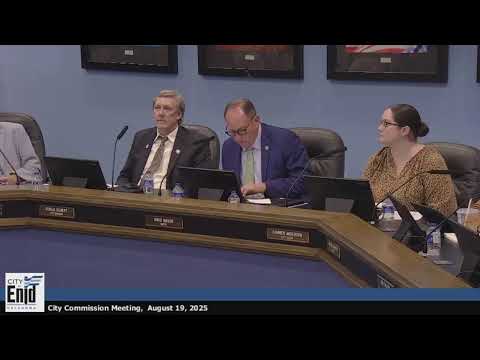
The Enid City Commission on Aug. 19 approved multiple measures to advance a long‑planned waterline project, strengthen flood‑damage rules, and pursue federal and state transit grants.
Commissioners voted to authorize the city’s participation in a financing package to complete the Ames waterline project by pledging a portion of sales tax and utility revenues to secure a promissory note. The city said it has secured approximately $10 million from the Oklahoma Department of Commerce via a P3 program and $4 million in congressional funding, but needs matching and closing funds to finish the project. The commission approved a resolution to move forward with the financing and then approved an emergency declaration to make the resolution effective immediately; both measures passed by 6‑1. A companion resolution by the Enid Municipal Authority to authorize a promissory note “not to exceed $10,745,000” also passed 6‑1.
John Wolf, municipal financial advisor, explained the city’s repayment capacity to the commission, saying the city’s projected revenues would provide roughly twice the coverage required by lenders. "Adding this piece of debt in, you are still at 200% times the coverage necessary," Wolf said, describing the debt‑coverage analysis used by lenders and the Oklahoma Water Resources Board.
Separately, the commission unanimously (7‑0) adopted an amendment to Title 13, Chapter 1, Section 13‑1‑6 of the municipal code to clarify that electrical, heating, ventilation, plumbing equipment and service facilities must be located at least 1 foot above base flood elevation for affected projects. Commissioners and staff clarified that the provision applies to new construction and to substantial improvements (the ordinance references a 50% threshold for value/reconstruction before upgrades are required).
The commission also appointed Don Rose to the Environmental Enforcement Board. The appointment was decided by votes recorded for the candidates (five votes for Rose, two for another applicant), and Rose was confirmed.
Enid Public Transportation Authority and city staff secured several routine grant approvals. The commission authorized staff to submit an Oklahoma Department of Transportation Public Transit Revolving Fund application (roughly $100,000), a Federal Transit Administration (FTA) 5307 formula grant application (the commission was advised the city’s split letter estimated $999,000), and an FTA 5339 capital grant application to purchase vehicles. All transit‑related resolutions passed unanimously (7‑0).
Other routine business cleared the agenda: approval of minutes, consent items, and claims including a $367,042.16 claims docket and a separate claim docket of $574.61 (all passed 7‑0). The commission recessed and reconvened for related municipal authority and transportation authority items as part of the meeting sequence.
During public comment, four residents urged stronger enforcement of animal‑welfare ordinances, saying the shelter should not release animals unless they are spayed or neutered and that enforcement and intake vaccination protocols need attention.
The commission’s votes will allow staff to finalize loan documents, proceed with grant applications, and implement the updated flood standard; many of the actions are contingent on external approvals and loan closings before funding is available.