Get Full Government Meeting Transcripts, Videos, & Alerts Forever!
Get email alerts on the Land Development Ordinance topic
No spam. Unsubscribe anytime.
Eau Claire council hears package of Century Code amendments and fee proposals, public hearings set stage for vote
Summary
City staff presented a package of Land Development Ordinance (LDO) updates, cross‑code cleanups and a proposed 2025 fee schedule that includes a $100-per-inch tree fee-in-lieu and a statutorily required park impact fee assessment; planning commission recommended approval and council is expected to consider final action at its next meeting.
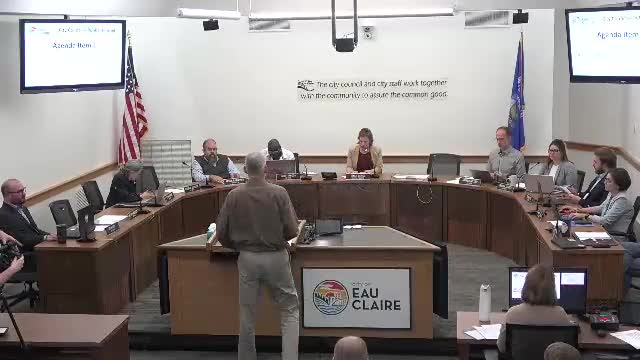
City of Eau Claire staff presented public hearings Monday on a multi-part Century Code update that would replace and align the city’s land development rules and update related city code and fee schedules, including a proposed $100-per-inch fee in lieu for high‑value tree preservation and a new park impact fee assessment authorized by state law.
The package, presented by planning staff (Noel), included revisions to Title 17 (the Land Development Ordinance or LDO), cross‑references and repeals in Titles 5, 14, 16 and 19 to reflect the LDO, and proposed changes to the city’s 2025 schedule of fees and licenses. Planning commission members recommended approval of the LDO edits and related cleanup items.
The amendments refine multiple land‑use sections: they clarify rules for plan unit developments and confirm vested rights while requiring amendments to move projects toward compliance with the new code; they add explicit language for residential accessory structures and caps on detached garages (no larger than 1,500 square feet in the revised language); they reinstate a flag‑lot provision in the subdivision chapter copied from current code; and they incorporate DNR‑requested clarifications to lowest‑floor floodplain standards so that non‑habitable lowest floors (for example parking under a building) are treated consistently with redevelopment needs downtown. Noel said the city has prepared manuals, checklists and an updated online portal to reduce confusion for applicants; those materials are scheduled to go live Oct. 1.
On fees, staff proposed a $100-per-inch tree preservation fee‑in‑lieu for projects that cannot meet on‑site requirements. Noel said one‑ and two‑unit existing homes remain exempt. The city would hold collected fees in a separate fund and direct forestry staff to replant trees on public property or in parks near where removals occurred. “We walked that back to $100 per inch,” Noel said, describing the compromise after outreach with developers and consultants.
City Attorney Nick clarified the legal posture for the park impact fee: state law requires a statutory assessment to support an impact fee that reflects new demand on park systems. The city’s consultant and staff produced a statutory impact fee study that identifies a maximum supported fee; as Nick explained, the council may set any fee up to that maximum but cannot exceed it because the charge must remain a user fee rather than a tax. Nick noted the analysis produced a per‑unit upper bound (presented in the staff materials) that the council can reduce as a policy decision.
Speakers from the development community urged caution on fee levels. Pat Smith, owner of Oak Corner Insulation and government affairs chair for the Chippewa Valley Home Builders Association, asked council to adopt the lower recommended fees, saying higher fees add to development costs that are ultimately passed to buyers and renters; he supplied project‑level impact estimates from the study (for example, the Cannery Apartments scenario at the 100% level in the study would add substantial costs to that project). Christina Thrun (Chippewa Valley Home Builders Association) and Ian Gager (Realtors Association of Northwest Wisconsin) also urged keeping fees low to protect housing affordability. Scott Rogers (Eau Claire Area Chamber of Commerce) encouraged monitoring and adjusting the code after implementation to ensure it meets affordability and supply goals.
No formal votes were taken at the Monday hearing; staff flagged several calendar items for next steps. Noel said the LDO materials, the online manual and the permit portal will go live Oct. 1, and the fee schedule language would carry an effective date timed with the city’s budget calendar (staff recommended insertion of an effective date in November so the schedule would apply into 2026). The planning commission’s recommendation and the statutory impact fee study are now before council; council members may propose amendments when the ordinance and fee schedule return for formal action at the next meeting.
Background: the Century Code project consolidated and modernized multiple land‑use and development regulations and followed a multi‑year review by staff, consultants and the planning commission. The public hearings Monday focused on cleanup, clarity and the financial tools (tree fee and park impact fee) the city can use to implement code goals without shifting maintenance obligations to the impact fee fund.
Looking ahead, council will vote on the ordinance and fee schedule at its next scheduled meeting; until then, staff will finalize the manuals and answer outstanding questions asked during Monday’s hearings.