Get Full Government Meeting Transcripts, Videos, & Alerts Forever!
Get email alerts on the Regional Sewer District Marshall County topic
No spam. Unsubscribe anytime.
Marshall County leaders, residents spar over regional sewer district costs, oversight and health risks
Summary
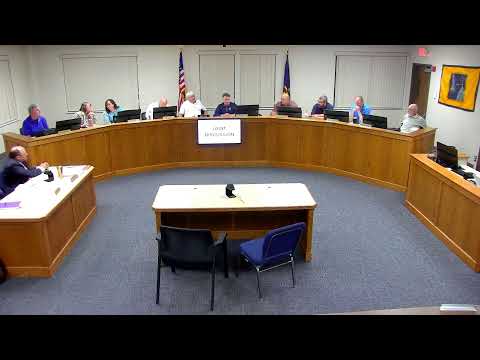
Marshall County elected officials, public-health staff and residents met in a special work session to debate the Marshall County Regional Sewer District, its projected household rates and the district’s governance after years of study and months of public opposition.
Marshall County elected officials, public-health staff and residents met in a special work session to debate the Marshall County Regional Sewer District, its projected household rates and the district’s governance after years of study and months of public opposition.
The session focused on three linked questions: how large monthly sewer bills could rise for lake-area households, whether the district followed a transparent process when it was created, and what alternatives the health department can offer for failing septic systems. "We are here today because a large growing number of Marshall County residents have become concerned with the Sewer Project around the lakes," County Council member Greg Compton said during opening remarks.
Why it matters
Speakers said the district’s estimated customer charge has risen sharply since initial public presentations. Officials also described a pending lawsuit over appointment and removal authority for the district’s trustees, and health officials warned about water-quality risks tied to failing septic systems and pharmaceuticals in private wells.
Most important details
- Origin and timeline: County documents and speakers said Marshall County began formal work on watershed concerns after a Soil and Water study and a Clean Water Task Force. The county’s joint resolution to petition the Indiana Department of Environmental Management (IDEM) to form the Marshall County Regional Sewer District was approved in March 2022; IDEM issued an order creating the district in December 2022.
- Rate estimates and money already spent: Presentations to elected bodies initially cited $75–$85 per month as an estimated household fee. A later financial-advisor estimate disclosed to officials placed a maximum scenario at $208.27 per month; a March 2025 rate study cited a worst‑case $229.08 scenario. Commissioners and council members said they were not shown the higher estimate before the vote to petition IDEM. County councilor Jesse Bohannon summarized local federal relief history and said, "the federal government required the county to come up with a plan for how to disperse our roughly $9,000,000 in American rescue plan funds." Commissioners also said the council refused a recommended $2,000,000 appropriation in 2022 and later set aside $500,000 to assist low‑income residents with hookup costs.
- District spending and borrowing: County officials and a councilor reported invoices and consultant fees for the sewer board totaling about $1,149,064.86 through May (documents provided to the council). The sewer board sold a $3,075,000 bond‑anticipation note to a local bank; officials said that note will need payoff or refinancing (a bond closing) by 2027 unless other arrangements are made.
- Governance and litigation: Commissioners said their petition to IDEM gave appointing authorities control over vacancies on the district board and that they adopted a home‑rule ordinance reaffirming that appointees serve at the pleasure of the appointors. After commissioners declared the seat of trustee Thomas McFadden vacant and appointed Bill (or "Woodward" as stated at the meeting) to fill it, McFadden objected and litigation was filed in Elkhart Superior Court. County counsel reported a motion to dismiss is scheduled for hearing Oct. 10.
- Public‑health context and alternatives: Marshall County Health Officer Barbara Hallam and Alice Quinn of the Indiana State Department of Health described documented septic failures and a class of problematic "dry well" systems and emphasized risks to private wells. Quinn explained how pharmaceuticals appear in groundwater, saying in the meeting that "some of it is excreted... and if the effluent is not properly handled... it goes down and penetrates into the aquifer." Health staff described state rules that allow "best judgment" repairs, advanced on‑site systems and permanent holding tanks in some cases, but they cautioned about long‑term operational costs for holding tanks and maintenance requirements for advanced systems.
- Alternatives and vendor testimony: Vendors and consultants described advanced on‑site aerobic systems and clustering/shared systems as alternatives when soils allow. AK Industries’ representative explained their aerobic units and maintenance needs, and engineers repeated that many property‑by‑property constraints (lot size, soils, separation distances) determine whether a replacement septic or alternative system will work.
Public reaction and next steps
Residents at the meeting described large petition drives opposed to the district in parts of the service area, and speakers urged stronger transparency and outreach. County officials said the commission will consider a resolution asking IDEM to dissolve the district and that commissioners could provide funding to retire the district’s short‑term borrowing if dissolution is pursued. Commissioners also noted upcoming board appointments and said those appointments offer another point of accountability.
Quotes from the meeting
- "We are here today because a large growing number of Marshall County residents have become concerned with the Sewer Project around the lakes," Greg Compton, County Council member.
- "The federal government required the county to come up with a plan for how to disperse our roughly $9,000,000 in American rescue plan funds," Commissioner Jesse Bohannon.
- "That list... was not for a grant. That was for an SRF loan," Nicole Cox, County Council member, distinguishing loan programs from grants.
- "One of the major concerns I, as a health department, have... is our well system," Barbara Hallam, Marshall County Health Officer.
- "...if the effluent is not properly handled... then it goes down and penetrates into the aquifer and comes back up," Alice Quinn, Indiana State Department of Health.
- "I think the overall, I think the county made the right decision to initiate the district and get it going," Ken Jones Sr., citizen who helped organize earlier efforts in favor of the district.
- "I think it's a little disingenuous for there to be comments about the transparency of the district. The district has always been transparent," Christopher, speaking for the Marshall County Regional Sewer District.
What officials said they may do next
Commissioners said they will consider a formal petition to IDEM asking it to dissolve the district; that petition would be based on Indiana code language allowing IDEM to dissolve a district that the department "determines... is not economically feasible, fair, or reasonable." Commissioners also described the ongoing lawsuit over trustee removal and said the court will decide whether previously appointed trustees served for fixed terms or at the appointing authority’s pleasure.
Documents and clarifications requested at the meeting
Officials and members of the public asked for clearer, itemized accounting of the sewer board’s invoices, copies of financial‑adviser rate studies and a more complete list of properties whose septic systems are documented as failing. Health staff agreed to provide additional detail about local well testing and the county’s sanitary code and to confirm the county’s local ordinance status with the state technical review panel.
The work session produced no formal votes to approve or reject the sewer project; instead it produced a proposal from the commissioners to petition IDEM to dissolve the district and confirmed that litigation over board membership is pending in Elkhart Superior Court. The county and district also face a financial choice about how to manage the district’s existing short‑term borrowing if construction does not proceed.
—Reporting by the Marshall County Board of Commissioners work session