Get Full Government Meeting Transcripts, Videos, & Alerts Forever!
Get email alerts on the Remote Participation Policy topic
No spam. Unsubscribe anytime.
Pompano Beach commission denies remote participation request after debate over policy and privacy
Summary
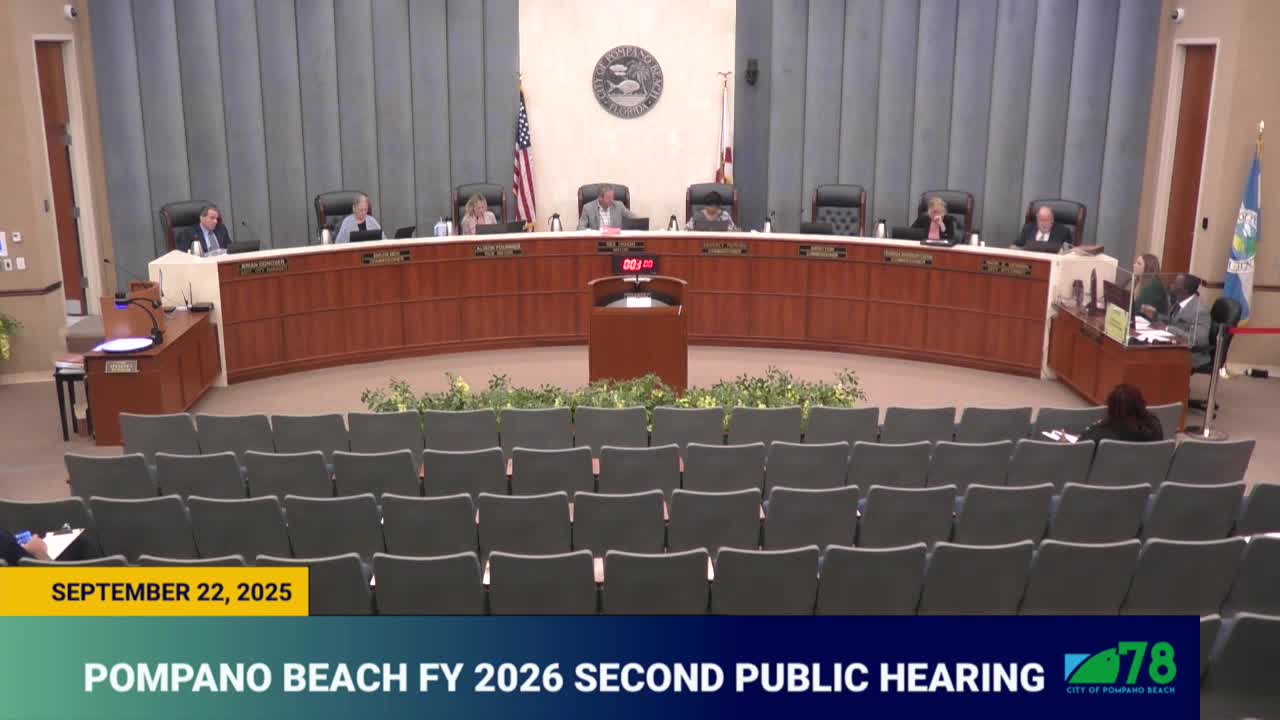
The Pompano Beach City Commission voted on Sept. 22 to deny a request from a commissioner to participate remotely, after city attorney explained the city's standard for remote participation and several commissioners expressed concern about precedent and privacy.
The Pompano Beach City Commission voted on Sept. 22 to deny a commissioner's request to participate remotely at the meeting, after an extended discussion about the city's remote-participation policy and whether the candidate's stated reason met the standard for 'extraordinary circumstances.
City Attorney Berman read the city's electronic-participation policy aloud and said it permits remote participation only when the absence is 'for physical disability such as medical treatment or other similar extraordinary circumstance as determined by the city commission' and when a physical quorum is present. Berman referenced an attorney general opinion in explaining the standard.
Several commissioners said they respected privacy and would not press for personal details, while others said scheduled meetings should normally require in-person attendance and that the commission should not create a precedent that would allow routine remote participation for non-emergency absences.
Vice Mayor Fournier made the motion to allow the commissioner to participate remotely and the motion was seconded. Commissioner Smith asked, "What is the, extraordinary circumstance that, commissioner Fessett can't attend?" City Attorney Berman replied that the request before the commission was an email from the commissioner and that the petition did not include further details; he reiterated the policy's criteria and that the commission itself determines whether the circumstance qualifies.
Commissioners recounted past instances of remote participation in personal or medical emergencies. Commissioner Perkins described a prior occasion when a personal mental-health episode prevented attendance and said he understood not wanting to disclose private medical details. Commissioner Seagerstein Eaton also described participating remotely while a relative entered hospice care and said such situations could meet the standard.
Other commissioners said that because this was a regularly scheduled meeting and not an emergency, the public and fellow commissioners reasonably expect in-person attendance. One commissioner expressed concern that, without clearer limits, remote participation could be used from non-emergency settings such as vacations.
The commission then called the roll. The motion to allow remote participation failed on the roll-call vote: Commissioner Perkins — yes; Commissioner Seagerstein Eaton — yes; Commissioner Smith — no; Vice Mayor Fournier — yes; Mayor Harton — no. With that result, the requesting commissioner did not participate remotely for the remainder of the meeting.
The discussion also included references to the city's process history: City Attorney Berman said the policy has been in place since 2016 and cited AGO 02-1941 regarding "extraordinary circumstances" and the board's discretion. Several commissioners said they had informally allowed remote participation in past meetings without a formal roll call, and commissioners debated whether to require more disclosure going forward.