Get Full Government Meeting Transcripts, Videos, & Alerts Forever!
Get email alerts on the City Budget topic
No spam. Unsubscribe anytime.
Eau Claire council weighs $31 vehicle-registration increase to close $1.5 million budget gap
Summary
City Manager Hirsch told the Eau Claire City Council the 2026 budget faces about a $1.5 million shortfall driven largely by health insurance and limited levy growth. Councilmembers signaled support for raising the local vehicle registration fee and asked staff to return a balanced budget for approval in November.
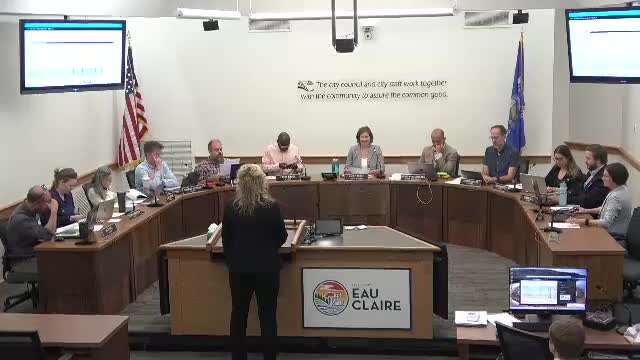
The City of Eau Claire faces a roughly $1.5 million shortfall in its 2026 general fund, City Manager Hirsch told the Eau Claire City Council during a Sept. 9 budget work session, and councilmembers signaled support for raising the local vehicle registration fee to help close the gap.
Hirsch said the shortfall persists after net new construction and one-time adjustments. “Right now, we’re at around a $1,500,000 deficit,” Hirsch said. She and Finance Director Stephanie walked the council through a spreadsheet of revenue and cut options and asked for policy direction on a possible increase to the local vehicle registration fee, sometimes called the wheel tax.
Council members focused most of their discussion on three revenue paths: a local referendum (for 2027), incremental cuts to city services and programs, or raising the local vehicle registration fee. The council heard that the largest drivers of the shortfall are rising employer health-insurance costs, limited levy growth tied to net new construction, increased enterprise fund subsidies (for transit, cemetery, and parking operations), and inflation-driven cost increases across departments.
The council’s informal sense of the meeting: a majority signaled support for a substantial fee increase rather than larger service cuts. City Manager Hirsch reported that seven councilmembers indicated support for a $31 increase in the local vehicle registration fee, which staff said would largely close the gap when combined with a small package of voluntary reductions. Hirsch told the council she will prepare the budget on that assumption and said the submission schedule requires a clear direction: a vote on the fee and the budget are both likely to occur in November, and fees would take effect in early March if approved.
Why it matters
The local vehicle registration fee is a user-targeted tool that the council can raise without a statewide law change; it is limited to transportation-related expenditures and must be approved by the Department of Revenue (DOR) for processing. Council members repeatedly framed the choice as one between asking vehicle owners to pay more or asking residents to accept reduced services such as fewer library hours, reduced park or pool access, cuts to transit routes or hours, or staff reductions by attrition.
Details and options discussed
- Revenue need and drivers: Hirsch and Stephanie showed a roughly $1.5 million deficit driven primarily by double-digit health-insurance increases, the 2025 levy-limit mechanism (net new construction), rising enterprise subsidies (notably transit), and general inflation on operating costs. The staff used a 3.35% factor for CPI-related adjustments in their modeling.
- Local vehicle registration fee (LVRF): Council members suggested a wide range of possible increases. Council Member Miller proposed raising the city’s portion to a combined total that would add roughly $16 per vehicle annually; other council members discussed smaller increases ($8–$10) and larger increases into the $30–$40 range. Council discussion repeatedly referenced a practical ceiling in local practice of not exceeding the state/local combined rate (an $85 figure frequently cited in the discussion as a benchmark). City Manager Hirsch said staff would prepare a budget assuming the council’s directional decision tonight and bring a formal fee proposal back with the budget for votes in November.
- Referendum timing: Staff explained a referendum would be a 2027 option only. The city would need roughly 70 days of lead time before an election plus an extra month to coordinate with DOR; staff estimated a referendum to raise equivalent revenue could be in the $3 million range depending on scope and the insurance renewal projection for 2027.
- Service cuts and alternatives: Staff presented a catalog of potential reductions and efficiencies—some relatively low-impact (LED streetlight conversions, consolidated customer service points), some more disruptive (shortening pool or library hours or routes, eliminating a day of transit service, reducing partner organization funding). Library staff said ending a high-cost digital service (Hoopla) would save roughly $54,000; a library representative said the system’s Hoopla bill had grown to more than $5,000 per month and is pay-per-use, making it increasingly expensive.
- External partner funding: Council discussed previously approved one-time funding for outside groups. Decky (economic development partner) had received a one-time increase last year that staff described as non-recurring; the manager proposed resetting most external requests to the regular baseline during the budget process.
Public and operational impacts discussed
Council members raised equity and public reaction concerns and asked for a clear communications plan. Several council members urged staff to design a straightforward outreach and education effort because a sizable per-vehicle increase will prompt public comment. City Manager Hirsch warned that if the council later changes direction—refusing the fee at budget adoption—staff will need to return with difficult service-reduction scenarios.
Next steps
Staff will use the council direction from the Sept. 9 work session to prepare a formal balanced budget and a fee proposal. The city manager said she expects to release the proposed budget Sept. 29 for council review. The fee-change ordinance and the budget will both appear on the November agenda; if approved, the local vehicle registration fee increase would be processed by the DOR and likely take effect in early March.
Ending
Council members asked for additional detail on specific potential cuts and more analysis of alternatives such as a local sales tax. Staff said it will return with a formal budget book and a fee ordinance for council action in November and will provide public-facing materials explaining the gap and the options considered.