
Water temperatures and algal blooms strain lagoon; seagrass recovery mixed, mapping due in 2026
Get AI-powered insights, summaries, and transcripts
Subscribe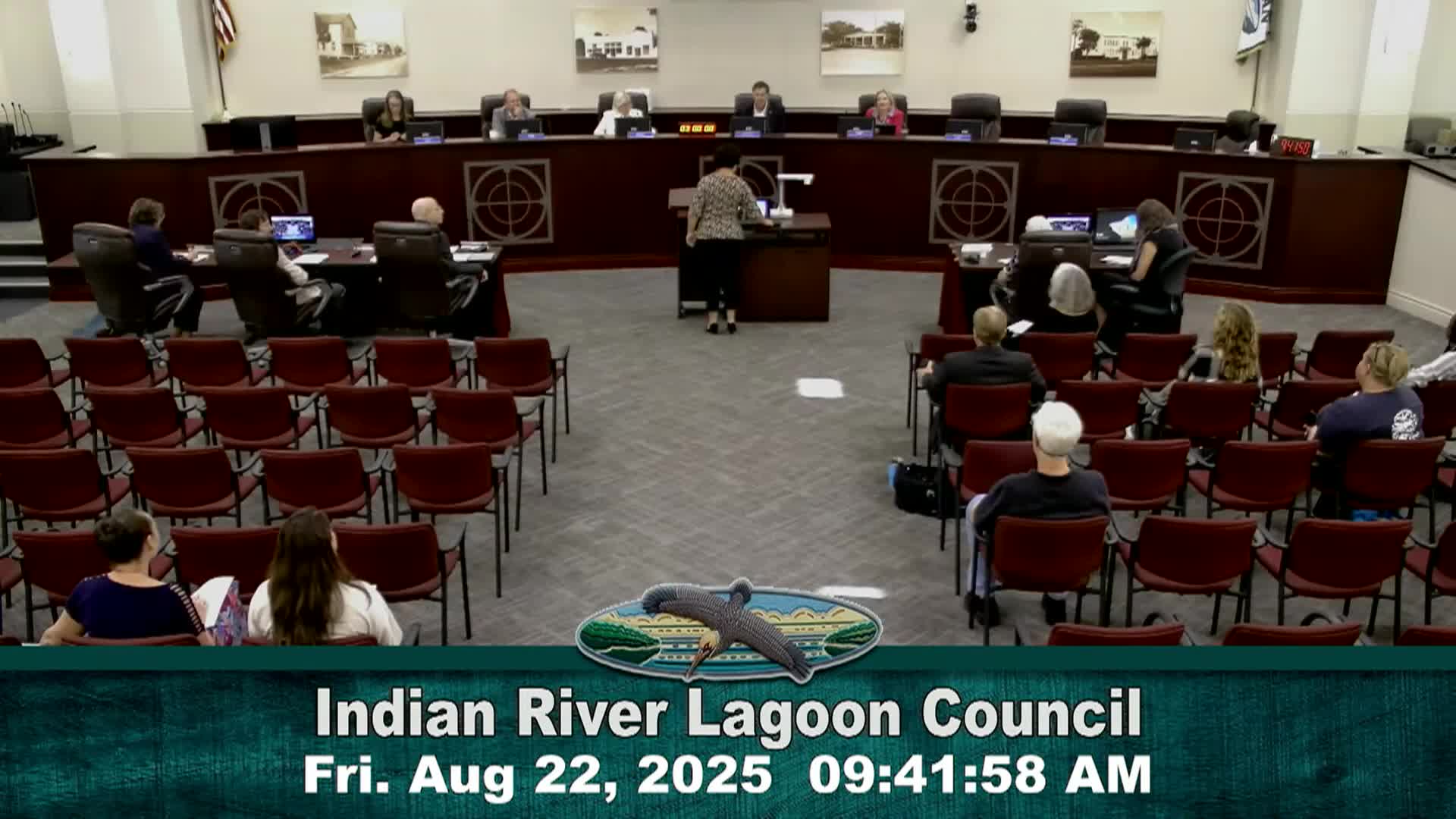
Summary
St. Johns River and South Florida water districts reported higher water temperatures, localized hypoxia, widespread phytoplankton blooms and mixed seagrass recovery across the Indian River Lagoon at the Aug. 22 council meeting; draft aerial seagrass maps are expected January 2026.
At the Indian River Lagoon Council Board meeting on Aug. 22 in Sebastian, St. Johns River Water Management District scientist Lauren Hall and South Florida Water Management District scientist Melanie Parker presented lagoon-wide monitoring results showing elevated water temperatures, site-specific algal blooms and a mixed pattern of seagrass recovery.
Lauren Hall, presenting Northern and Central Lagoon data for the St. Johns River Water Management District, said rainfall during the May–July period was highly variable across the watershed and that freshwater pulses have driven localized phytoplankton blooms. Hall said dissolved oxygen has dropped at times below the hypoxia threshold and that recent low-DO events have produced local mortality. “Over the last week, we’ve actually seen some more of that, and that is when we start to see the animals being impacted and we start seeing some fish kills in localized areas,” Hall said.
Hall reported salinities above 20 parts per thousand at most sites but noted greater variability at sites influenced by tributaries; Banana River stations recorded repeated dissolved-oxygen dips below 2 milligrams per liter. She described ongoing, widespread phytoplankton blooms — including brown‑tide and Pyrodinium bahamense blooms reported in parts of Mosquito Lagoon and Banana River — that have reduced Secchi depths in some northern areas to less than 0.5 meters.
Melanie Parker of the South Florida Water Management District presented Southern Lagoon and St. Lucie Estuary monitoring. She said inflows to the St. Lucie Estuary have been low since lake releases ended in late March and that estuarine salinities at continuous monitors have generally risen into the range considered optimal for adult oysters. “The optimal range is 10 to 25, and the good news is most of those sites are in the optimal range right now,” Parker said, while noting short surface dips after rain events.
Both presenters gave preliminary seagrass updates. Hall described site-level seagrass patterns: northern and southern Mosquito Lagoon sites that showed notable recovery in 2023–24 experienced small declines in 2025 but remain substantially improved versus pre-2016 conditions; some central Indian River Lagoon sites showed little or no recovery. Hall also reported the summer expansion of Caulerpa (reported in the field as “calerpa”), now present across the northern lagoon and parts of southern Mosquito Lagoon; staff are sampling nutrients and working with FAU Harbor Branch to study possible effects.
Council staff reported that aerial photography, ground-truthing and photo interpretation for a lagoon‑wide seagrass map are complete; draft maps are expected in January 2026 and final maps by late spring 2026. Hall also reported extension of a DEP-funded seagrass seed-distribution study for an additional year to include the southern lagoon; the study found large differences in seed presence between species and areas (Ruppia seeds were widespread; Halodule seeds were concentrated in northern hot spots and largely absent from the middle section).
Council members and staff flagged monitoring implications: higher temperatures reduce oxygen solubility and exacerbate DO fluctuations; shallow embayments (for example, Mosquito Lagoon) show large turbidity swings; and tributary-proximate sites show greater variability in salinity and colored dissolved organic matter.
The presentations were followed by questions from county commissioners and district representatives about the site-specific nature of rainfall effects and the role of local stormwater runoff in fueling blooms. Presenters and staff stressed that many findings are preliminary and that seagrass mapping and QA/QC of field data remain in progress.
Looking ahead, staff said they will continue laboratory and field work on the expanding Caulerpa patches and on seed-distribution sampling and will circulate draft seagrass maps when available.