Get Full Government Meeting Transcripts, Videos, & Alerts Forever!
Get email alerts on the Nutrition Snap topic
No spam. Unsubscribe anytime.
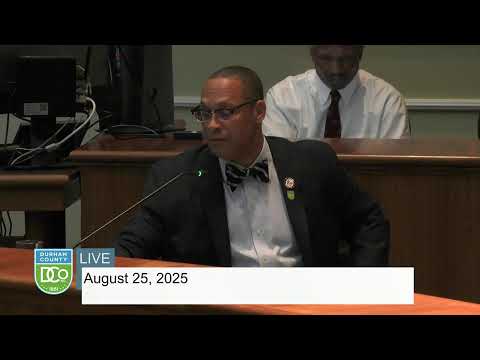
Durham commissioners unanimously approve resolution urging state to fund SNAP
Summary
The Durham County Board of Commissioners approved a resolution calling on the North Carolina General Assembly to cover an estimated $420 million annual state cost to preserve SNAP benefits in the state, citing local food security and economic impacts.
The Durham County Board of Commissioners on Aug. 25 approved a resolution urging the North Carolina General Assembly to appropriate roughly $420 million annually to offset a federal cost shift that would otherwise require states to pick up part of Supplemental Nutrition Assistance Program (SNAP) costs beginning in fiscal year 2027–28.
The resolution, moved by Commissioner Steven Valentine and seconded by Vice Chair Doctor Lee, passed on a voice vote after the board heard presentations from county staff and department directors about SNAP’s local impact.
SNAP serves about 13% of North Carolina households, the resolution says; county and state figures cited at the meeting were 1,357,112 SNAP participants statewide and 32,660 participants in Durham County. County staff said research shows SNAP improves food security and health outcomes, and that each dollar in SNAP benefits generates roughly $1.50 to $1.80 in local economic activity. The resolution also cites North Carolina Department of Health and Human Services (NCDHHS) estimates that the state would face an additional $420,000,000 in annual costs beginning in FY 2027–28 if the federal cost-share shift is implemented.
Reina Goldstein Benug, Durham County food security coordinator, told the board the resolution outlines ways SNAP supports residents, retailers and local farmers and warned that the loss of benefits would be “devastating.” Maggie Clapp, director of the county Department of Social Services, and Dr. Rodney Jenkins, director of public health, joined Benug in the chamber to emphasize cross-departmental impacts on families, health and hunger services.
Commissioners discussed public outreach and advocacy to state legislators. Several commissioners urged residents to contact their state representatives and the county’s lobbyist at the North Carolina Association of County Commissioners (NCACC). The board asked county staff to share the resolution with the Durham legislative delegation, the NCACC lobbyist, the school board and the city council.
The board’s statement highlighted additional figures included in the resolution: SNAP-related transactions of about $974,844,947 redeemed in February 2023 statewide, roughly $500,000 in annual farmers-market support reaching more than 400 North Carolina farmers, and studies that show Medicaid and other health cost savings associated with SNAP participation.
The motion to adopt the resolution was made in open session and approved by the board. The resolution text and related documents will be distributed to state legislators and local partner agencies per the board’s direction.
Ending: The board did not announce any immediate county-level budget commitments tied to the resolution; the action is a formal statement urging state funding and expanded advocacy by county staff and commissioners.