Get Full Government Meeting Transcripts, Videos, & Alerts Forever!
Get email alerts on the Capital Planning topic
No spam. Unsubscribe anytime.
Norwalk council reviews long-range capital projects, debt capacity as library, water and interchange land on list
Summary
City officials held a work session to review about 40 large projects — including a proposed $25 million library and $20 million water capacity purchase — and discussed prioritization, legal limits on bonding and strategies for timing ballot measures.
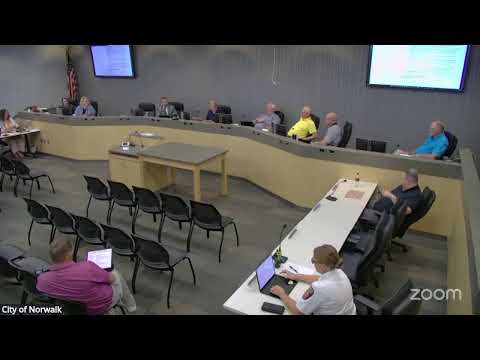
Norwalk City Council members and staff met in a work session Thursday to review a consolidated list of large capital projects expected to appear over the next 3 to 20 years and to discuss how the city should set priorities and manage debt capacity.
Council members were presented with a list of roughly 40 large-scale proposals — including a proposed new library estimated at $25 million, a $20 million water-capacity purchase, a $35 million aquatic center, a $30 million new police station, a $20 million new or renovated city hall, and a potential I‑35 interchange near Fillmore to serve anticipated truck traffic — and staff asked elected officials to begin ranking projects so the administration can map those priorities into the capital-improvement program and next year’s budget.
City staff said the exercise is intended to focus council attention on projects that “move the financial needle,” rather than routine vehicle or small park maintenance. Officials emphasized the work session was an initial, informational step to give council members background on costs and timing so they can later provide formal prioritization.
Staff gave council an overview of how much debt the city may legally carry and the city’s internal policy limits. Under Iowa Code, a municipality may issue debt up to 5% of total assessed value; using 1/1/2024 assessed values presented by staff, that cap equates to about $94.1 million. As of the end of fiscal 2025, city debt totaled about $48.3 million; with planned borrowing for current projects, staff estimated Norwalk’s debt outstanding would reach about $51.6 million, roughly 54% of the statutory maximum and about 73% of the city’s internal policy limit.
Why it matters: understanding legal debt capacity and timing helps the council decide whether to pursue bond financing, tax-rate adjustments or other mechanisms — and whether some projects should be deferred, combined or scaled to match revenue expectations.
Staff also summarized which projects typically require voter approval. Under state law and city policy, “essential corporate purpose” projects (water, sewer, streets, fire equipment and similar) generally do not require a public vote beyond normal revenue mechanisms; “general corporate purpose” projects such as a new library or city hall typically require voter approval in the form of a bond referendum, which requires 60% voter approval. Staff noted the city can issue a limited amount of debt (currently about $910,000 for cities of Norwalk’s size) without classifying it as essential or nonessential; that threshold changes annually with CPI adjustments.
Council members and staff discussed how timing, growth assumptions and outside actions could change priorities. Staff said their financial forecast assumes 6% annual growth in assessed valuation, and that projected debt service percentages can fall as existing debt retires; however, they cautioned that legislative changes to tax or bonding rules remain an uncertain factor. Several council members urged considering “want versus need” in ranking projects and suggested scoring criteria be tied to the city’s strategic priorities. Staff offered a sample decision matrix that scores projects on values such as citizen health, infrastructure need, crime prevention, ability to generate revenue and alignment with council goals.
On water capacity, staff said the timing of Central Iowa Water Works’ planned plant expansions is the critical variable. Staff described the "Veil" plant expansion and other regional plant projects as possible five-year items and said the city must give Central Iowa Water Works estimates of future demand to secure capacity; once the authority asks for financial commitments from member communities, projects typically proceed only after formal commitments are obtained.
Council members asked for more detail on funding mixes and phasing. Staff said the current project-cost figures were presented in today’s dollars and are preliminary; they proposed a phased follow-up in which council members score each project and staff returns with a prioritized list and a financing plan showing what could be done within likely revenue scenarios.
The work session concluded with staff asking council members to prepare individual priority rankings and reconvene roughly one month later for a follow-up work session to aggregate scores and identify a recommended sequence of projects.
Ending: Staff said it will prepare written materials — including a project-by-project fiscal impact sheet, recommended scoring criteria and options for staging requirements that trigger voter referendums — ahead of the next work session so the council can convert the initial list into an actionable capital plan.