Get Full Government Meeting Transcripts, Videos, & Alerts Forever!
Get email alerts on the Industrial Revenue Bonds topic
No spam. Unsubscribe anytime.
Committee advances revised Industrial Revenue Bond policy recommending housing rules, taxing-district involvement and expanded service area
Summary
The committee reviewed draft Industrial Revenue Bond (IRB) policy updates that would allow housing under leaseback IRBs with conditions (mixed-use, job creation and affordability/workforce thresholds tied to IRB term), require early taxing-district negotiation of PILOTs, expand eligible area to the urban service area, and approved moving ordinance/
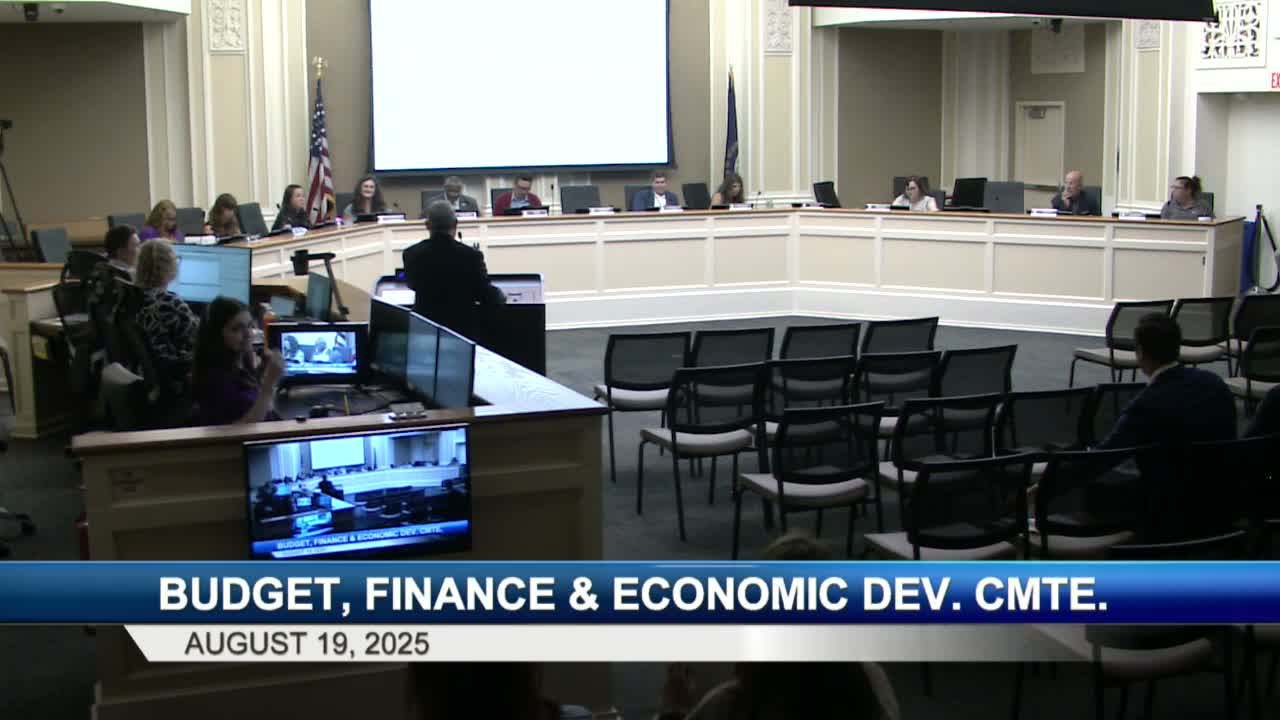
Lexington-Fayette Urban County Government staff presented proposed updates to Industrial Revenue Bond (IRB) policies and procedures at the Aug. 19 Budget, Finance and Economic Development Committee meeting. Senior Administrative Officer Craig Vince said the review, undertaken at the administration's direction, examined leaseback IRB structures and the procedural handling of applications so the city can allow housing under limited circumstances while addressing taxing-district concerns.
Vince summarized the key proposed changes: require a pre-application meeting with LFUCG economic-development staff; engage property-taxing districts (Fayette County Public Schools, LFPL, and Lextran) early in preliminary staff review; condition formal application eligibility on demonstrated advance discussion of payment-in-lieu-of-tax (PILOT) negotiations; and expand geographic eligibility for IRBs from a narrow downtown infill boundary to the entire urban service area. He said the Economic Development Investment Board reviewed the draft and recommended its approval to council.
On housing specifically, Vince said the draft ties housing-affordability requirements to the length of the leaseback IRB term. Under the draft language presented: a 15-year leaseback IRB would require at least 20% of proposed housing units on-site to be "affordable" (defined in staff discussions as 80% of area median income); a 10-year leaseback IRB would require at least 20% of proposed housing units to be "workforce housing" defined in the draft as 80% to 100% of AMI. Council members raised concerns about consistency with other city code definitions (which reference up to 120% AMI for some workforce housing bonuses) and about whether the categories should be allowed to blend or be treated more flexibly.
Committee members and stakeholders suggested language changes and expressed a preference for early taxing-district involvement; Craig Vince and staff agreed changes could be made to allow more flexibility (for example, permitting a hybrid mix of affordability tiers under an agreed approach) and to align AMI thresholds with other city policies. Council member Sheehan praised the added early taxing-district consultation, saying it addresses concerns from a recent application that lacked timely taxing-district agreements. Vice Mayor Wu and others urged caution not to create undue barriers for smaller housing developers and to retain affordable housing goals while not making the program unusable.
After discussion, Council member Baxter moved and a colleague seconded a motion to report the ordinance and related resolution out of committee with changes reflecting the committee conversation; the motion passed by voice vote with no opposition. Staff said they will present amended ordinance and resolution language at the council report-out stage reflecting committee feedback.
The draft policies are intended to preserve the primary economic-development purpose of IRBs while creating a clear process for when leaseback structures can include housing and ensuring early negotiation of PILOTs with taxing districts. Committee members asked staff to return with amended language addressing the AMI ranges and hybrid affordability options before the item proceeds to full council.