
City Council approves Midtown South rezoning and Lenox Hill modernization; passes child care, transgender-patient, cooling-center and supportive-housing bills
Get AI-powered insights, summaries, and transcripts
Sign Up Free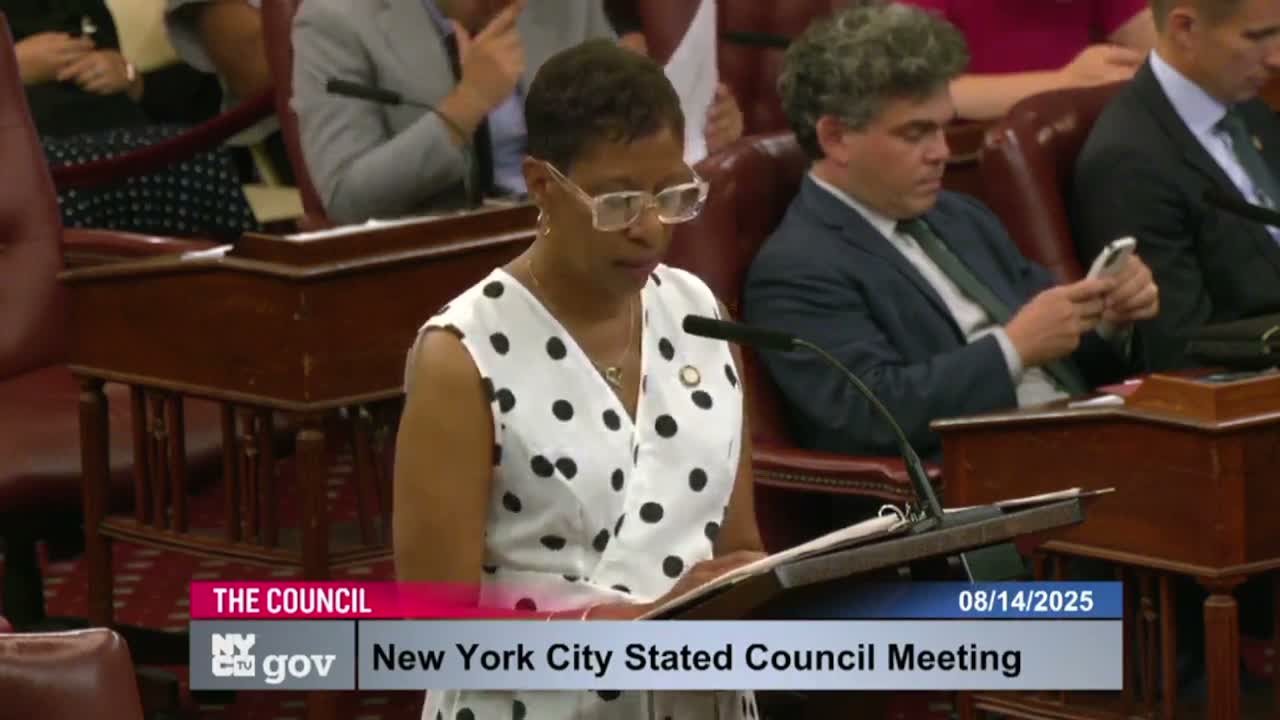
Summary
At its stated August 2025 meeting the New York City Council approved a package of land-use actions including the Midtown South rezoning and a modified Lenox Hill Hospital plan, and passed several public-safety and health bills—among them child care safety measures, transgender patient–rights signage and reporting, a cooling-center codification anda
The New York City Council on its stated August 2025 meeting approved a large package of land-use actions that includes the Midtown South mixed‑use rezoning and a modified redevelopment plan for Lenox Hill Hospital, and passed multiple health, safety and housing bills, council leaders said.
The measures were adopted as part of a bundled general‑orders calendar. Council members recorded a combined vote of 44 in favor and 0 opposed on most items on the general‑orders calendar; three measures—Intro. 6‑28A (transgender patient signage), Intro. 10‑56A (LGBTQIA+ competency training for school medical staff) and Preconsidered Res. 10‑13 (a transparency resolution)—were adopted 37 to 7. Intro. 6‑29A (annual reporting on hospital training for transgender care) passed 43 to 1. Land‑use call‑ups were adopted earlier in the meeting (41 to 0) and the revised land‑use call‑up vote was recorded as 43 to 0.
Why it matters
The Midtown South rezoning is one of the city’s largest neighborhood rezonings in decades and, according to council remarks, will make room for nearly 10,000 housing units citywide tied to the plan, including more than 2,800 permanently affordable homes negotiated under Mandatory Inclusionary Housing (MIH). Council members said the package includes community‑benefit and economic development investments and infrastructure commitments intended to support jobs in the Garment District and the surrounding neighborhood.
The Lenox Hill portion of the package approves a modified plan for the 1869 hospital that city speakers said trims height limits, modernizes clinical space and converts patient rooms to single occupancy. Council member Keith Powers said the project will include about 475 single‑bed patient rooms, new ambulance bays, modernized operating rooms and about $7.5 million in community benefits while preserving inpatient capacity; he also cited the hospital’s annual patient volume and workforce in urging approval.
Major votes and actions (selected)
- Midtown South mixed‑use rezoning and related land‑use approvals: Approved as part of the land‑use package; revised land‑use call‑up vote 43 yes, 0 no. (Action recorded as land use approval.)
- Lenox Hill Hospital modification (rezoning to facilitate modernization and new ambulance bays): Approved as part of the land‑use package; revised land‑use call‑up vote 43 yes, 0 no. (Action recorded as land use approval.)
- Child‑care safety measures (Intro. 10‑41A, Intro. 10‑42A and Res. 5‑63B calling on the State to adopt related bills): Passed; Resolution 5‑63B (calling on the New York State Legislature to pass state legislation to tighten day‑care regulations and inspections) was approved by voice vote in council. Council members linked the measures to the fentanyl death of a 1‑year‑old in a Bronx day‑care and noted that the bills will increase inspections, training and transparency for child‑care providers.
- Transgender patient rights signage (Intro. 6‑28A) and hospital training reporting (Intro. 6‑29A): Intro. 6‑28A and Intro. 6‑29A were adopted; 6‑28A passed 37‑7, and 6‑29A passed 43‑1. Public Advocate Jumaane Williams said Intro. 6‑28A “will require signage to be posted detailing patient rights and hospital services for trans and individuals,” and Intro. 6‑29A will require annual reporting on hospital training for providers who treat transgender patients.
- School medical staff competency training (Intro. 10‑56A): Adopted 37‑7. Council member Crystal Hudson told colleagues the measure will require physicians and nurses employed by or contracted with the Department of Health and Mental Hygiene and working in public schools to complete annual competency training on health concerns related to sexual orientation, gender identity and expression.
- Codifying cooling centers (Intro. 9‑98A): Adopted as part of the package. Council members said the bill would require the Office of Emergency Management to designate cooling center locations during heat emergencies with a minimum number of centers per population and to solicit public feedback on access.
- Supportive housing eligibility (Intro. 1100A): Adopted as part of the general‑orders calendar. Council member Carlina Rivera said the measure will amend eligibility criteria for a city‑funded supportive housing program to count periods of detention in a city jail, state prison or residential mental‑health treatment facility as time experiencing homelessness when the person was homeless before detention and likely to be homeless after release.
- Transparency resolution and related finance items (Preconsidered Res. 10‑13 and other finance actions): Preconsidered Res. 10‑13 was adopted 37‑7. Several council members registered conflicts or disclosures on the record before voting; a handful of members voted no on specified measures and otherwise voted for the bundled calendar.
What council members said
Council member Pirina Sanchez framed the child‑care bills as action flowing from a family tragedy and said the measures were shaped by the child’s parents and advocates. “Nicholas should be here today,” Sanchez said during remarks recalling the 1‑year‑old whose death prompted the bills.
Council member Keith Powers, describing the Midtown South plan and Lenox Hill project, said the rezoning would add housing and infrastructure while securing “over $448,000,000 in economic development investments” negotiated as community benefits for the district and the Garment District’s industry.
Public Advocate Jumaane Williams described the transgender patient‑rights bills as overdue and said signage and reporting would make clear what services hospitals offer to transgender patients and how hospitals train staff to provide that care.
Implementation and next steps
Land‑use approvals will proceed through the remaining technical steps required by the City Planning process and any further agency reviews. Several of the enacted local laws and introductions require follow‑up by city agencies (for example, DOHMH, OEM and the Department of Social Services) to issue guidance, reports or to administer new eligibility rules. Council speakers said community benefits and agency investments secured through the rezoning negotiations will be directed to infrastructure, workforce and cultural investments in affected neighborhoods.
The council will publish formal legislative texts, committee reports and the full roll‑call records on the council’s legislative website for those seeking detailed bill language, amendments and the full vote list.