Get Full Government Meeting Transcripts, Videos, & Alerts Forever!
Get email alerts on the Budget topic
No spam. Unsubscribe anytime.
Cullman County Schools holds first public hearing on fiscal 2026 budget
Summary
District staff presented revenue increases tied to state programs, a plan to use local A&T funds to buy buses and capital projects funded in part by a recent $18 million grant; ADM declines reduced state unit allocations.
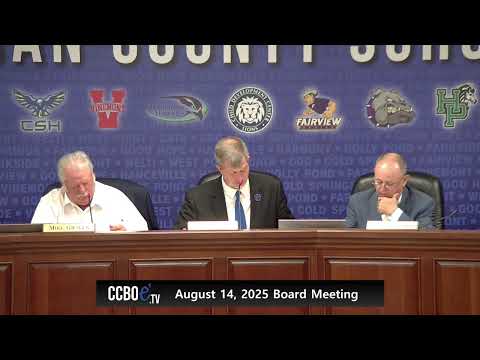
Cullman County Schools held its first public hearing on the fiscal 2026 budget at a school board meeting, during which district finance staff outlined projected revenues, state program increases and planned uses for local and supplemental funds.
District finance staff said the district’s average daily membership fell compared with last year, reducing the state-funded unit allocation, while new state program funding and local revenue increases drove an overall rise in budgeted revenues.
The hearing, described by the presenter as “the first budget hearing for the FY26 budget,” covered five fund types that determine the district’s funding mix. “The law requires us to have two public hearings every year and present it to the board so that they can review it and to the public,” the presenter said. The presenter explained that the district’s state funding is primarily determined by average daily membership (ADM) and the number of units the district earns from the state.
Staff reported an ADM decline of about 4.8 from the prior year and said total state-funded units fell about 3.6. The presenter said teacher units declined by roughly 0.6 but that some school staffing cross a threshold that produced larger changes in certain positions (for example, assistant principals changing by 1.5 units at an individual school). “While I'm getting this there it comes back,” the presenter said when explaining the unit calculations.
The district’s budget narrative shows a total budgeted revenue figure of about $140 million for FY26, an increase of roughly $9 million from the prior year. Staff said roughly 67% of the increase in state revenue resulted from targeted state program additions tied to the RAISE program (which consolidates multiple state allotments), including additional building-based math coaches, ARI reading specialists and expanded state-funded pre-K classrooms. Specific state-funded increases cited in the presentation included an $85,000 increase for ARI (one additional ARI teacher), $630,000 for seven additional math coaches, about $150,000 for state special education preschool and roughly $813,000 tied to an increase from 13 to 18 OSR pre-K classrooms.
Staff outlined transportation funding and bus replacement practices: the state provides $7,581 per bus per year for fleet renewal over 10 years, while a new bus costs about $150,000–$160,000. Because the state fleet renewal payment covers a fraction of a bus’s cost, the presenter said the district plans to use some local A&T (instruction and technology) funds to purchase new buses this year to avoid drawing down the fleet renewal fund and to preserve capacity for future principal and interest payments.
The presentation described local half-cent sales tax balances and planned capital uses. Staff said the half-cent sales tax fund began the year with about $11.5 million and that the district budgeted roughly $6.5 million of that for capital projects (including HVAC and STEM and work at Good Hope Elementary), leaving an estimated $5 million remaining in that fund after those planned expenditures.
Staff said the district has received several supplemental appropriations and one-time allocations, including a previously announced $18 million grant to expedite building a new career center. Staff also said the district received an investment-in-technology appropriation of about $10.6 million that will mostly be spent in the following fiscal year.
On operating costs, staff reported general fund expenditures up about 6.4% overall. Salary expense increased about 1.8% (driven by step increases rather than across-the-board raises), while benefits increased about 9% because of a rise in health insurance allocation per employee and higher employer retirement match percentages. The presenter said the general fund is projected to end the year with roughly a $36.3 million balance, which staff described as about 3.3 months (100 days) of reserves.
After the presentation, the presenter invited questions and said a second public hearing will be held before the board considers final budget approval. “If y'all have any questions or anything I need to look at or change before the next one, let me know,” the presenter said, adding that remaining state allocations (Title II and Title IV) should be available before the next hearing and will be incorporated then.
The board took no final vote on the budget at the hearing; the district expects another hearing and a future vote on adoption.