Get Full Government Meeting Transcripts, Videos, & Alerts Forever!
Get email alerts on the Tree Removal topic
No spam. Unsubscribe anytime.
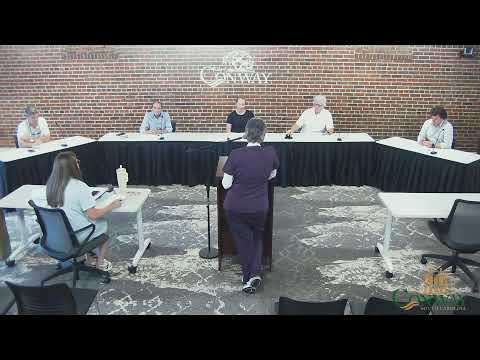
Conway Tree Board approves removal of magnolia after tomography finds large cavity; conditions mitigation and fee-in-lieu options
Summary
The City of Conway Tree Board approved removal of a 29-inch magnolia tree after a sonic tomography detected a large hollow cavity. The board forgave mitigation penalties on condition the owner plant four trees on a property and pay a fee-in-lieu for remaining mitigation by Nov. 1, 2025.
The City of Conway Tree Board approved removal of a magnolia tree after an arborist’s sonic tomograph showed a large internal cavity and staff recommended removal because the tree posed a risk to nearby structures.
City staff explained that the tree owner had commissioned a Picus sonic tomography test on the 29-inch magnolia and that the machine detected a large hollow cavity, which staff said “is likely formed due to fungal plant pathogen.” The arborist advised that corrective pruning of codominant stems was not recommended and that the cavity was unlikely to recover with antifungal treatment; staff recommended removal because the tree’s drop zone included a clinic and a neighboring home.
The board voted to approve the tree removal. The initial motion approved the removal only; members then addressed mitigation and penalties related to an earlier removal of a landmark live oak on the same property.
Staff recapped that the earlier oak removal (a 36-inch landmark live oak) had been carried out on Aug. 3, 2024, and that mitigation was required by ordinance. At the time of the oak removal the permit framework was different; staff acknowledged there had been confusion about permit timing and which ordinance applied. Under current ordinance calculations, staff said failure to undertake earlier required mitigation could multiply mitigation obligations and, using the ordinance formula, could lead to a larger total mitigation obligation (staff illustrated how prior and current requirements could combine to a larger number of replacement trees if penalties were applied).
Board members discussed options including full mitigation planting, a fee in lieu, extended time frames, and partial forgiveness. Staff provided a fee-in-lieu calculation: if the board assessed the full mitigation requirement that staff had computed (36 trees), the fee-in-lieu total would be $30,600. (That total implies a per-tree fee of $850 based on the calculation $30,600 ÷ 36.) Staff also said the per-tree fee figure that had been cited earlier in discussion appeared as $8.50 in an exchange; the board relied on the $30,600 total when discussing remedies.
The board first voted to forego mitigation for the diseased magnolia (staff had said mitigation for a diseased tree would normally be required but staff was amenable to elimination). Later, after extended discussion about the combined mitigation picture stemming from the previously removed oak and the magnolia, the board adopted an amended motion that forgave penalties on the condition that the applicant plant four replacement trees on a property the applicant owns (planting may occur on this property or other City-owned properties the applicant owns in Conway) and pay a fee in lieu for the remaining five mitigation trees by Nov. 1, 2025. The amended motion passed on a voice vote; the transcript records “aye” votes but does not record individual roll-call tallies.
Staff clarified that trees planted to satisfy mitigation would become protected trees on the property where they are planted and would themselves be subject to protection and mitigation rules if later removed. Staff also told the board that mitigation plantings cannot be used to satisfy unrelated landscape requirements for future redevelopment; mitigation is additional to landscape requirements for parking and site redevelopment.
Speakers indicated the applicant is pursuing property expansion and civil/site planning that could provide formal locations for some mitigation plantings in the future, but no site plans had been submitted to the city at the time of the meeting. The board allowed the applicant and staff to work out specific planting sites, permitted a mixture of planting and fee-in-lieu, and set the Nov. 1, 2025 deadline for the required combination of plantings and payment for the remaining mitigation required by the board’s motion.