Get Full Government Meeting Transcripts, Videos, & Alerts Forever!
Get email alerts on the Mcps Properties Plan topic
No spam. Unsubscribe anytime.
MCPS properties plan: consultants report broad community input, 14 sites under review; open houses set for mid-September
Summary
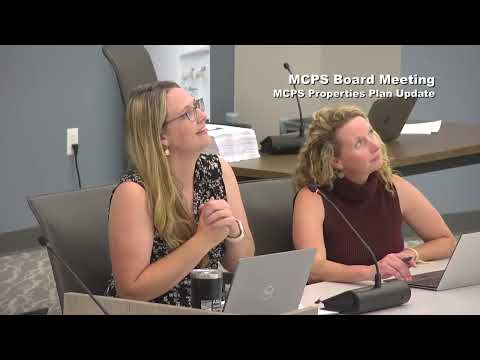
Consultants and district staff told the Missoula County Public Schools board that a year-long properties study reached more than 1,300 survey respondents and evaluated 14 properties. The planning team will hold open houses the week of Sept. 15 and return recommendations and implementation steps later this school year.
Missoula County Public Schools officials and outside consultants gave the board an update on the district's multi-site properties review, reporting large community participation and a phased plan for analysis and decision-making.
Kate Dinsmore of WGM Group told the board the project now evaluates 14 properties (the original scope of 13 was expanded to add Jefferson Elementary) and is organized in four phases: define process and needs, data collection and analysis, plan development, and implementation. "The project is split into 4 phases," Dinsmore said.
Consultants said the engagement effort included targeted learning sessions with organizations that currently use district properties, planning-committee meetings, and an online survey distributed via MCPS listservs and neighborhood councils. Rachel Hafdoria, who led the engagement summary, said the team received more than 1,300 survey responses and that response patterns varied by property. She told trustees the Dickinson Building (Lifelong Learning Center), the Peace Farm (Duncan Drive), and Fort Missoula (Egg Center) drew large response shares because those sites have active users.
Survey findings reported to the board showed the public prioritized instructional space and student activities when asked what MCPS should consider in maintaining facilities. On other options, responses were mixed: roughly 37% of survey respondents agreed the district should consider supporting housing while about 40% disagreed; about 30'2% agreed the district should consider selling properties while about 42% disagreed. When forced to pick the single most important lens, 35% of respondents selected maintaining the existing community benefits; 8% selected housing as the top lens.
Max Grevey of LPW Architecture outlined the built-facility assessments completed to date, which examine system condition (envelope, mechanical, electrical and structural), site size and access, potential for future school use, and current revenue generation. Grevey said teams completed rapid walk-through assessments for the properties and developed an internal rating framework to compare sites for likely future uses.
Consultants described several recurring themes from outreach: (1) concern from current property users about losing access to community spaces and the value of locally invested improvements; (2) substantial deferred maintenance or infrastructure needs on some properties; and (3) innovative partnership models now operating on some sites that support community services. "There was concern about losing access to space," Hafdoria said.
Trustees pressed consultants about scope and valuation. Several trustees asked why the team did not obtain detailed market valuations for every parcel. Dinsmore and Burley McWilliams, the district's project lead, said the scope and budget currently fund detailed commercial evaluations for a subset of higher-priority properties (the team had asked Sterling CRE to produce valuations for about five or six properties so far). McWilliams said the planning committee could expand that scope if the board elects to fund more parcel valuations.
Board members also asked how site size and access affect reuse. Grevey said small, constrained sites such as Whittier (described in the assessment as a little over 2 acres) are unlikely to meet recommended minimum acreage for traditional elementary, middle or high schools and therefore scored low on future-school potential. "From a practical budgetary standpoint, we're trying to approach it from that perspective and rule out whether a property makes sense for any particular use," Grevey said.
Next steps announced to trustees included a draft assessment and alternatives posted to the project website, a set of public open houses the week of Sept. 15 (the team said those events will be held at the six main buildings in the study to allow building tours and review of alternatives), and continued planning-committee review. Consultants said they expect a more complete set of recommendations and a draft implementation plan to return to the board in late 2025 or early 2026 (the team indicated final deliverables may extend into February of the next calendar year).
McWilliams told trustees the planning committee has met monthly since January and includes trustees and representatives from the City of Missoula and the Missoula Economic Partnership. He said the committee's work is intended to produce a consistent decision-making framework that the board can apply to each property.
The presentation was information only; there was no board vote. Open-house dates, survey results and property summaries are posted on the MCPS properties plan website, and the consultants said they will post more-detailed assessment data after planning-committee review.
Ending: The board did not take action on the plan at the meeting; staff and consultants will hold community open houses the week of Sept. 15 and return recommendations and a draft implementation plan to the board later in the fall or winter.