Get Full Government Meeting Transcripts, Videos, & Alerts Forever!
Get email alerts on the Tax Policy topic
No spam. Unsubscribe anytime.
Committee advances income-tax rate realignment to shift property-tax relief to public safety
Summary
The committee approved Proposal 274 to reallocate portions of the local income-tax structure, moving the property-tax relief rate into the public safety rate and winding down the levy-freeze stabilization fund as required by recent state legislation (Senate Bill 1). The presenter said the 2.02% top rate paid by residents will not change; the shift,
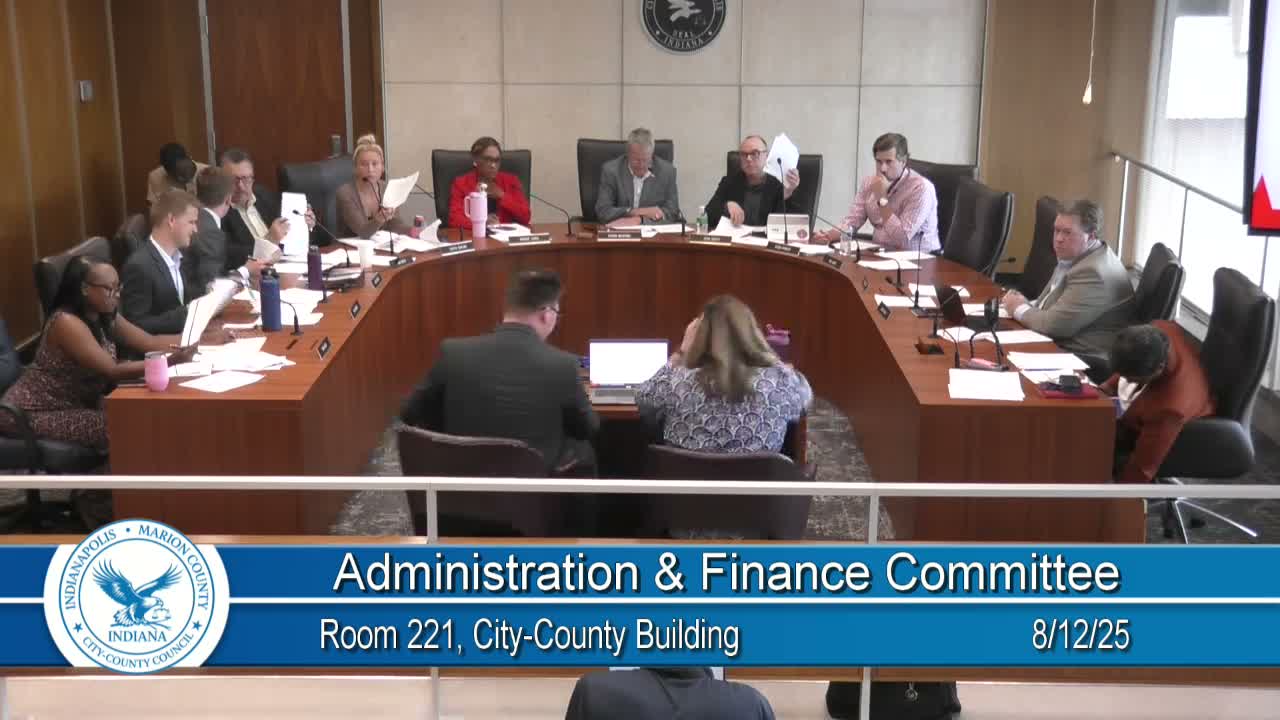
The Administration & Finance Committee on the Indianapolis City-County Council voted to advance a rate-change plan for the county’s local income tax that shifts the existing property-tax relief rate into the public-safety income-tax bucket and reduces the levy-freeze stabilization allocation as the state phases out those mechanisms.
Controller Abby (last name not specified in the committee record) told the committee the change does not alter the 2.02% income-tax rate residents pay. Instead, the proposal — introduced as Proposal 274 — changes how the Local Income Tax Council allocates revenue among sub-buckets and local units. “The rate paid by citizens… will not change,” she emphasized as she walked the committee through charts showing the shifts.
Under the plan, half of the levy-freeze rate’s distribution will be spent down in 2026 and the remainder is intended to be used in the 2027 budget cycle; the office plans to reduce the levy-freeze stabilization fund toward zero ahead of the statutory phaseout in 2028. The proposal also moves the entire property-tax relief rate into the public-safety rate, increasing allocations for certified shares and public-safety distributions. The controller said the net effect is to free up additional dollars for essential government services — with a stated focus on supporting public-safety officers and protecting negotiated union contracts.
Committee members raised distribution concerns for local taxing units. Councilor Brian Mowery noted an estimate from the MSD Warren Township schools’ CFO that the change could reduce their receipts by roughly $300,000; Controller Abby said that estimate equates to about 0.5% of that district’s levy and that impacts vary by district. Councilor Joseph Lee asked whether included and excluded towns would see net gains; Abby said included cities and excluded towns could receive higher direct income-tax allocations for public safety even as their property-tax revenue base shifts.
The presenter explained the change is driven by Senate Bill 1, which eliminates the property-tax relief and levy-freeze rates beginning in 2028 and introduces a statewide credit mechanism. The controller said the new state credit is expected to provide larger direct property-tax relief in Marion County than the current local mechanism, but she cautioned the state-provided credit is an unfunded cut to local budgets and required a reallocation to avoid deep cuts to city services.
The committee voted to move the proposal forward by voice vote after questions and discussion. The controller said the ordinance requires authorization to consult the Department of Local Government Finance to confirm the submitted rates; the committee action grants that authorization as part of the process.
What to watch: the Department of Local Government Finance review and then full council action; district-level allocations and the precise impacts on specific schools and towns will be refined as the Controller’s office finalizes calculations and consults the state.