
Council committee backs ordinance change to allow Mayor’s Action Center staff to seek Teamsters representation
Get AI-powered insights, summaries, and transcripts
Sign Up Free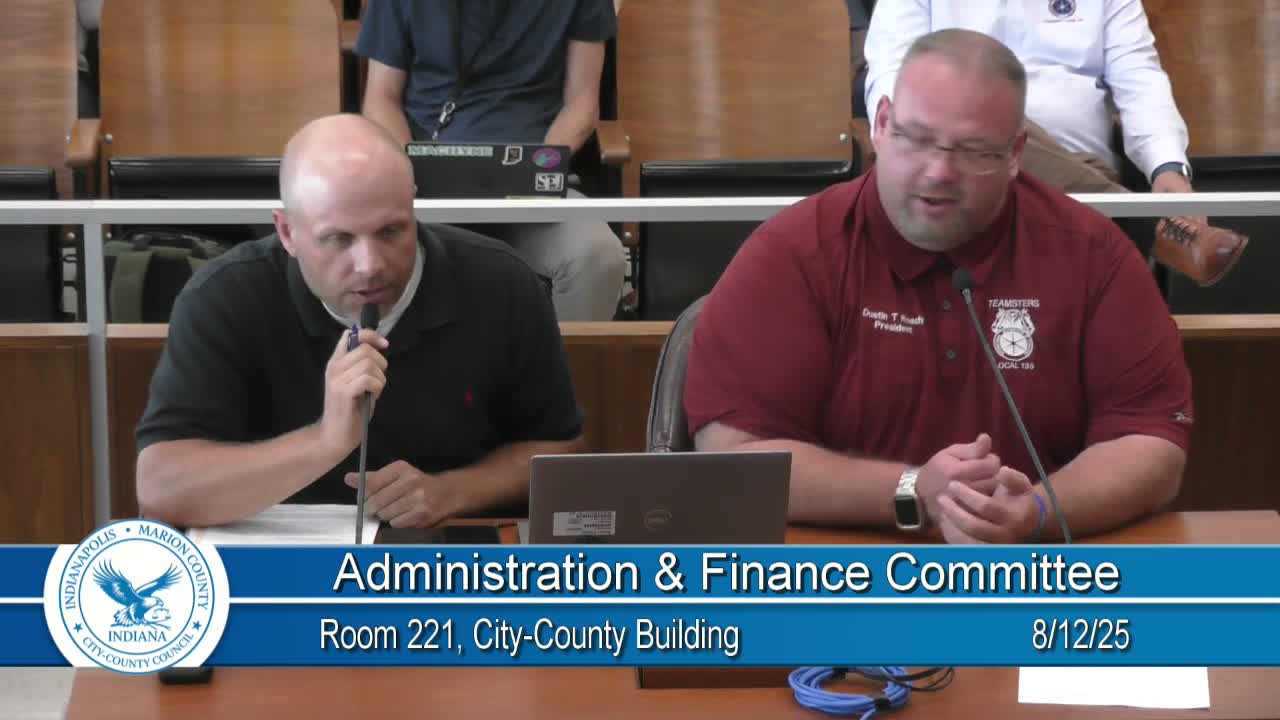
Summary
The Administration & Finance Committee voted to advance an ordinance amendment clarifying which mayor’s-office positions are 'confidential employees,' clearing the way for customer service representatives at the Mayor’s Action Center to organize and pursue representation by Teamsters Local 135.
The Administration & Finance Committee on the Indianapolis City-County Council approved an amendment clarifying which positions count as confidential employees under the city’s employer-employee cooperation ordinance, a change intended to allow Mayor’s Action Center customer service representatives to organize.
The amendment, introduced as Proposal 235, was presented by Dustin Roche, president of Teamsters Local 135, and David Flink, the union’s general counsel. Flink said the change addresses a technical reading of the code that could be interpreted to exclude Mayor’s Action Center (MAC) customer service representatives from collective bargaining rights because they are housed within the mayor’s office. “They’re customer service representatives. They have nothing to do with formulating labor relations policies at all,” Flink told the committee.
The mayor’s office signaled support for the proposal during the budget presentation earlier in the hearing. Deputy Mayor Dan Parker said the administration intends to recognize organizing already underway once the ordinance change is passed and to proceed to the next phases of the election and bargaining process.
Committee members voiced general support during discussion. Councilors asked whether organizing at the MAC would be limited to Teamsters; Roche said the organizing group chose the Teamsters but the ordinance clarification is not written to single out any particular union. Asked whether pay increases would automatically follow, Roche said pay and other terms are subject to collective bargaining. The committee approved the proposal by voice vote after a motion and second.
The ordinance change is procedural: it narrows which positions are categorized as "confidential employees" (who are excluded from collective bargaining under the ordinance), so that frontline MAC staff are not treated as confidential simply because they are in the mayor’s office. The presenters described the change as aligning the city code with federal labor-law concepts of confidentiality and supervisory status.
What happens next: passage at full council and then a formal election and bargaining process, if the MAC workers continue to seek representation. The committee record did not include details of a negotiated contract, wage rates, or a final vote tally by named members.
The committee also heard that there had been no prior requests from other mayor’s-office units for the same clarification; Roche said the MAC organizing was the recent, active case.