Get Full Government Meeting Transcripts, Videos, & Alerts Forever!
Get email alerts on the Public Safety topic
No spam. Unsubscribe anytime.
Grimes County commissioners review sheriff's preliminary budget, agree to two sergeants, vehicle funding and begin jail planning
Summary
At a July 29 budget hearing the Grimes County Commissioners Court reviewed the sheriff's preliminary budget. The court directed staff to convert two patrol positions to sergeants, approved increased machinery-and-equipment funding for replacement/outfitting of patrol and CID vehicles, asked staff to separate dispatch and jail budgets for clearer OT
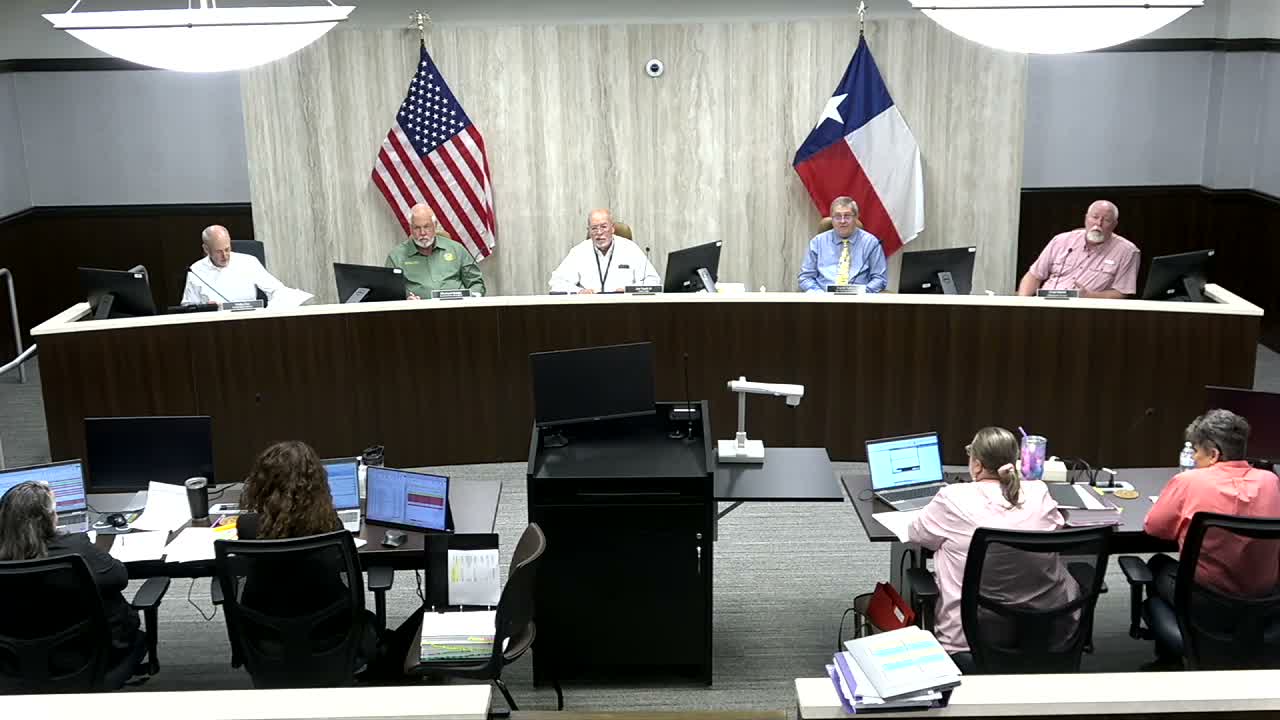
Grimes County Commissioners Court on July 29 reviewed a preliminary budget for the sheriff's office that would add two sergeant positions, fund replacement and outfitting of patrol vehicles, and begin setting aside money for jail repairs and a longer-term expansion.
The prospect of adding supervisory pay, new vehicles and further jail work comes as county leaders and sheriff's office staff told commissioners they are coping with rising call volumes, an aging vehicle fleet and frequent jail overtime. County officials said they will move two existing patrol positions into two sergeant slots and increase the county's machinery-and-equipment allocation so officers can be put on the road with fully outfitted vehicles.
County Judge (name not specified) told the court the preliminary budget includes two personnel changes the sheriff asked for and that the county has already absorbed a roughly $1,100-per-employee increase in insurance costs for FY2026: "the county has already made the decision and has absorbed the cost of about $1,100 per person increase in the cost of insurance," the judge said. The judge also noted the county had factored recent legislative fuel-tax changes into fuel budgets: commissioners were told a recent state law removed the 20¢-per-gallon state highway tax for county vehicles, lowering effective fuel costs compared with last year.
Why it matters: Commissioners said adding on-the-ground supervisory coverage and replacing aging vehicles is a safety and operational priority. Sheriff's staff described frequent overtime, high daily jail counts on weekends, and maintenance-intensive older units. The court directed staff to budget conservatively while separating dispatch and jail cost lines so overtime and other recurring costs can be tracked separately.
Key decisions and budget direction - Two patrol positions will be reclassified to two sergeant positions. County staff estimated the immediate additional salary burden at about $21,000 total; commissioners indicated general agreement to include the change in the budget. - Machinery-and-equipment for the sheriff's office was raised in the preliminary numbers from $300,000 to $400,000 to cover vehicle purchases and outfitting for multiple units. Staff identified a current request for four vehicles (1 CID, 1 jail transport, 2 patrol) and said outfitting a marked patrol vehicle (radio/camera/installation/other equipment) is approximately $93,680 per vehicle in current estimates. - Commissioners asked that dispatch and jail budgets be split into separate sub-budgets (or departments) so overtime, training and other recurring costs are clear for each function. The court asked staff to return with a line-by-line allocation for dispatch vs. jail.
Staff presentations and cost drivers Sheriff's office staff gave detailed line-item explanations during the hearing. Captain Ashley Brockett, identified as captain of operations, described operational impacts of training and equipment procurement and explained why deputies often revert to handwritten tickets when ticket printers and the RMS software are unreliable: "we have ticket writers ... but there is a constant battle ... they end up getting frustrated, and they ended up saying, hey, give me my ticket book, and I'll just write a ticket because of the problems that we experience with crimes (RMS)."
Blaine Heckler, communications supervisor for the sheriff's office, described the scheduling structure for dispatch and why a standalone dispatch budget will make overtime forecasting clearer: "The big one is going to be the overtime ... it is part of the salary structure already that we're guaranteed overtime with just how our shifts work," he said.
Fleet, equipment and K-9 costs - Fleet size and condition: staff reported 55 total units across the sheriff's office (29 patrol/SRO units, 9 CID units, 9 jail/courthouse units, plus admin and spares). Several older units were identified for auction or replacement; staff said six units were scheduled for auction and several others are past recommended mileage thresholds. - Vehicle costs: staff gave a per-vehicle example: a Tahoe base price around $52,000, plus outfitting costs including cameras, radios and installation. Updated outfitting estimates cited to commissioners put the total per fully outfitted patrol vehicle near $93,680. - K-9 program: the court discussed an established requirement that handlers get 30 minutes per day to tend a K-9. Commissioners left a $2,500 K-9 expense line in the preliminary budget (down from a larger request), and confirmed a recurring staff assumption that daily care time is part of the workday rather than separate overtime in most cases.
Personnel, stipends and overtime Sheriff's staff requested targeted recruitment stipends (field training officers, night shift, bilingual pay). Commissioners agreed to increase the line for stipends in the sheriff's office to $11,200 (from lower preliminary entries) to cover several $500 stipends across identified roles.
Dispatch and jail overtime: commissioners asked staff to provide a clearer forecast. The court noted existing dispatch overtime was roughly $55,000; with the added dispatcher position the commissioners and staff discussed that allocation could rise and concluded the best next step was to separate the dispatch and jail lines and return with projected overtime numbers for each function. Separately, the court raised the sheriff's jail overtime line from $75,000 to $84,000 in the preliminary numbers pending the split.
Jail facility needs and expansion planning Commissioners and staff discussed immediate repairs and longer-term expansion. Rodney (project manager) described foundation settlement and a near-term quote of roughly $181,000 to level the jail foundation; staff warned that costs can increase once work begins. Commissioners directed staff to begin reserving capital funds and to explore a phased plan for expansion; county staff estimated a conceptual full expansion could be on the order of several million dollars (planning-level figure discussed in the meeting was roughly $7.4 million, with significant uncertainty and design-phase contingencies). The court discussed setting aside $3 million from available funds to start design and early construction phases while recognizing additional funds would be required in subsequent budgets.
Open items and next steps - Staff were asked to separate dispatch and jail budgets and return with a line-by-line allocation for overtime, training and supplies. - Commissioners asked for a clear equipment/vehicle procurement plan and updated price quotes for outfitting per-vehicle costs. - Design development for a jail expansion remains at a conceptual stage; commissioners asked staff to provide a refined cost study and options at the next budget meeting.
Ending Commissioners closed the session noting remaining work to finalize FY2026 budget lines and the need to revisit several allocations when the court meets again on pending special items and to review updated ambulance procurement and capital receipts. A formal motion on agenda item 3 concluded the meeting (see actions).