Get Full Government Meeting Transcripts, Videos, & Alerts Forever!
Get email alerts on the Groundwater topic
No spam. Unsubscribe anytime.
Tiverton planning board and URI outline groundwater study, seek 30–40 volunteer wells
Summary
University of Rhode Island scientists and Tiverton planning board members described a multi-season groundwater sampling effort focused on areas south of Bulgemarsh Road, asking homeowners to volunteer private wells for nutrient, pathogen and water-table testing.
Stu Hardy, a member of the Tiverton Planning Board, introduced a University of Rhode Island team and described a planned groundwater study aimed at parts of Tiverton that lack piped water and sewer.
The study, led by Soni Pradhanang, professor of water quality in URI’s Department of Geosciences, will seek roughly 30 wells (with capacity up to about 40) as a representative sample of groundwater conditions — prioritizing areas south of Bulgemarsh Road and portions east of Stafford — and will test for nutrients, common ions and, where requested, pathogens. The team emphasized seasonal sampling and an option for short-term water‑table loggers in consenting wells.
The study’s purpose and scope
Hardy said the planning board approached URI to better understand the geohydrology of Tiverton neighborhoods that rely on groundwater rather than public water supply. "I have volunteered to be the planning board liaison with the University of Rhode Island," Hardy said, introducing the URI team and explaining the outreach goal.
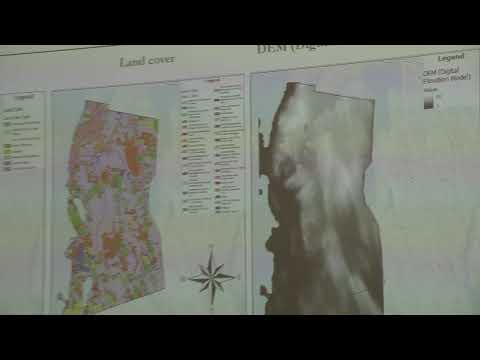
Pradhanang described the project methods and the team’s priorities. "I'm really hoping with the kind of work that we are doing now, with the kind of data that we collect, we will be able to make some informed decision making when it comes to planning," Pradhanang said. She said the team used land‑use maps, elevation data, drainage-class maps and available water‑table data to create a preliminary vulnerability map identifying red zones the team recommends for sampling.
Sampling targets and what will be measured
Pradhanang said the team hopes to recruit a broadly representative set of homes — not clustered in a single corner — with priority given to the area south of Bulgemarsh Road because those properties are fed entirely by groundwater. "Thirty is not a hard hit number there," Pradhanang said. "We could possibly go up to 35. . . . If there is, you know, let's say we got 40 participants, that would be great."
She outlined three levels of sampling: 1) two 50‑milliliter bottles for nutrient and major‑ion analysis (nitrate, phosphate, ammonia, sulfate, chloride, calcium, magnesium); 2) a 100‑milliliter IDEXX bottle for pathogen testing, which requires pickup and laboratory testing within 24 hours; and 3) permission to open well casings briefly to measure water table depth with a temporary logger. "We follow this protocol very strictly," Pradhanang said of field sanitation and laboratory procedures.
Logistics, confidentiality and seasonal design
Pradhanang said field teams will provide labeled bottles, a chain‑of‑custody form and written instructions; labels on bottles will include only address and sampling time while the custody form will record who sampled and other details. Homeowners will receive their individual results; the town will also receive aggregated data. Andreas (Andres) Karma and Shariah Ben Shahid, URI graduate students, will coordinate sampling dates and bottle pickup.
The team plans summer sampling as the first season (when water withdrawals are higher), followed by fall, winter and spring to capture an annual hydrologic cycle. Pradhanang said loggers would be sanitized between uses and not left permanently in private wells without homeowner consent.
Questions and community concerns
Residents raised concerns about homes that already have saline or contaminated wells and about potential leachate from the capped landfill. Pradhanang said the team hopes to obtain Department of Public Works permission to access monitoring wells at the landfill site and indicated there are about four monitored wells there that could provide historical context. She said the study’s water‑chemistry tests could help indicate whether contaminants originate from landfill leachate, septic systems or other sources.
Community sign‑ups and next steps
Planning board members and URI asked homeowners interested in participation to sign a sheet at the meeting or contact the planning board staff; Pradhanang asked volunteers to take a photo of the chain‑of‑custody form as an added backup. The team will post a narrated sampling video and a one‑page instruction sheet on the town website. There was no formal vote at the meeting; the discussion focused on outreach, sampling design and logistics.
Ending
Pradhanang closed by thanking attendees and encouraging participation: "How many of you are willing to volunteer your well? . . . I would label whoever have their well sampled as either citizen scientists or science ambassadors because you are helping us generate data to make informed decision for our town and for yourself." The planning board and URI will proceed with volunteer recruitment and initial summer sampling coordination.