Get Full Government Meeting Transcripts, Videos, & Alerts Forever!
Get email alerts on the Public Safety Dc topic
No spam. Unsubscribe anytime.
Congressional hearing spotlights federal surge, local reforms and budget strains in Washington, D.C.
Summary
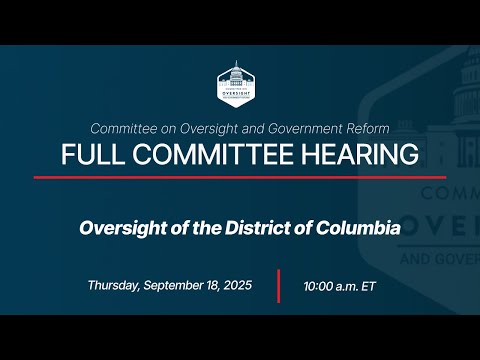
House Oversight Committee members pressed D.C. officials on crime data, the Trump administration's federal surge and local reforms, while witnesses urged federal support for prosecutions, reimbursement and prevention programs.
House Oversight Committee members questioned Washington, D.C., leaders on the causes of and responses to a recent spike in violent crime and a federal deployment to the city, while also debating whether local laws and underfunding contributed to the deterioration.
Chairman James Comer opened the hearing by citing data he said followed a federal surge: "Since President Trump mobilized the National Guard and took control of the Metropolitan Police Department, violent crime has decreased 39%," he said, and asked witnesses how Congress and federal agencies should help sustain crime reductions.
The committee heard from Mayor Muriel Bowser, D.C. Council Chair Phil Mendelson, D.C. Attorney General Brian Schwab and Gregory Jackson, the former deputy director of the White House Office of Gun Violence Prevention. Bowser told the panel she had sent the council D.C.'s "thirtieth consecutive balanced budget with no new taxes or fees" and argued the city had driven down a 2023 spike in violence with local efforts and regional partnerships. "The state of the district is strong," Bowser said, while urging continued federal help on officer recruitment, federal reimbursements and homelessness services.
Mendelson pushed back on Congressional criticism of the council's recent policy changes, saying, "Political rhetoric notwithstanding, criminal activity has been on the decline, with violent crime dipping to a 30'year low last year and even lower this year." He argued the District must be resourced for the federal roles that affect prosecutions, prison programming and pretrial services.
Attorney General Schwab explained the split prosecution system in the District and his office's focus on juvenile prosecutions and victim services. "Because the vast majority of crime in the District of Columbia is committed by adults, not juveniles, it is the U.S. Attorney's Office that handles the vast majority of prosecution," Schwab said. He called for filling U.S. Attorney vacancies, better resourcing of the Bureau of Prisons, CSOSA and pretrial services, and more federal action against illegal gun trafficking.
Gregory Jackson, who ran the White House gun violence office under the prior administration, repeated the priority of prevention and said federal enforcement to stop traffickers is critical. "We did this by investing in prevention and intervention efforts to communities at risk and strategically investing in law enforcement to keep illegal guns off of our streets," he said.
Members asked for specifics about several contested topics: the role of the National Guard (state versus federal duties), D.C.'s juvenile sentencing laws (including the Youth Rehabilitation Amendment statute referenced in testimony), and a March cut of $1.1 billion from D.C.'s locally raised budget that city officials said forced mid'year cuts. Several members pressed Mendelson and Bowser on whether local policy steps had contributed to higher crime rates; Mendelson replied that reforms had simultaneously strengthened some penalties and that federal responsibilities for prosecution and incarceration complicate local accountability.
Bowser and Mendelson both requested more federal reimbursement for Metropolitan Police Department services related to the federal presence; Mendelson testified the city was owed roughly $83 million in underfunding for those costs over recent fiscal years. Bowser said restoring D.C.'s budget was a necessary step: "We want the money because it was approved by this Congress and it's our money," she said.
Several members argued the federal surge was both legally suspect and unnecessarily militarizing neighborhoods. Witnesses and members also debated whether the surge itself or increased federal law enforcement and coordination (FBI, DEA, ATF, U.S. Attorney) produced measurable crime declines. Bowser and Mendelson said joint federal'local operations helped; Schwab and Jackson emphasized prosecution, stopping gun trafficking and prevention resources.
Committee business and votes. The panel approved a new subcommittee roster by unanimous consent at the start of the hearing and later recorded a roll call vote on a member's motion to subpoena FCC official Brendan Carr that resulted in the motion being tabled (ayes 24, nays 21).
Why this matters: D.C.'s status as the nation's capital means crime and public-safety choices there are intertwined with federal agencies, reimbursements and constitutional peculiarities of the District of Columbia. The hearing highlighted that many reforms city leaders seek require federal cooperation (federal prosecutors, prison programming and intergovernmental reimbursements) even as Congress debates local preemption and oversight bills.
Outlook: Witnesses asked for several steps Congress could take or support to reduce crime long term: restore D.C.'s appropriated local funds, fill federal prosecutor and judicial vacancies more quickly, fund CSOSA and pretrial services, and boost federal enforcement against gun trafficking that supplies illegal firearms to the District. Members on both sides said they would press their priorities in coming legislation and appropriations votes.
Ending note: The hearing underscored deep disagreements on how to weigh short'term deployments and long'term prevention and the limits of local authority in a federal district. Several members said they would pursue bills and appropriations to shore up enforcement, funding and accountability; D.C.'s leaders urged cooperative, sustained federal support rather than one'time surges.