Get Full Government Meeting Transcripts, Videos, & Alerts Forever!
Get email alerts on the Traffic Enforcement topic
No spam. Unsubscribe anytime.
Board schedules Sept. 25 traffic-enforcement hearing after uptick in citations; city cites speed-camera reductions
Summary
President Mandelmann announced a Public Safety & Neighborhood Services Committee hearing Sept. 25 on traffic enforcement after reporting traffic citation increases and early speed-camera reductions at monitored locations; he also cited limits imposed by state law on wider camera use.
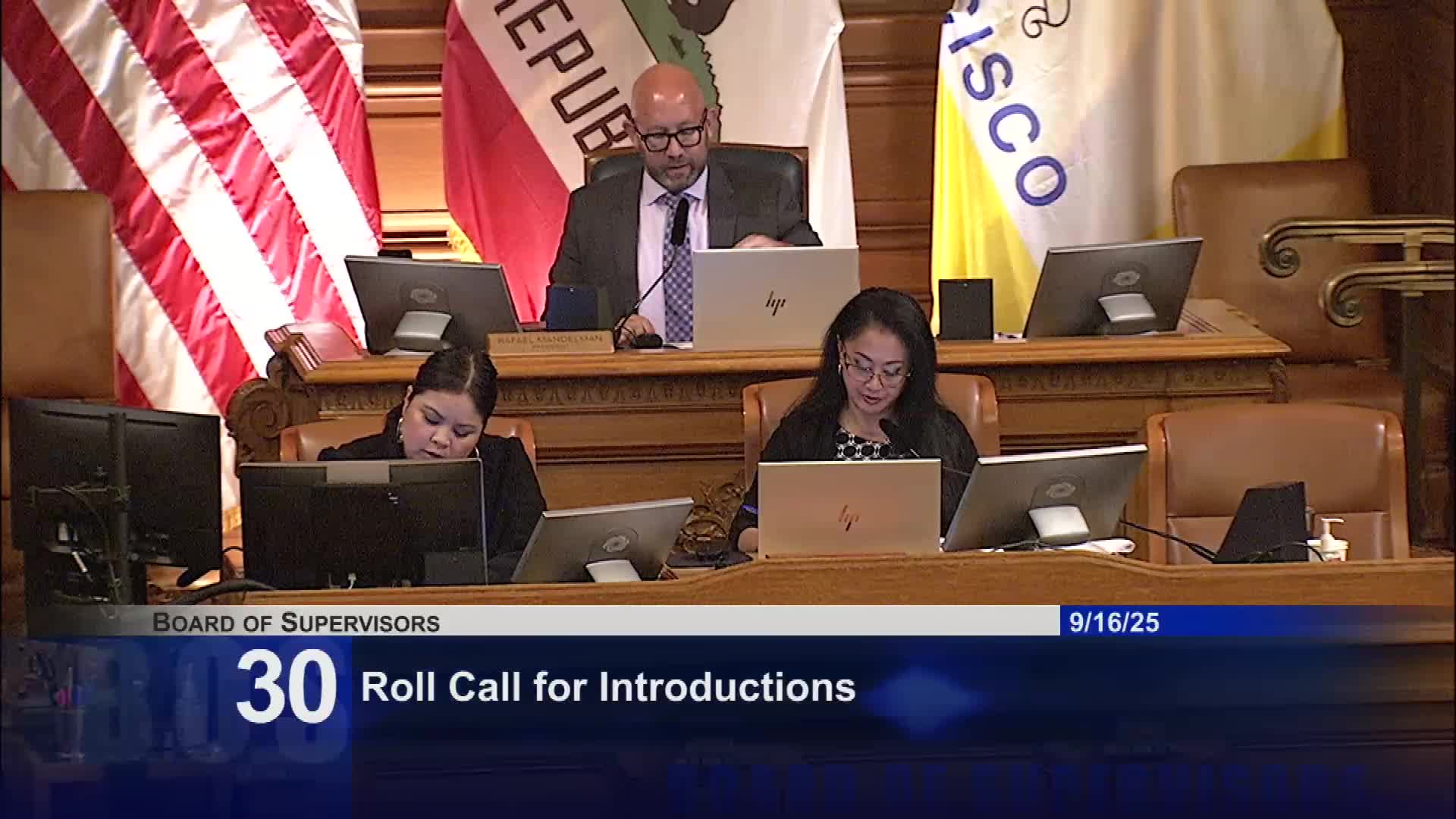
President Rafael Mandelmann announced Sept. 16 that the Board of Supervisors' Public Safety and Neighborhood Services Committee will hold a hearing on Sept. 25 to continue oversight of traffic enforcement in San Francisco.
Mandelmann summarized recent data: traffic citations for 2025 are up about 21% compared with 2024, following a 59% increase in 2024 over 2023. He said the city has begun to see measurable reductions in speeding where speed-safety cameras have been installed: 33 camera locations are in operation citywide, and Mandelmann cited results including a 15% decrease in speeding events at a camera on Market Street between Danvers and Douglas during its first two months. He said corridors with cameras have seen an average 30% reduction in speeding, with examples of a 63% decrease on Fulton over 13 weeks, 45% on Geneva over eight weeks, and 40% on Bayshore Boulevard over seven weeks.
Mandelmann also warned that the San Francisco Police Department’s traffic company remains understaffed and that enforcement remains below 2014 levels despite increases. He noted that state law currently restricts broader deployment of camera technology.
The hearing on Sept. 25 will continue dialogue with SFPD and SFMTA about enforcement, traffic-calming infrastructure, and how to reduce fatalities and severe injuries.