Get Full Government Meeting Transcripts, Videos, & Alerts Forever!
Get email alerts on the Stormwater Infrastructure topic
No spam. Unsubscribe anytime.
Council considers enforcement, maintenance options for Red Canyon Ranch detention basin after silt buildup
Summary
At a City Council conference Aug. 12, staff described silt accumulation and an altered outfall at the Red Canyon Ranch detention pond and presented legal and regulatory options — notice to the HOA/developer, injunctive relief under Title 11, and amending engineering design criteria to add enforcement penalties.
City officials told the Norman City Council on Aug. 12 that a detention basin in the Red Canyon Ranch development has substantial silt buildup and an altered outfall that together are reducing the basin’s capacity and could increase flooding risk for adjacent private properties.
City Attorney briefed councilors on the site and said the basin, located in Red Canyon Ranch Addition Section 2 near the intersection of Tecumseh Street and 12th Avenue Northeast, is private property owned by the Red Canyon Ranch Property Owners Association and not a public facility. Neighbors at 700 Riverview Drive and adjacent properties have raised concerns about capacity and potential overflow.
The attorney said the basin has accumulated about "75,000 cubic feet" of silt near the concrete outlet structure and that an opening cut into the concrete outfall — a V-shaped cut with a bar placed across it — allows water to discharge sooner than the structure was designed to do. "By doing it the way they did it, it's causing water to exceed probably what it was originally what the natural discharge rate would have been," the City Attorney said.
Staff discussed legal remedies and limits. Title 11 provisions were cited as a potential path that allows the municipality or an affected private party to seek injunctive relief to "restrain, correct, or abate any violation" of municipal ordinances or regulations; the city attorney referenced a provision read in the meeting that he identified as "title 11, at 47 1 0 7." Staff also reviewed the city's engineering design criteria (sections cited in the meeting included 5,001.3, 5,001.4 and a separate stormwater section 6,000) as potential bases to require maintenance or to pursue municipal enforcement.
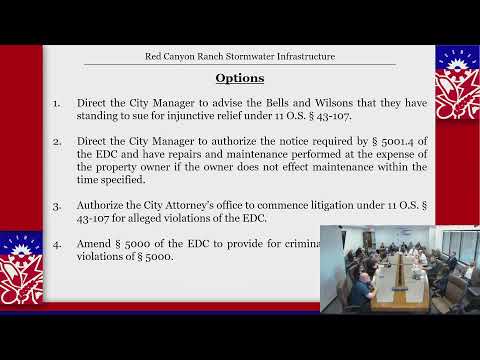
City staff said the main practical options are to: 1) notify the developer/HOA and require maintenance under existing code provisions that allow the city to perform necessary repairs at the property owner's expense after notice; 2) pursue injunctive relief or other district-court remedies under Title 11; or 3) amend the engineering design criteria so those drainage-structure rules carry the same enforcement penalties currently applied to stormwater violations in section 6,000, which could include municipal fines for ongoing noncompliance. Staff also flagged that collection of city-incurred maintenance costs could be legally complicated because the basin and the properties are private and because the developer may still control the HOA under the recorded covenants for decades, the attorney said.
Councilor Hoot and other council members pressed staff about whether similar problems exist in other newer developments and about proactive steps the city could require during platting and HOA formation. Staff and councilors discussed options to require maintenance schedules and clearer HOA responsibilities at the time of plat recording so future HOAs receive maintenance plans and contact information for contractors.
City Attorney recommended a two-step approach: first notify the developer/HOA and offer an opportunity to cure the defects and perform maintenance; then, if the owners fail to comply, consider litigation or exercising the city’s authority under the cited Title 11 provision. "I almost think you'd have to do 2 first," a council member said, referring to notice and opportunity to cure before pursuing enforcement tools.
No formal enforcement action or vote was taken at the meeting. Council members asked staff to draft notice language, return with options for code amendments that would add clearer enforcement tools for private drainage structures, and explore collection mechanisms should the city perform uncompleted maintenance at the owner’s expense.