Get Full Government Meeting Transcripts, Videos, & Alerts Forever!
Get email alerts on the Human Services topic
No spam. Unsubscribe anytime.
Pitkin County panel approves second-quarter human services spending; state changes expected to raise caseloads and local costs
Summary
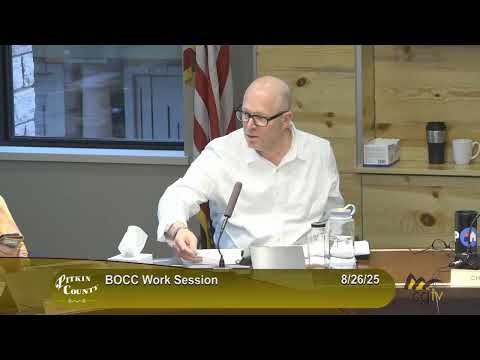
Pitkin County’s Board of Social Services approved second‑quarter expenditures and payroll at its Aug. 26 work session as staff reported continued overspends in some program areas, a $92,000 closeout withholding by the state and expected workload and cost increases from federal reconciliation changes affecting SNAP and Medicaid.
Pitkin County’s Board of Social Services on Aug. 26 approved the department’s second‑quarter expenditures and payroll and heard staff warn that recent state and federal changes will increase local workloads and risks to the county budget.
Lindsay Maysh, director of human services for Pitkin County, opened the update by saying, “We’re here for our second quarter board of social services report out.” The board then heard a program‑by‑program budget review from Stuart Fox, the county’s budget analyst assigned to human services.
The board voted by voice to approve the second‑quarter budget expenditures and later approved the department pay roster for the quarter. Both votes were approved by voice as recorded on the meeting transcript.
Fox told commissioners the department’s overall revenue and expenditures for the quarter largely tracked prior trends; some programs show improved predictability because of contracts with outside providers. But he also reported two program areas—adult protection services and CDHS administrative costs—were not fully covered in the state’s mitigation closeout and will leave Pitkin County with a combined $92,000 overage. “That overage will be held back from this upcoming fiscal year,” Fox said, describing how the state withholds future reimbursement until the shortfall is covered.
Program highlights and clarifications
- Child care assistance (CCAP): County staff attributed improved enrollment and higher expenditures to a policy change that raised the household eligibility threshold to 300 percent of the federal poverty level and to updated provider reimbursement rates. "All that hard work, we're seeing more people being eligible," Fox said.
- Child welfare: More predictable billing of outside counsel has helped stabilize that program’s expenditures, staff said.
- Child support and other contracted services: Some programs remain over budget on a percent basis but represent small dollar variances — for example, Fox said a program showing 108 percent of budget was roughly a $2,500 variance in actual dollars.
- SNAP and food assistance: Maysh noted that food security remains a county concern. As of the spring reporting in the meeting, staff said Pitkin County had roughly 222–227 active SNAP cases covering about 265–266 individuals (different slides referenced May vs. June counts). The department also reported meeting federal SNAP timeliness standards and receiving a state certificate for processing speed.
How state and federal changes may affect the county
Staff dedicated a large portion of the report to federal changes in the House reconciliation package (referred to in the meeting as "HR1" or the reconciliation bill) and related state planning. Maysh and Fox said the bill’s provisions could substantially increase county workload and expenses in SNAP and Medicaid administration:
- SNAP changes described by staff include expanded work requirements for able‑bodied adults without dependents, narrower waiver eligibility (only counties with unemployment above 10 percent), changes to eligibility for some immigrants, and a reduced federal administrative cost share that staff estimated could cost counties in the low‑hundreds of thousands of dollars annually. Maysh said the Colorado Human Services Directors Association rates several of these items as having a “substantial” local impact.
- Medicaid: Staff described a proposed new work or community engagement requirement for many expansion adults (80 hours per month) and an increase in redetermination frequency from annually to every six months for expansion adults starting Dec. 31, 2026. Both changes would increase county administrative workload and could require additional full‑time staff, Maysh said.
Staff emphasized these effects are primarily operational and related to new verification, tracking and redetermination tasks; they did not characterize proposed policy changes as final law but said the county is working with state associations and other mountain counties to plan for the operational impact.
What the board decided and next steps
- The board approved the department’s second‑quarter expenditures by voice vote and later approved the county payrolls for the quarter; both actions were recorded as passed by voice vote.
- Staff will continue to track state mitigation with CDHS and said the $92,000 withholding will reduce future reimbursements until the county has offset that overage.
- Staff said they are preparing a timeline and additional briefings on federal reconciliation changes and their projected local impacts, and will continue coordinating with neighboring counties and the Colorado Human Services Directors Association.
Why this matters
Pitkin County’s human services department administers economic assistance, child and adult protective services, veteran services, a senior center and the local Healthy Community Fund. Shifts in federal rules for SNAP and Medicaid and reductions in federal administrative cost share can increase county operating costs and staff workload even when the programs are primarily state‑ or federally funded. Commissioners asked staff for follow‑up estimates of caseload and potential staffing needs, and staff said they will bring more detailed timelines and cost scenarios to future meetings.
The board scheduled follow‑up briefings and will consider any formal budget adjustments when staff can provide more precise estimates and state guidance.