Get Full Government Meeting Transcripts, Videos, & Alerts Forever!
Get email alerts on the Zoning Text Amendments topic
No spam. Unsubscribe anytime.
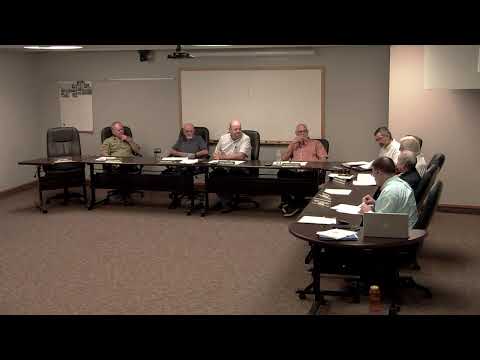
Planning commission backs broad zoning text amendments to standardize setbacks, lot rules and remove 7‑acre agricultural split cap
Summary
Reno County Planning Commission voted to recommend a package of text amendments that reduce many setback and minimum parcel dimensions, require continuous road frontage, eliminate minimum lot width/depth ratio, and remove the seven‑acre cap on agricultural lot splits; staff said there were no written or in‑person public comments.
Aug. 21 — The Reno County Planning Commission voted to recommend a package of text amendments to the county zoning and subdivision regulations intended to standardize building setbacks, simplify lot‑size rules, and remove a seven‑acre maximum for agricultural lot splits.
County planner Mark Vonachin summarized months of drafting and outreach, saying the amendments were posted to the county website and published as required; he reported no written public comments and no in‑person speakers at the hearing. "Most of those setback requirements will be reduced," Vonachin told the commission, adding the aim is uniform setbacks across zoning districts and clearer, consistent language tying zoning approvals to sanitation, public works and other permitting requirements.
Key proposed changes described by staff include: reducing many minimum building setbacks and several minimum lot frontage and depth requirements; requiring minimum road frontage to be continuous rather than aggregated from separate segments; removing the lot width‑to‑depth ratio restriction for newly created parcels; expressly tying zoning permits to approvals required by public works or sanitation (so a zoning permit would be invalid if required sanitation or entrance permits cannot be obtained); and removing the current rule that limited a single agricultural lot split to a maximum of seven acres in favor of more flexible split options.
Vonachin said the lot‑ratio removal and repeal of the seven‑acre maximum were among the principal policy changes prompting the text amendment effort. He noted that the regulations had inconsistent phrasing across residential districts about a height limit phrase "and or 2 and a half stories," and asked the commission to include the removal of that phrase across R1, R2, R3 and village districts so all residential districts would read consistently that structures shall not exceed 35 feet.
Commissioners asked procedural and clarifying questions about outreach and next steps; staff said notices were sent to townships and to municipalities within three miles of affected parcels and that the official newspaper posting and an online posting complied with statutory notice requirements. No members of the public provided testimony during the hearing.
A motion to recommend the text amendments (case no. 2025‑09), with the requested edits to the height language in articles 4‑1071, 5‑1071 and 6‑1071, passed by roll call. The minutes record the recorded votes as: Stan — yes; Schaefer — yes; Delta — yes; Macklin — yes; Martin — yes; Curtis — yes. The package will be forwarded to the Reno County Commission for consideration and possible adoption.