Get Full Government Meeting Transcripts, Videos, & Alerts Forever!
Get email alerts on the Downtown Planning topic
No spam. Unsubscribe anytime.
Planning commission briefed on downtown master plan update, public engagement plans
Summary
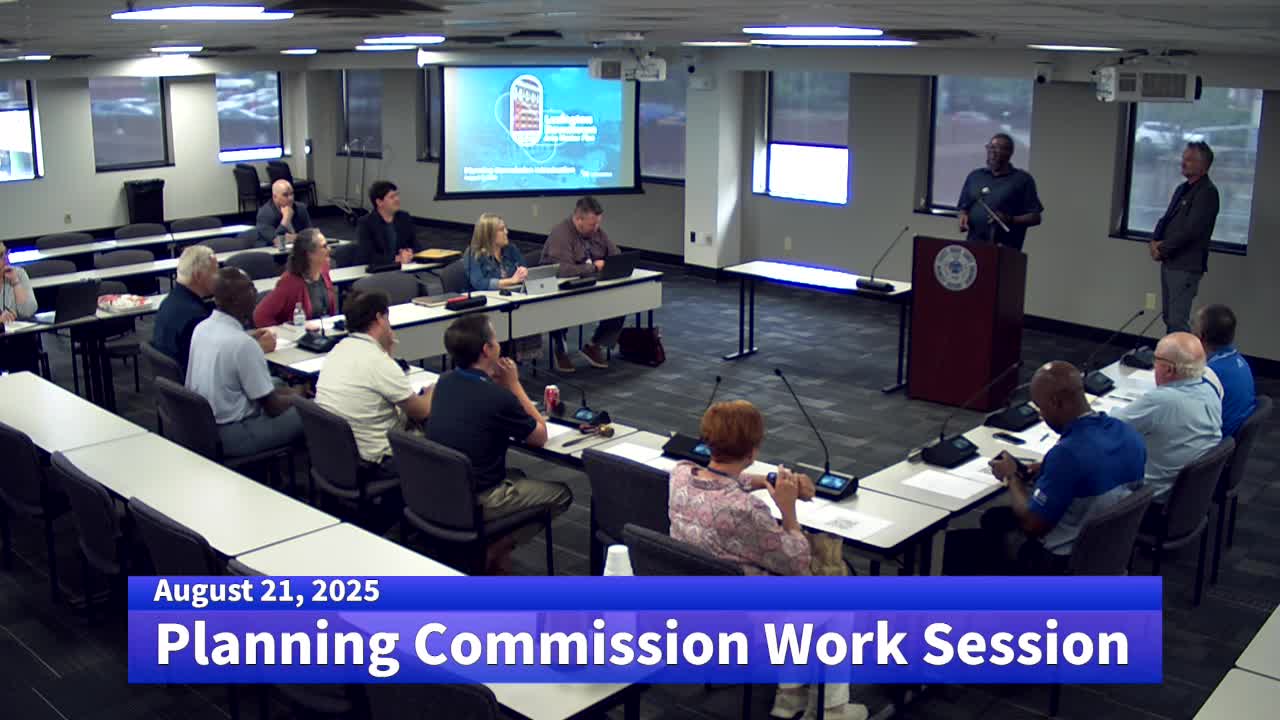
The Lexington-Fayette Urban County Government Planning Commission on Aug. 21 heard an introduction to a one‑year update of the downtown master plan and the consultant’s early public‑engagement results.
The Lexington-Fayette Urban County Government Planning Commission on Aug. 21 heard an introduction to a one‑year update of the downtown master plan and an overview of early public engagement from consultant MKSK.
MKSK principal Andy Knight told the commission the firm began work under a May 16 contract and has been conducting stakeholder interviews, market and housing analysis, and a tree canopy inventory. Knight said MKSK will lead three rounds of public engagement — a listening session, an ideas‑testing workshop and a final public celebration — and is planning its first full public workshop for early October at the Lyric Theater.
Why it matters: The update is intended to be both community driven and data driven and to produce implementable actions, zoning recommendations and funding options that staff and decision‑makers can use when considering downtown land‑use changes.
Knight described the project team and coordination: MKSK is the prime firm supported by Development Strategies (market/development analysis), WSP (transportation/mobility), EHI (neighborhood engagement), CivicLex (digital/creative engagement) and Urban Canopy (urban forestry inventory). He said the project team has already held multiple advisory‑group and stakeholder sessions and ran a July 4 pop‑up at the Fifth Third Pavilion that yielded “about 500 responses” to an on‑site QR survey and roughly “350 people participate” at the booth; another participation figure of 315 was shown on a project slide summarizing bead‑based exercises on priorities.
Scope and schedule: Knight said the plan will include a housing market and conditions analysis, recommendations for zoning text (the plan will recommend language rather than draft final code), mobility and connectivity recommendations, a tree canopy inventory, and an implementation‑oriented financial strategy. Knight said the housing/market analysis is underway and several stakeholder roundtables have been completed. The team will release more analysis and engagement materials on a project website and interactive online tools.
Boundary and zoning questions: Commissioners pressed MKSK and staff on the plan’s downtown boundary. Planning staff explained that a clear, community‑adopted downtown boundary is intended to help guide future zoning decisions and zone‑change recommendations, and that adopting the plan as an element of the comprehensive plan would give those recommendations a policy foundation. Commissioners and some residents urged a boundary approach that distinguishes the Central Business District from adjacent historic, residential neighborhoods and preserves greenery and urban canopy in those surrounding areas. One commissioner noted past downtown zoning flexibility (for example zero‑lot‑line development) can reduce tree canopy and open‑space expectations in adjacent neighborhoods.
Public comment and concerns: Resident Amy Clark (628 Castle Road) thanked the commission and urged clearer online information. Clark said the project website (downtownlexplan.com) lacked specific dates for tasks and did not list advisory committee membership. She asked to be invited to neighborhood meetings and urged the plan to “conserve affordable housing and homeownership” and to consider the effect of University of Kentucky student housing on downtown rental rates. Trish Smith of the Belcourt neighborhood said she supported the commission engagement on distinguishing the Central Business District from historic neighborhoods. Robin Mickler and another planning commissioner confirmed that two planning‑commission members served on the advisory committee and that the overall advisory body included roughly 20 people, including UK representatives.
Next steps: MKSK and staff said they will continue stakeholder interviews, post analysis to the project website, and run the October public meeting (team indicated Oct. 8 at the Lyric Theater during the presentation). The team emphasized the plan will aim to be actionable, with funding and implementation pathways to follow as recommendations crystallize.
Ending: The commission offered early suggestions and asked staff and MKSK to return with additional materials; no formal actions or votes were taken on the plan at the work session.