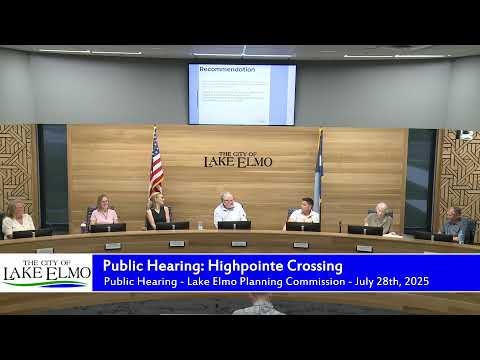
Lake Elmo planning commission recommends denial of High Point Crossing land‑use amendment after septic tests fail
Loading...
Summary
The Lake Elmo Planning Commission on July 28 recommended that the City Council deny a developer’s request to amend the city’s comprehensive plan and expand the MUSA to serve the 78‑acre High Point Crossing site in the Inwood area.
The Lake Elmo Planning Commission on July 28 recommended that the City Council deny a developer’s request to amend the city’s comprehensive plan and expand the Metropolitan Urban Service Area (MUSA) to serve the 78‑acre High Point Crossing site in the Inwood area.
The developer sought a new future‑land‑use category described by city staff as “open space low density residential” (OPLDR) and a limited MUSA extension so the project could connect to public sewer. After discussion and public comment, the commission voted to recommend denial; the item will go to the City Council for a final decision.
The recommendation follows the developer’s disclosure that a proposed community septic (shared) system for the previously approved open‑space planned unit development would not meet revised state review standards. Nathan (city planning staff) told the commission the developer completed additional soil testing and a mounting (hydraulic connectivity) study, and the results indicated the community system would not be reliable for the site. The developer explained that, because of that testing, their team explored alternatives including individual on‑lot septic systems, redesigns with fewer lots, and a public‑sewer option.
High Point Crossing was approved as a preliminary plat in September 2024 with 65 residential lots, more than 50% of the property proposed as preserved open space, six wetlands and one existing homestead on roughly 78 acres. The developer told the commission the previous preliminary plat included a community septic system and that later, more detailed hydraulic connectivity testing (including work by Saint Anthony Falls Laboratory and an independent firm, Braun) showed that the shared system would likely fail within a few years even if enlarged.
Staff proposed the OPLDR category as a tool to allow developments that preserve at least half of a parcel as publicly accessible open space while allowing a lower net density than existing low‑density categories. Under the proposal, OPLDR would be allowed only inside the MUSA and would carry a density range of about 2–3 units per acre; staff emphasized that densities inside the city’s sewered areas must average at least 3 units per acre under current Metropolitan Council guidance and that the next planning cycle will push toward a 3.5 units‑per‑acre citywide goal.
The developer said developers had evaluated alternatives. One option would be to reduce the project scale and rely on individual septic systems; the developer and a septic consultant identified about 22–23 locations on the property that passed simpler percolation tests and could support individual septic systems. The developer also presented alternatives that would shrink lot sizes or add attached “twin homes” to meet the proposed OPLDR density; staff said the twin‑home option was not supported under the draft OPLDR standards.
Public comment opposed the amendment. An emailed comment from Anne Buchek argued the applicant should have checked published soils maps before pursuing development and called the proposed amendment “spot zoning.” Rosemary Armstrong, a resident who spoke at the hearing, urged commissioners to preserve the area’s rural character and to avoid extending sewer infrastructure north from the existing MUSA boundary just for one development.
Commissioners and staff questioned the broader implications of creating a new land‑use category before the city’s Imagine 2050 comprehensive planning process. Commissioners raised concerns about setting a precedent for MUSA “islands,” sewer capacity, who would pay to oversize sewer mains if needed, and whether the city should approve a new district for a single parcel rather than consider it in a citywide plan update. Nathan noted the city has a 120‑day review deadline for complete applications (the record shows that deadline was October 25, 2025), which limits how long staff can defer action.
Formal action: a motion to recommend denial of the comprehensive plan amendment and MUSA adjustment (the developer listed as Rachel Development) passed on a planning‑commission vote; the commission’s recommendation goes to the City Council. Staff noted that if the council were to approve the amendments, Metropolitan Council review would follow and the developer would return with revised zoning and a revised preliminary plat showing a sewered alternative.
Next steps: the Planning Commission’s recommendation is advisory; the City Council will decide whether to approve, deny or modify the proposed comprehensive plan amendment and any MUSA boundary change. If the council approves, the Metropolitan Council reviews comprehensive‑plan amendments for conformity with regional policies before final adoption.
Meeting context: the item generated extended staff and developer presentations, multiple commissioner questions, one written public comment and one in‑person public speaker; commissioners repeatedly asked for a clearer demonstration of alternatives that preserve the area’s character if sewer is not available.