Get Full Government Meeting Transcripts, Videos, & Alerts Forever!
Get email alerts on the Wailea 670 Amendments topic
No spam. Unsubscribe anytime.
Residents, labor groups and experts clash over Wailea 670 amendments as council hears public testimony
Summary
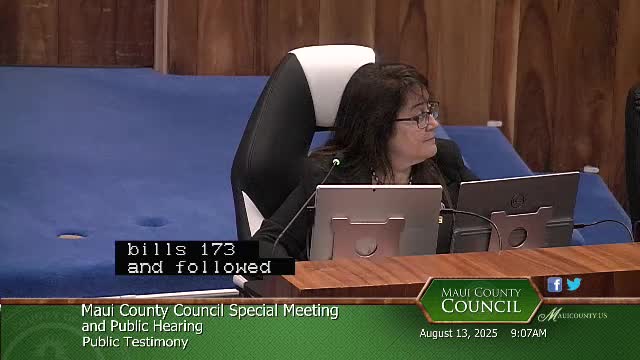
Dozens of residents, labor representatives, conservation experts and county public‑safety officials urged the Maui County Council on Aug. 13 to either preserve or restore conditions tied to the long‑running Wailea 670 (Honua'ula) development as public testimony opened on Bills 171 and 172.
Dozens of residents, labor representatives, conservation experts and county public‑safety officials urged the Maui County Council on Aug. 13 to either preserve or restore conditions tied to the long‑running Wailea 670 (Honua'ula) development as public testimony opened on Bills 171 and 172.
Chief Greg Okamoto, testifying for the police department, said the county supports the bills and described a plan to “share that facility” with fire and ocean‑safety units in the project area. “This is chief Greg Okamoto testifying on behalf of the police department on, Bill 171 and 172. The police department, we're in support of this, Weather 6 70 project,” he said.
Why it matters: The proposed ordinance changes before the council would alter conditions approved with earlier phases of the project, including where affordable housing would be built and when certain infrastructure improvements must be completed. Testimony at the hearing focused on three recurring concerns: whether the developer should be allowed to reduce the number of in‑district affordable units, whether occupancy can begin before widening of Pi'ilani Highway and whether the project’s water and conservation commitments remain enforceable.
What speakers said and pressed the council to do
- Affordable housing: Multiple speakers urged the council to keep or restore an on‑site requirement for 450 affordable units. “At the very minimum, 4 50 affordable units should be the requirement of what's built,” Jordan Hocker said. Several community groups and intervenors argued the project originally promised 700 units and that successive reductions risked breaking prior commitments.
- Roads and evacuation safety: Testimony repeatedly raised evacuation and traffic risks on Pi'ilani Highway and South Kihei Road, amplified by recent tsunami and storm events. Keala Kopowiki Santos said a recent tsunami warning produced “a complete deadlock” in South Maui and that adding thousands of residents without additional evacuation capacity “could have been devastating.” Attorney Ryan Hurley told the council that permitting occupancy before the highway expansion “gives the developer and the county a feel‑good photo opportunity while placing the lives of our most vulnerable community members at risk.”
- Water and drought: Several residents and speakers noted prolonged drought conditions and county water restrictions in South Maui as a reason to hesitate before allowing additional development. “We don't have enough water,” Nancy told the council; she said local water board meetings and ongoing restrictions showed supply was constrained.
- Conservation and cultural resources: Scientists and cultural representatives urged the council to hold the developer to previously described conservation and endowment commitments. Dr. Lee Altenberg said an approximately $2.9‑$3.0 million endowment for management of a native dry‑forest preserve “was deleted from the July 2022 Honua'ula Natural Resources Preservation Plan” and asked the council to seek documentation. Royal patent descendants and cultural advocates also testified that burials, sacred sites and historic properties in the project area require added review under HRS Chapter 6E.
- Labor and jobs: Labor union representatives testified in support of the amendments, saying the project would deliver construction jobs and workforce housing sooner. Pani Miatoga of Operating Engineers Local 3 said the changes “will allow the developer to build more affordable housing sooner.” Representatives of the Hawaii Regional Council of Carpenters also urged support.
Procedural, financial and transparency issues
Speakers and intervenors criticized the process that led to the proposed changes. Albert Perez of Maui Tomorrow said planning staff had allowed the developer’s consultants to draft material and that the county should require the developer to open its financials if it claims the originally promised affordable units will not “pencil out.” Perez estimated the developer stood to gain “additional profit” if in‑district requirements were weakened and urged the council to preserve the conditions set by the earlier approvals.
Developer representation and background testimony
Public speakers repeatedly referenced the developer’s attorney, Cal “Chip” Chase, and Honua'ula Partners (also referenced in testimony as HP HoldCo LLC). Charlotte McLaughlin and others identified financial backers and raised questions about whether overseas financing would treat community obligations as negotiable. McLaughlin pointed to an overseas bank, saying the firm “wants the state to pay for the widening of the Pi'ilani. That's us, that's our taxes.”
No formal council actions recorded during testimony
The Aug. 13 session recorded public testimony and procedural discussion; the transcript does not capture any final council votes on Bills 171 or 172. Several testifiers asked the council to delay final action, request additional documentation (for example, the status of the $3 million endowment referenced in preservation plans) or require enforceable deed restrictions that keep units affordable in perpetuity.
Ending: next steps and what the council heard
The council closed public testimony after a long hearing that included scores of speakers on both sides of the amendments. Speakers asked the council to require independent hydrology studies, retain in‑district affordable‑housing requirements, keep developer‑funded road improvements tied to occupancy and preserve conservation funding. Council members indicated they would request resource staff and potentially bring county administration officials online when deliberations begin, but no final decision was recorded in the hearing transcript.
Selected direct quotes from the hearing
"Over 90% of the testimony was against these amendments," said Michael Hill, a long‑time Maui resident.
"The $2,914,484 endowment was described in the April 2018 draft preservation mitigation plan," said Dr. Lee Altenberg, who asked the council to verify whether an endowment commitment remained in effect.
"Greed and profits," attorney Ryan Hurley summarized when describing why he opposed the reductions to in‑district affordable housing.
(Reporting note: quotes are taken verbatim from speakers' oral testimony during the Aug. 13 public hearing and are attributed to speakers who appeared in the hearing transcript.)