Get Full Government Meeting Transcripts, Videos, & Alerts Forever!
Get email alerts on the Student Progression topic
No spam. Unsubscribe anytime.
Bay District Schools unveils new student progression plan and publishes consolidated student code of conduct
Summary
District staff presented a new student progression plan required by state law and a consolidated 76-page student code of conduct published as a live document on the Bay District Schools website; board members asked questions about third-grade retention, remediation, and parent access to the new materials.
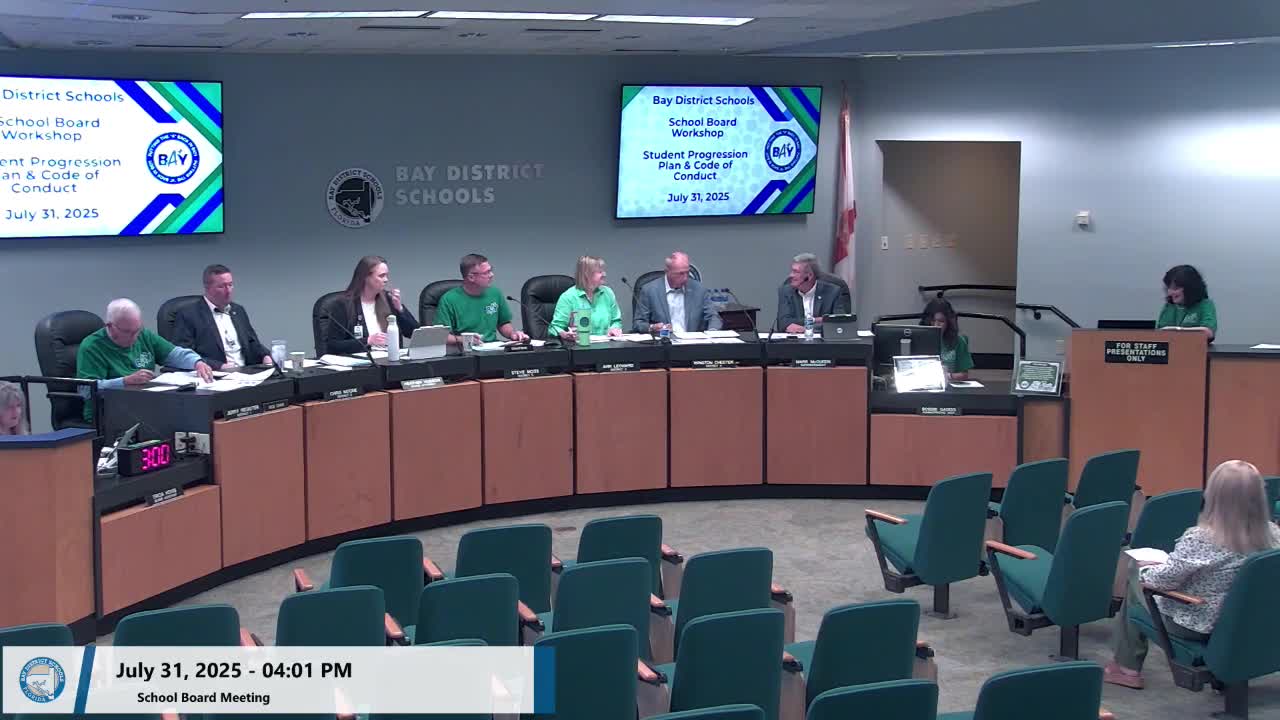
Bay District Schools staff on July 31 presented a new student progression plan required by state law and a consolidated student code of conduct that the district posted as a live, bookmarked document on its website.
The student progression plan, presented by Elena Simmons, the district’s director of secondary instruction, outlines the procedures the district will use to determine whether students move from one grade to the next and describes remediation and progress-monitoring steps for students who need additional support. “This is to really be transparent with our families,” Simmons said, describing the plan’s purpose and layout.
The plan summarizes state-required reporting obligations, including annual reporting on retention by grade for kindergarten through 10th grade and the third-grade English language arts proficiency metrics tied to mandatory retention rules. Simmons said the district had 128 third-graders retained this year and 224 students promoted through “good cause” exemptions; she said 24 students achieved Level 2 on a July FAST retest and were promoted without needing a good-cause exemption. Simmons said the district places students who are retained or promoted through good cause into a Tier 3 progress-monitoring plan.
Dawn Cates, the director of student wellness, summarized the code of conduct, which the district combined with the discipline matrix and other related board policies into a single 76-page live document so families can navigate quickly. “It was important to give the parents an overview, a one-pager,” Cates said, explaining the document’s title page, the parent letter, and the bookmarked table of contents. District staff said the published page links to board policies and that a Spanish version will be available soon.
The consolidated code includes the district’s discipline matrix, full language on anti-harassment and bullying policies, expectations and consequences for threatening behavior toward staff, investigation procedures, and sections describing supports available to students alongside disciplinary actions. Cates said the student code of conduct brings together the policies the board previously approved and packages them in a parent-facing format that will also be accessible through the district’s parent portal (FOCUS).
Board members asked detailed questions about third-grade retention, the criteria for good-cause exemptions, and how the district monitors students who have multiple retentions. Simmons explained the state’s good-cause categories (limited English proficiency, students with disabilities on alternate assessments, portfolio demonstration, intensive intervention, prior retentions, and others) and noted that portfolio promotion is uncommon because it requires students to meet a high percentage of benchmarks across the year. Simmons and Cates emphasized that retention is not treated as a first-line strategy; principals must participate in retention decisions and the district focuses on early intervention in kindergarten through second grade to prevent future retention.
District staff said they will publish the student progression plan as a live Google Doc with bookmarks by elementary, middle and high school sections and that the one-page parent letter will be attached to the online materials and pushed through FOCUS and principal communications. Simmons also said the board will receive summer-reading recovery and credit-recovery results at the next board meeting.
Board members and staff acknowledged a common public perception that students are “socially promoted” by age; Simmons responded that “there’s no such thing as social promotions” in the district and described the district’s guardrails for reassessments and retakes, including requirements that students complete formative work before being allowed to retake an assessment and a minimum recorded score floor (50) for retaken summatives.
The materials shown to the board are now posted on the Bay District Schools policies page and the district said both the full document and a Spanish translation will be available for parents. Staff asked principals and school administrators to distribute the parent-facing one-pager and to include links in school handbooks and orientation materials.
The presentation concluded with board members commending the accessibility features of the new document and staff saying they will continue to provide data updates and program outcomes to the board.